Prep is Play and Play is Prep

A man wanders through a liminal space with dice and dominos.

Category: Campaign Design

The Bleak + The Pearl, Intermission #6 – New Icons, Learning Rolls, and Meet the Lighthouse 6

Trying Out a New Token Paradigm

In previous The Bleak + The Pearl Intermission (#5) I talked about taking the main storyline and putting it on a semi-hiatus as a way to focus on some new characters, get back to a purer dungeon delving experience, and just slightly rest up from what had been a kind of intense story building learning experience. This week’s post will combine some of the progress on that as I plan to (next week) launch into the first of these new delves.

A slightly minor aspect to this hiatus and soft- | hard- relaunch is that I wanted to go back to the days where I was using a homebrew virtual table top setup to explore the dungeon mixed with hand-rolled dice and both virtual and handwritten notes. While looking over my assets for this, I found a stack of tokens I had made using John Kapsalis art originally designed for or around Advanced Fighting Fantasy and while I love JK’s art and look forward to using it again in any AFF endeavors into which I might dive, I also wanted to give a good strong think about the aesthetics of this new era.

To remind you, this is what my original set up looked like.

Four heroes on a fantasy map face off versus 3 zombies and a berserk cultist.
The Blue Delve Boys face off against a berserker cultist and three zombies.
(Art by John Kapsalis, Dyson Logos, and Crypto Cartographer – arranged by Doug Bolden – used here for personal use but all rights are reserved by original creators).

Dyson Logos (or other) map, JK art, a GIMP template using some token borders I found (after digging through my files, I am 98% sure I was using “Character Token Portrait Frames for VTT” by Crypto Cartographer at least as base), and then a few other pieces here or there. Monsters were freqently “close enough” selections. Characters were “close enough” with some matching more than others. I would use text boxes to mark changes on the map and would often use a fog layer to update the map as I went to show explored areas and such. Over time, it made a nice digital artifact. You can see an example at the top of my recap for the “The Lost Citadel of the Scarlet Minotaur” dungeon.

There are a couple of problems with the set-up that are not quite actual problem. The two biggest (outside of a potential rights thing and tracking down credits for multiple sources every screenshot I might share) are that the characters/monsters never quite fit my mental vision and each token tended to involve a multistep process. I had to dig through my dozens of JK token packs, find the one I wanted. Snip it out from the whole. Import it into GIMP. Possibly trim or mask out portions of it to make it pop out better. Pick a frame fitting whatever mood or need I felt worked best. Export that out into a PNG. Upload that into my VTT. Then, when another encounter would show up, either reuse a “close enough” token or start back over.

As I have explored more and more with tools and aids that I like, one thing I have come to use a lot for some of my element is the CC-BY 3.0 tokens/icons at games-icons.net. It takes a little bit of practice to get used to what tokens are or are not there. As you get used to their selection, though, you start to get generate some ideas about how you could creatively add them in. At least I do.

This lead me to a new sort of idea. Find some broad “iconic representations” of the characters—Grusk can be represented by his axe, Bloodlust, while Tom might be lockpicks—and then use the icon customize option to add in a few colors, cut a few pieces out, and generally make icons not really meant to be precise tokens to the characters but stand-in elements that allow me to keep up my own mental map of the characters while also being clear enough that I am not confused about who is who. For monsters, a few basic icons can do heavy lifting: basic corporeal undead types, insect types, cultist types, spirit types, demon types, etc. Then when I come across a gnoll I do not have to find a gnoll token that is roughly the right shape and equipment but instead I use the mid-level humanoid beastman generic token. Save the tokens in such a way that I keep the symbol name, the artist, and the rough representation in the file type.

Here is what the above scene would look like using these more generic tokens. I’ll add in a “web spell” effect and a few more enemies to demonstrate.
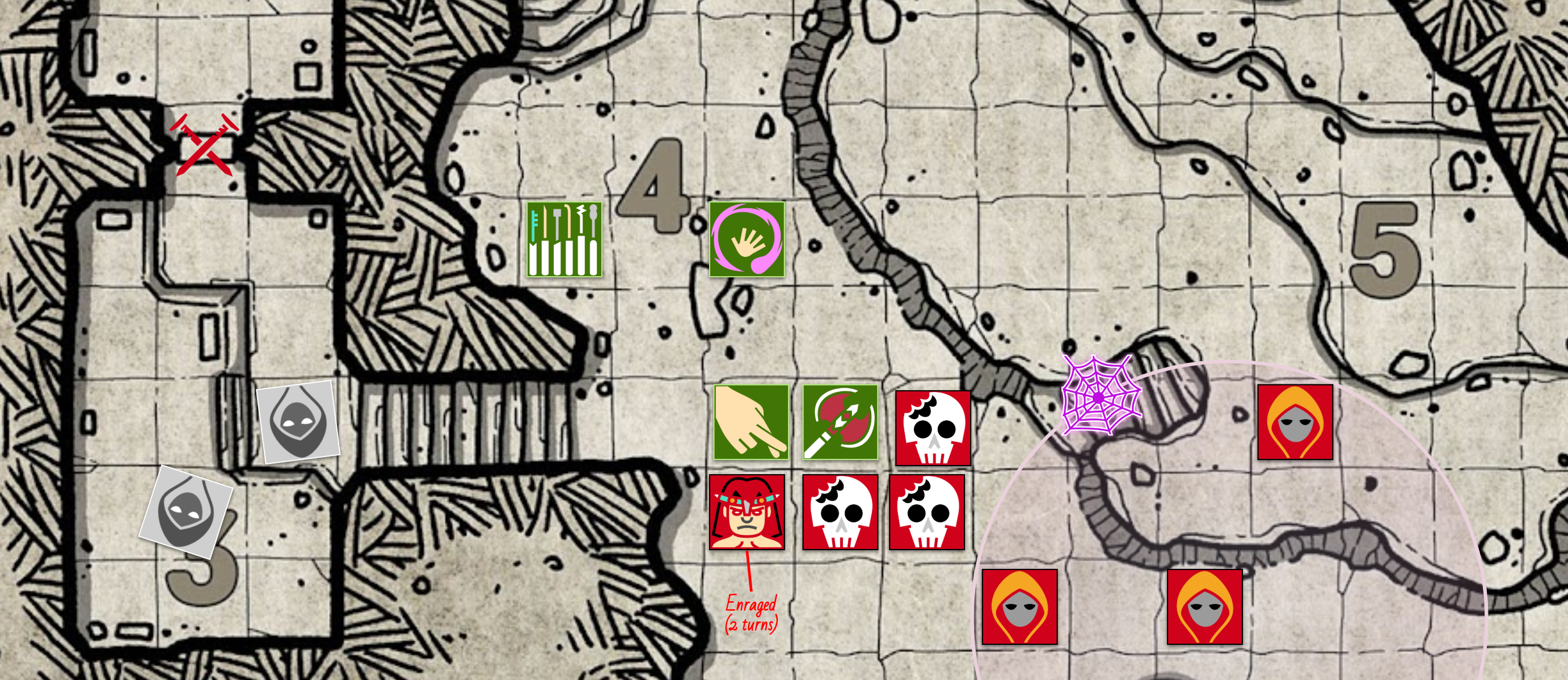
Tokens on a fantasy map. Undead icons are attacking axe icons while some more like cultists are pushing up from the south.
Three zombies attack Grusk while an enraged berserker cultist attacks Inar. Three other cultists are being trapped in Rance’s Web spell. Two dead cultists are in the previous room.
(Map by Dyson Logos. Icons by Delapouite, Lorc, and GamerAce135 from games-icon.net [CC-BY 3.0])

While the old art definitely had its charm, I really like the “board-game aesthetic” of the new art. I also like how it frees me from trying to describe a scene with my token choices and instead gives me more freedom to represent a scene and encourages a bit of creativity with colors and themes. I also like adding the spell effects and such to better track the status of things, backed up by some text.

Re-Introducing the Blue Delve Boys and Learning Rolls

In that light, here are the Blue Delve Boys and their current tokens. These might change over time depending on factors but for now, here’s what they look like.

An axe with blood red blade, a hand with fingers crossed, a set of lockpicks, and a hand casting a spell.

As I was making up icons and working on the “Lighthouse 8” (see below) I came across a line in the Kelsey-made Bard write-up: “Add 1d6 to your learning rolls.” I realized I did not know what that meant. I found out that I had been missing a whole mechanic that is exactly the sort of reason why I like to play Shadowdark. As I said in a recent post, Shadowdark tends to allow characters to have more fiction than other OSR and OSR-adjacent games. “Learning” is precisely what I am talking about. While the Carousing rules got a fair amount of discussion during the build up to SD‘s release, I found that I had overlooked it’s first cousin. Instead, you can have your character attempt to learn a new skill or general knowledge during downtime instead. It is described as such on Page 91: “Learning enables you to do new actions or gives you advantage on certain checks.” You work out what you want to learn and can learn with the GM, then start out making a INT DC18 check. The next time you try to learn it, you reduce that by one step—i.e., DC15, DC12, DC9, etc—until you learn it or give up trying.

Over the course of these months of adventure, there have been a fair amount of downtimes. If I was playing a more traditional campaign, maybe four-ish. With the more story-heavy style campaign, maybe eight-ish. I will cut that into the middle and say six downtimes for six months of playing. Maybe high, maybe low. I don’t know. It’s complicated.

There were two carousing checks. This leaves four attempts to learn.

Grusk and Tom are going to want to learn Bleak navigation for sure. Then, if they pass that, then Grusk would want to learn more about delving while Tom would learn hunting. Inar will first try for first aid. After that, he will try for sneaking around. It is not really allowed for him to learn the full thief ability kit but since halflings have a natural sneak and he is prone to trying to stay a bit back to help once people get injured, I figure this is kind of a extending of what he can already do [and I have never really used his halfing invisibility properly except maybe once]. Finally, Rance will definitely start out learning the Ancient language. After that, he will work on improving his “monster lore” abilities since he seems to have that inherent based on how I play. Finally, he will being working on learning how to operate and repair automatons based on Jonias’s notes.

Let’s see how this goes…

Making the Rolls and the Outcomes

Grusk, learning Bleak Survival (at -1 to INT): 7 vs DC18, 6 vs DC15, 13 vs DC12. Grusk (on the third attempt) gets Bleak Survival and advantages to rolls related to navigating and surviving the Bleak, including a broad sense of what level of Bleak they at.

Grusk, learning “Delving” (at -1 to INT): 9 vs DC18. Not yet, but he will continue.

Tom, learning Bleak Survival (at -2 to INT): 13 vs DC18, 3 vs DC 15, 3 vs DC 12, 10 vs DC9. Tom (on fourth attempt) gets Bleak Survival with the same as Grusk. No time to learn Hunting just yet, but that’ll be next.

Inar, learning First Aid (at +1 to INT): 19 vs DC18. He gets it on first attempt. He will get ADV to first aid rolls while trying to stabilize others. I’ll also say this can be used to generally do things like identify wounds, give a rough prognosis, identify poisons/diseases he might have some experience with. Generally the kind of stuff that might be helpful in a non-magical, non-specialized way.

Inar, learning Sneaking (at +1 to INT): 13 vs DC18, 9 vs DC15, 11 vs DC12. Next time he will be against DC9.

Rance, learning Ancient Language (at +3 to INT): 15 vs DC18. 20(!) vs DC15. Rance not only learns Ancient on his second attempt but we’ll say he is good at it and gets ADV to reading Ancient Text.

Rance, improving Monster Lore (at +3 to INT): 14 vs DC18. 19 vs DC15. His final learning attempt nets him ADV to identifying monsters and will allow him to make deductions about Bleak altered creatures. He will next turn to using his Ancient Language skills to translating Jonias’s notes about the automatons.

Background for the Lighthouse 6

Behind the scenes, I created the initial four heroes while learning Shadowdark and only spent a somewhat short while making them. I gave them only a thin backstory—they were in The Pearl, they were orphans raised at a monastery (which got the name “The Blue Delve” from somewhere, probably some random table), and one of them had nightmarish dreams of something going on in the Bleak—that picked up elements like a snowball rolling downhill. They quickly became the reason for the campaign and so had developed a kind of necessary plot armor. If one of them died, it would sort of be weird to continue the campaign as it was going. Part of the reason for the reset is to build up some other characters, personalities, explore some extended materials, and effectively remove the plot armor a bit. Things can get more tense as it goes.

In terms of The Bleak + The Pearl’s world: 300-years ago, Jonias Grunkheart enlisted the lords and ladies of the four other Grunce leading families to enact an incomplete version of a great plan. This is the Lighthouse, a rebuilt Ancient technology that takes the energy of The Bleak and uses it against itself to push it back (while generating both visible light and also The Light, the neutral energy power source of all Ancient technology).

The Grunkhearts provided the technology and planning. The Mariuses provided materials and wealth from their shipping. The Bittermolds provided magical assistance and expertise on darker truths. The Harcurams provided legal and administrative support. The Mistameres provided physical strength to build the Lighthouse and protection for the workers constructing it.

After the Lighthouse was completed, and the Monolith carved underneath (more a monolith symbolically, implying all the people of Barthus were one), the families continued to rule Grunce (the Grunkheart family estate, semantically decayed from “The Grunkhearts’ Land”). Other people from all over Grunce filled the city to the brim and other great houses from other cities were not content to be left out. Various power struggles occurred while the Lighthouse went from being well known technology to something increasingly forgotten, a background artifact shining light into the distance. The Grunkhearts remain with some power but other families have virtually pushed them out. Cal Grunkheart, nephew to the current ruler of the House, has taken on the goal of fixing and expanding the Lighthouse. The Mariuses have done marginally better but have given up their seafaring ways, focusing entirely on money trading. The Mistameres lost their family land and combined as a family with the Harcurams for form House Mysturam. And the strange, weird Bittermold House retreated into the Bleak and have largely vanished besides various small manors and estates all laying claim to the name.

[Doug’s Note: Mistamere is a reference to the Frank Mentzer created dungeon found in the red box Basic Dungeons & Dragons because running that adventure was the first time I ever played a tabletop RPG and I thought it might be fun to convert to Shadowdark. The name remains Mentzer’s though this family is quite different. Bittermold as a family name is a reference to Cursed Scroll #1 and was created by Kelsey Dionne. Unlike Mistamere which is 99% an original creation with a naming-shout-out, the Bittermolds are more directly influenced by their source and will soon show up when that module is run.]

Meet the Lighthouse 6

As our heroes have been risking it all to support Cal Grunkheart and the Lighthouse Keepers, Cal has come up with the plan of tasking his cousin Gryffin Grunkheart (possible future Lord Grunkheart) with gathering up members of each of the other five families to begin reclaiming Grunce and protecting the future of Barthus. Possibly even pushing The Bleak back and retaking the land.

A lighthouse, a lyre, and a dragon skull in gold and blue.

The leader of the Lighthouse 6 is Gryffin Grunkheart, the middle son of Lady Moreena Grunkheart (and technically third in line of succession, including his mother). His family protests him entering The Bleak since this precludes him from fathering heirs but he considers Cal to be the true Grunkheart lineage. Served for time as a minor captain of the city guard before aggreeing to help the Blue Delve Boys to deliver an anti-magic cloak to The Pearl. Here he met Boris Loo and decided to dedicate his life to adventure. He is a Human Ranger. His shares the Grunkheart symbol of a Lighthouse as his personal crest with Cal. He is a loyal leader and often will risk his own safety to protect his crew.

[Doug’s Note: Rangers were developed by Kelsey Dionne and released along with the Bard as a special supplement. Speaking of…]

Louis Harcuram is one of the few “true Harcurams” left. His branch of the family is much poorer and he was raised a fisherman before taking up performing and traveling as a minstrel. In the Sofron Desert, he met Ronick Mistamere and enjoyed the irony of partnering with a Mistamere due to the long family association. When he and Ronick received the call to join with Gryffin, they both took the chance and headed to Grunce. He is a Human Bard and his symbol is a lyre.

Ronick Mistamere is a Dragonborn Pit Fighter. Not all Mistameres agreed with the plan to merge and settle down running warehouses and stores. Those went west into the desert where they took any chance they could to reclaim the militant might of the Mistameres of old. Ronick’s branch combined themselves with desert dragons and attempted to lay claim to the desert. Beaten, they instead settled for being mercenaries and pit fighters. Ronick’s great strength and fearsome appearance (with bronze and lapis lazuli scales) earned him a fierce reputation, which was enhanced by Louis acting as hype man. The two are great friends and both look forward to working with Gryffin. His symbol is the skull of one of his desert dragon kin.

[Doug’s Note: “Dragonborn ancestry” in this case is derived from Unatural Selection with breath (and electricity immunity) from the desert dragon as given in Shadowdark, itself. Pit Fighters are from Cursed Scrolls #2.]

A crossbow, a deer head with multi-color antlers, and a velociraptor head crossed with a ninja turtle.

Dhelia “Del” Marius is the maybe-mad descendent of infamous Mad Del Marius. While the Marius family has officially given up the family tradition of sailing the high seas, this new Del has reclaimed it in style. Sort of. She mostly just swept up a lot of other, better, sailors’ vomit and trash. Once the chance came to prove herself, she requested a boat from her distant cousin, Lady Varren Marius, who granted it because Lady Varen had already pledged to support Cal after the return of the family spear by the Blue Delve Boys. Del is a Human Swashbuckler and has her own ship thanks to her reluctant cousin. Del’s symbol, and the name of her ship, are both “The Crossbow.”

[Doug’s Note: The Swashbuckler class being used here is from Letters from the Dark VI: Scallywags.]

Ada Bittermold is probably an actual Bittermold. The lost family had a complicated family tree involving humans, halflings, and less savory entries. Ada looks more human than most of the current members except for the fact that she has deer antlers and deer hooves and lower legs. Whether demonic or Bleak-touched is unknown by her at this time. She tries to offset this by dressing in bright colors to show she is friendly, but the overall effect combined with her odd sense of humor and weird moods makes her look more like a poisonous tree frog than anything else. She is a ??? Witch and her symbol is a deer’s head with multicolor horns and eyes.

[Doug’s Note: Originaly, she was going to be a Tiefling as outlined in Unnatural Selection but after I was working out how to make Boris (below) I decided to make her a bit more unique instead. 3/day she can talk to plants or fungus (though plants are not great conservationalists and mushrooms are worse). The Witch class being from Cursed Scrolls #1.]

Boris Loo is a Teen-aged, Bleak-Touched, Ninja Chelonian. He comes from a long line of gentle chelonian fisherfolk but his parent’s vessel was swept off course and shipwrecked off the shores of Barthus. Forced to travel through The Bleak to reach safety, his mother gave birth to Boris only to find her son was different. Rather than the soft curve of the sea turtle’s head, he had the head of a snapping turtle. What’s more, he was less concerned with gentle fishing and self-taught himself the ways of “the ninja” even as his Bleak-induced mutations made themselves more and more evident. The family tried to hide him belowdecks to act as the ship’s cook. Once the Loos helped Gryffin get to The Pearl, Boris met the young Grunkheart and immediately adopted himself as Gryffin’s hyperactive younger brother. His symbol is his own face, wearing his traditional green mask which match’s Gryffin’s cloak.

[Doug’s Note: Boris started out as gentle, turtle monk NPC meant to be additional backstory to the Blue Delve but I realized the potential TMNT joke and sought to figure out how to accomplish it with Shadowdark. He is the Chelonian ancestry from Unnatural Selection and then a reskinned version of the Ras-Godai class from Cursed Scroll #2. In his case, it is not the Black Lotus that gives him his powers, but being exposed The Bleak while still an unlaid egg. There has always been the potential for more Bleak-touched characters but I have not really worked on figuring that out until now with him and Ada.]

Gryffin and Louis have already showed up, albeit somewhat briefly, in the game. Technically, Gryffin was the start of the whole Grunkheart clan and the drama with the Lighthouse and is the one who introduced everyone to Cal, but the basic structure of the Lighthouse was already created before Cal and Gryffin were created.

The Potential Others

There are already four potential other characters to fill in gaps in any of the ten existing folks die, retire, etc. I won’t delve too much into them (pun!) until it’s a better time to bring them up but effectively:

  • A Garfolk Thief who was found by Cal in the Monolith
  • A Mycellan Priest who befriended the thief and joined him on his adventures
  • A Forest Elf Ovate who met and formed a relationship with Rance after a night of carousing (currently spending some time working with the city guard)
  • A Salamander Slayer who has dedicated his time after meeting Grusk to learning how to fight devils and demons.

Each of these are a shout out to a previous adventure or two and are mostly a thin sketch which can be built up if the need arises.

The Bleak + The Pearl Intermission #5: A { Short | Mid | Longish | Un- } Hiatus from the Mainline Plot [Shadowdark + SoloDark] [Meta]

Above is a glimpse into how this campaign started six months ago. Dyson Logos maps (or dice drop point crawls) imported as backgrounds on Google Presentations; John Kapsalis art (almost always, with some games-icon icons when nothing else made sense) made into tokens using GIMP; map adjustments and such typed directly as text fields on the map; and a few notes and details typed into a couple pages of a Google Doc file. This still persisted until the Monolith got going enough it was easier to switch the whole campaign to Theater of Mind and blog-format first.

Bonus: You can see which Kapsalis heroes and monsters I picked to represent our main four heroes. Spotted Tom was just one of the goblins that caught my eye. Rance was a contemplative blue mage (maybe an elf, don’t recall) token originally used as Haig Raven in my Barston Bakersfield campaign. Inar is a silly little hafling with a staff (he wears pretty sturdy armor in the main campaign and has a crimson-red mace). And Grusk was depicted as shirtless and got his signature axe because his token had one. With the exception of Tom, the other three names were from when I tried to make the campaign in Roll20 to start and I just literally used the default random names generated. I actually kind of forgot that’s what the characters looked like. 

Too Long; Didn’t Read Summary

In short, the campaign started as my “just dungeon, don’t story” campaign and got immensely Doug-ified on the way so now requires pages of lore and while it still has some fun, usually quite short “dungeon” dives it has lost a lot of its initial anti-campaign focus (the exactly opposite of that, really). Since there are possibly months of main storyline left, using a natural break in the storyline coming up to go ahead and declare it time for a couple of months of side-quests and introduce several (at least six) new characters to make a kind of second team that will join the main one here or there in various ways. Will eventually shift back into the main storyline after everyone gets a few levels higher and we can move into the higher level, more domain-level of play. 

Or, How a Campaign Changed Over Time

According to my notes, I launched this campaign, The Bleak + The Pearl, around the middle of June 2024. At the time, there were only a few basic lore truths:

  • There were two vast islands that combined were a complete continent.
  • The western island was “The Bleak” and was dark and foggy and grimy and full of ruins. This island was originally Barthus and for centuries had been the site of a great kingdom but now was mostly just skeletons of old buildings and smaller settlements. It was to be the setting of the more “grim” sessions.
  • The eastern island was “The Pearl” which was a wild and green place with huge mountains, ancient barbarian keeps, dragons, and much more of a “large scale, mid-magic fighters-in-leathers tackling giants” kind of vibe. This was “The Silt” and was the place the ex-Barthics took refuge. This was to be the more “Frontiers of Adventure” style setting with less undead and more, you know, dinosaurs.
  • The islands are separated by a five to twenty miles of ocean called “the Gray Channel”. Whatever caused “The Bleak” has yet to find a way to cross it.
  • The initial heroes were refugees raised in The Pearl who are now going back to The Bleak because one of them keeps having dreams about a light fading, darkness spreading, and things getting worse.

There was, effectively, two meta-truths:

  • This campaign was going to be dedicated to pretty much straight dungeon delving and hex crawling with a few interrupt “city/society” scenes to act very nearly purely as dressing. 
  • Around half of the sessions would be played in pre-existing maps while the other half would either take Dyson Logos (etc) maps or just do a dice drop and use existing tables to find out content as I went.

It was the second (not posted to this blog) session where a drunken night turned into meeting Cal Grunkheart and deciding to help the Lighthouse Keepers which ended up becoming the meta-reason behind the campaign. This part is fine. It was initially going to be a mini-arc of sorts but over time morphed into a much bigger part of the campaign. Still fine.

As the mini-arc took over, there showed up a a mini-mega dungeon that was the cornerstone of this part of the campaign and a series of quests to the other dungeons and sites were going to be required to fix it up. This was fine. The “about 10 sessions to complete” was a lie but that’s ok. We were still playing. 

Prior to even starting to make the dungeon, I ran a couple of sessions in a pre-existing map, The Lost Citadel of the Scarlet Minotaur, tweaked to have elements from the campaign. Almost an entire month later, after spending way too long semi-agonizing on how to blend the more meta-elements with that initial intention we got the first entry into the Monolith. 

Over the next few weeks, I entered into an era I’ve talked about before but it represented me dealing with the stresses of solo-play. It felt less and less like fun and more and more like a difficult puzzle to solve. On the positive side, this led me to work out my more multi-phase style that is a staple for this blog (see: The GLOW for perhaps the most elaborate variation of it). I’ve seen other solo players do similar things but the distinct GM-phases where I build up information and player-phases where I test and break down that information (along with lore, interjections, and other elements) is a fairly Doug-Unique style of solo-play, one that has influenced even the play I do off this blog.

However, on the more negative-or-at-least-neutral side, I essentially lost the ability to sit down and play with a couple of colorful tokens and some varied dice rolls and had to spend increasing amount of times fact checking and considering long term impact of any and every decision.

Around three weeks from the start of retooling this campaign more and more into “Save the Lighthouse, Save the World,” I got to an encounter that effectively derailed and forever altered the entire The Bleak + The Pearl: The Grunkheart Golem. I had one room left off the starter/main branch of my dungeon and when I rolled the contents I got a boss monster. I suck at the sort of OSR-style play where rooms next to each other to have completely different contents/encounters so I wanted to come up with a reason a boss-level monster could be a few feet from the main entrance. The Golem was a solution to this and it changed quite a bit. 

  • Ancient Technology was actually some blend of high, science fiction technology with a much more refined magical system.
  • After the Ancient society collapsed, there were hundreds of years before Barthus showed up and established itself in the ruins.
  • Jonias had a more extensive appreciation for Ancient Tech than thought and had not died but instead went off to a lab in something called “The Everburning Forest” and not returned (I mean, he might have also died, we still don’t know at this time).

These seeds grew and sprouted a bit. After one intermission where I came  up with a general layout map of the forest, I had another intermission that finally sat down and figured out what the Bleak and the Pearl were. No longer just the name of two different fantasy tropes, The Bleak was a corruption of some primal energy inherit in the western island (in the Ancient tongue, it was The Becoming). Ancients had used it as part of their vast engines (along with The Pearl’s “Being”). The fall of the Ancients was basically due to them using up too much energy and draining it. Now, several centuries later, it has returned and it is changing people and causing buildings and landscapes to mutate though there are “shallows” where it has little to no impact and many settlements drifted into those shallows while traveling between them is basically an invitation to body horror. 

This led to a fight with a fight with an oddly mutated cyclops around two weeks later and then a full month after that I finally hit a stride with playing as the entered into the forest and encounters and mechanics were a lot more normal. Over the past couple of months they have pushed through the forest, found the old lab, and realized things are a lot weirder. 

While all of these shifts and dynamics have been broadly fine it still is a much different campaign than intended. For one, there has not been a pre-built dungeon/adventure since June (6 months). For two, roughly half of the session time has been dedicated to building up the world and establishing dozens of new World Truths. 

I adore the four core characters. I love Cal Grunkheart and his doomed mission that might just succeed. I like the whole trope of science-fiction world becomes high-fantasy world becomes weird body horror world. 

BUT, this was meant to be the campaign where I did not have to spend quite so long building up dungeons and where I could spend a lot of time just flipping through shopping lists and throwing a few fun monsters at people while checking for random encounters. It is just very hard to swap back to that without there being the sense that I am giving up on a lore I have spent four months honing and perfecting. 

To sum up some changes: A simple world to allow both “grim” and “dark” styles of fantasy play with only a vague storyline to justify it >> a “short” meta-quest that requires some more storyline >> the storyline becomes entirely about the meta-quest which starts dictating exactly which kind of adventures can be played >> dungeon delves start taking a backseat to more complex encounters >> virtually every post is as much about lore building and campaign design than any sort of proper dice rolling >> where we are now. 

Taking a Hiatus from the Mainline “Jonias Grunkheart Legacy” Quest

That’s why I am going to take advantage of plot developments in the world where it will take months of in-game time for Cal and his crew to move into the lab, learn the Ancient language more completely, and just get out and do some dungeon delves with pre-built or quick-built dungeons. 

The “main four” will still be part of this. However, I am about to introduce a “second six.” There were Five Great Families that came together to build the Lighthouse. The plan is to have a member from all five families join in. Some of the second six will be a tad weirder than the “four default” classes. A bard and a ranger. A pirate of some sort. A dragonborn pit fighter. A tiefling witch. I also have a silly idea for a turtle monk. The ranger will be second level and a character already met in the campaign. The other five will all be brand spanking new. 

This allows a few things. First, I can a couple of low level adventures again and those are always good fun. Second, it gives me a chance to build up a few back-up characters just in case one of the mains gets taken out or needs to spend months crafting spells or running a kingdom, etc. Third, it gives me a chance to build up a few alternate parties and combinations since those can be fun. Fourth, it just allows me to use a lot of supplements and zines I have paid good money for and I am itching to see how other classes and races work. 

Finally, it gives me a chance to go back for a bit to the OG campaign design: dungeon delves with minimal story requirements. An anti-campaign again, only this time backed with months of story that shapes some truths. 

Folks show up at a dungeon entrances, they go and grab treasure and experience, and then get drunk afterward. 

Being Spoiled for Choices and Return to Recap

Part of this is just because I currently have three very “talky” campaigns: The GLOW (which has at least two more mini-arcs I’d like to do, and it will likely spawn more), The Bloody Hands (the Stone Crack’d mini-arc likely has four to five more sessions at least, and a lot of world building is going down there, and I want to run another mini-arc soonish dealing with one character’s hidden illness and a hidden benefactor plotline from near the start), and Eustace Delmont (which is on pause, technically, because I have no time to play). There are also a few one-shots and playtests brewing or on-going. All told, I spend between eight and twelve hours a week playing these solo campaigns. I get lots of NPC interactions and world building time. 

I like the idea of taking a few maps, importing them into Google Drive, playing with some digital tokens and spreadsheets, then spending maybe half an hour a week writing up some of the fun things I did. This new arc will be back in recap style with a more OSR-style balance and less seriousness. A lot more braindead than I tend to solo-play. In balance is joy…

The “side-line quests” [I’ll call it something like The Gathering of the Families and Sundry Adventures] are a way for me to play with some of my absolute favorite solo characters, add in some more funky folk that will either be fun to play or get kicked off the team, and reduce lore from multi-paragraph continuations to maybe a short passage about why an Inn is called “The Screeching Duck” or something equally silly and funny (to me). Eventually Cal will have deciphered some stuff and we’ll be ready to get back into the main questline again. The Bleak is still there so hex crawls can have unexpected results, for sure. 

In fact, a couple/three of the planned adventures are actually going to be from the original story bank of adventures intended to tie into the Monolith (though now low enough level I would have had to redesign them or tweak them a bit for balance and content only now I can just drop a newbie team into them and play as is). The very first one I plan to play will be a different crew going after one of the fuelstone relics. Maybe also the second. So it’s less a hiatus as a bunch of side-quests presented in a different way until I feel like it is time to get back into the deep lore and two pages of conversation again. 

The Bleak and The Pearl [SoloDark] Intermission 4: Leveling up to Level 4 (and the Hunt for Magical Weaponry)

Note: This whole post will be out-of-character and just in “Doug Notes” mode.

Leveling Up to Level 4

The four adventurers hit level four with the most recent outing so we will work on that, first. 

  • Grusk gets +6HP (bringing his total to 21). His Weapon Mastery will also hit 1+2 (1+1/2levels rounded down). This brings his total bonus to hit to +4 for all weapons (STR+ & Talent) and +7 for axes. He also gets +3 damage when using axes. My boy! His title rank remains Barbarian
  • Inar gets +3HP (18 total). He gets an additional 2nd level Priest spell. While Smite is tempting, I’m going for Cleansing weapon (+1d4 extra damage, +1d6 vs Undead) since he tends to be the kind to cast spells on others for effect. His title remains Invoker.
  • Tom gets +4HP (15 total). He gets an additional dice to his backstab (+3D in total, though that is +3d4 for his attacks). His title remains Outlaw. 
  • Rance gets +3HP (12 total). He gets an additional send level Wizard spell. I’m going for Misty Step since scooting back out of battle will likely be beneficial to him. His title remains Seer. 
All four need 40xp to hit level 5. 

Acquiring Magic Items

In the pre-written adventures, low level magic items are not super rare. I have been using random tables for around 2/3s of the campaign and have really not generated a usable magic item since the Wand of Webs. This leads us to a place where there is a single magic item (the axe, Bloodlust), a Priest who can temporarily magically enchant weapons based on a DC11/DC12 check, and a Wizard who can cast spells. The team is high enough rank now that plenty of creatures require some degree of magical damage to actually take damage. By level 4, if I was GMing for a group, everyone would likely have 1 magical item or more at this stage. I have also been very, very stingy on GP. This is putting the group behind a bit on material possessions. 
To rectify this, I will not add any Gold/etc to their total but I will roll for 2 magic weapons (one for Inar, one for Tom, page 292 of the book) and then generate 2 additional magical items. 
  • Inar gets a +1 Mace that is studded with gemstones (ruby). It gives advantage to initiative checks but grows stupidly heavy in water and causes the wielder to make swimming checks vs DC18. It will be called The Crimson Star. 
  • Tom gets a +1 Short Bow. Arrows shot from it trail sparkles. The arrows can pierce through any material and once per day the bow will shoot flaming arrows (+1d4) for 5 rounds. This will, of course, interfere with any sneak attacks. The Lucifer’s Breath.
  • A Potion of Mind Reading (all creatures within near for 1 hour).
  • A statuette of a phoenix (with actual phoenix feathers) that makes the wielder immune to cold damage. 
That should be a good balance check. Tom’s is a bit OP BUT it also makes him a clearer target since his arrows will sparkle as he shoots them, etc. I am not sure if cold damage will be even in this campaign but there you go. 

The Bleak and The Pearl [SoloDark] Intermission 3: The Effects of the Bleak and The Pearl

On Being and Becoming and the Fall of the Ancients

In the language of the ancients the names of the twin islands were Artuunila and Siluutila: the place of being (siluut) and the place of becoming (artuun). There were not mere philosophical notions, but a way to describe the great immanent energy in these lands. Artuun warped and changed those exposed to it. Siluut reinforced the nature of things but in doing so made things outsized. Artuun turned a mountain into a magical plateau of strange fay magic. Siluut turned a mountain into a huge monolith beyond comprehension. 

Both took time. The creatures and plants on Artuunila shifted and merged in strange ways. The creatures and plants on Siluutila grew large and strong and severe. Neither was a place for civilization, both would inherently destroy any attempt to tame the land. Until the Ancients did just that by discovering uuxa: a form of energy generated by the tension where the two forced clashed. 

Uuxa is the same energy that Jonias Grunkheart later dubbed The Light. It feeds off the Being and the Becoming and repels them both, simultaneously giving the resource to fight back but also to make a safe place where the great teeth of the land can not grind those within it. Jonias suspected that the two energies were outsized here because of the Ancients who might have actually increased their output to create more uuxa, but the result was the opposite. Both energies decreased until they were barely noticeable: taking centuries to recreate the impact that a few years might have. 

The twin lands became just two large landmasses with somewhat unique ecosystems. The great engines of the Ancients ceased to function. 

And so the Ancients entered into millennia of decay, until the Barthic Empire rose to the west, led by the mage tyrants tapping into latent amounts of artuun as a mystical force further decreasing it. 

To the east was Silt, a semantic degradation of Siluutila. Remnants of siluut meant magic struggled to take hold so the Barthic mages avoided it. Left it a wild and unexplored land. 

On the Bleak and the Impact Upon Those Within

It is unknown exactly how the primal energy known as artuun became corrupted into The Bleak but the effects are known in more recent history. There is no immediate indication of your exposure to its foul energies. Buildings might decay faster. Certain fast growing life forms like molds will spread and grow new and strange spores. New growth on plants will be more gnarled, more diseased. Stranger. Darker. 

New generations of life are where it is always most obvious. Offspring of two healthy parents might show some strange mutation. Deer with spider legs. Two headed serpents. Birds with odd number of wings. For the people of the Barthic Empire, rumors of strange “witchery” in the provinces gave way to panic when it was their own children. A generation later, the children of people impacted by The Bleak were even more twisted. If it was every child, every generation, the society would have collapsed before it could attempt its great failed migration. 

The effects were tenuous at first. Even as they became stronger they were never automatic. A small village might find all of its newborn children born more mushroom than goblin but then the dwarf clan a few miles away would merely see a slight shift in hair color. This was the great cruelty. Because of this, people turned on each other. Those who suffered The Encroachment were blamed: a sign of the gods’ disfavor, a sign of some great sin. 

As wars and fleeing marches of refugees wiped out the Barthic Empire, researchers like Jonias Grunkheart realized it was already too late. The slow increase of The Encroachment meant that everyone sailing across The Gray Channel was already infected to some degree. Still, he and others fought valiantly to buy people time, to stop the flow of the strange destroying energy before it could cross. 

People spending days and weeks in The Bleak may show very few symptoms. A general sense of unease. A tendency to nausea. Of not feeling well. After a few months, shifts might be minimal. Fingers slightly different in length. Joints that bend at slightly new angles. 

Years in, and people will almost definitely show some changes. Different for everyone. Lifespans will decrease, even for those who manage to avoid the new dangers and monsters. New sicknesses and curses will be found. 

And then, for others, the Encroachment will never begin. Others can spend decades in The Bleak and never show any changes at all. 

Those that have children may see the true cost of their adventuring days because while not every child is born Bleaktouched, enough are for every person driven to expedition to understand the true cost of exploring the twice great land. 

On Borders and Shores

Another element unknown about The Bleak is why there are pockets where it does not reach. Jonias believed it was like an ocean that flowed to the rhythm of a tide we could not see. Islands rose out of this ocean and there some semblance of normalcy could remain. Other places he classified as Shallows and Deeps. In the Shallows, effects would be relatively minor. Entire generations could live somewhat peacefully if they were lucky. In the Deep, people will find it nearly impossible to survive even a single generation without risking great harm and change. 

As an old man, Jonias began to suspect that the material used to make the fuelstones were possibly the cause of these small regions of normalcy. He had believed them to be unique to the Everburning Forest, but grew to believe they were the leftover generators of the Ancients. People naturally gravitating to the places The Ancients had harnessed uuxa. Unfortunately, Jonias died before carrying out an expedition to study these energies. And the infighting in Grunce meant that the Keepers had to switch fulltime to keeping the Lighthouse functioning until Jonias’s dream of retaking Barthus had morphed, like everything in The Bleak morphs. No longer was it a conquest, it was merely a last stand. 

Others call these pocket zones of safety “The Borders” and several towns and villages and forts have grown up in them. Expeditions to raid the corpse of The Barthic Empire use them as layovers. An entire economy based on people willing to brave the miles and miles in between. Sometimes only to find that some border fort or border town had fallen in the weeks since it was last visited. Another victim in the centuries of Encroachment. 

DOUG’S NOTES

The general crunch of the new academic year is not precisely over but I am getting some time to actually sit down and play things and think about playing things again so wanted to try and work out some ideas and concepts. The intention was to jump straight into the short hex crawl related to the Everburning Forest but while prepping that I decided I wanted to go back and actually answer some questions. This is one of two campaigns I am running about some non-specific dark energy force that does…something. Figured it was best to work some mechanics about what that something might mean. 
Reading through Made in Abyss and thinking about the Southern Reach trilogy got me into the mindset of the broad “Stalker” genre greatly influenced by Roadside Picnic. The fictional trope of there being some place where reality and normalcy breaks down and people risk going into that place for knowledge and for fortune. 
The idea of a great civilization that was built on the back of an even greater civilization means it is logical that many, many treasures are buried out in a realm infested by an unknown source. But…did I want “The Bleak” to be something more allegorical – a general decline in civilization (the rough explanation at the start of the campaign) – or something more tangible – an energy that actually does something? I have been leaning towards it as an active force more and more so I decided to dive into the latter. The Bleak is an energy that corrupts. Everything. However, at its core it is a natural, primal force of change. One that is merely accelerated. And itself corrupted. I might not ever get around to getting more specific than that. I do not really need to be. 
When it started, this campaign treated “The Bleak” as basically a land where old magics had shifted reality and burned out the old cities but there was really no reason not to immediately retake it. In this new “twist,” no one can stay out in The Bleak for too long. 
Eventually we may get around to how The Pearl is a sister force to this, but there is no rush. It is the sword and sorcery counterpart to the grimdark fantasy of The Bleak. That is enough, for now. The “Being” and “Becoming” energy trope, by the way, is a nod to my very first RPG product from some years ago: Ghostlight. In the never completed “second edition,” the notions of being and becoming were going to be more definite forces with the general world built out the energy at the center of the two. 
The plan from this point on with the campaign is to lean into worldbuilding and plot development from here on out. While the campaign essentially started as a way to just dungeon dive without any real explanation, I think we are past that. 
Probably was from the get go. 
I’m also going to try a new style of art for this campaign using high contrast two-color art to highlight the “twin” nature of things but also to tap into the sort of dark art of the source material. 

The Bleak and The Pearl [SoloDark]: Intermission 1, The Monolith of the Cyclops Overview

The “Monolith of the Cyclops” will be something of the hub dungeon // wrap-around story for a few sessions in my SoloDark campaign: The Bleak the Pearl. I’ve dropped bits and dribbles here or there in the text already shared but the idea is that this dungeon (the “monolith” moniker makes no sense but it also sets a mood so I kept it, it was just randomly rolled as a title) is a mystical network of tunnels whose layout and composition were originally designed to channel energy into the “Lighthouse.” The Lighthouse which is used to the keep The Bleak at bay and to allow humanity to have a stronghold against the tide. Lately, the Light is failing and so The Bleak threatens to overrun the last great uncorrupted city…

And there are forces in the city that considers the fall of the Light to be a useful profit making opportunity. 

The map being used is The Halls of Amon-Gorloth II by Dyson Logos. I chose this one because it is big but not too unwieldly. It feels the right size to be a network covering the underground of what was essentially a “border city.”  It has some neat and varied features. And, frankly, it just sparked joy. 
The plan is to split it into rough quadrants and to give each quadrant its own encounter table and to give each one it’s own “fuelstone” (the mystical statues used to channel the energy towards the cyclops which then powers the Lighthouse). 
The four “flavors” are just to make it a bit varied but also to give me some experience in building up reasonable encounter lists for ShadowDark and to try out a few different enemy types.
  • Northeast: Marine/Sea Monsters + Slimes. This section will be flooded by sea water coming in from the large north-east entrance and have several rooms underwater with some care being spent to drain them using the resources and gadgets of the Lighthouse Keepers. The creatures here will be a mixture of fishy (Fishfolk, Saltwater Crocodiles, etc) and slimy (Black Puddings, etc). 
  • Southeast: Giant Insects and more Fungal Types. This section will have some of the icky from the first (so slimes are likely to repeat but I’ll toss in some mushroomy things) but will focus more on insects and insect type enemies. There will be giant cockroaches. A lot of giant cockroaches.
  • Southwest: Automatons, Golems, and Plant Types. This section will more “mechanical” with automatons and magical armor type enemies and I want to try and work in some plants and such, possibly created more on the fly with the creature generation rules. I’ll hold off any future predictions since I’ll need to scale this to something more level appropriate but golems and such will make an appearance. 
  • Northwest: Humans, Rats, and “Slum” enemies. will have some some human and various “fantasy slum” style encounters. A thieves guild setting up shop. Maybe some classic giant rats and such. 
The characters will have a rough map and a rough location of the five fuelstones. One in each quadrant plus the main “eye” which is the large statue in the lower left. Not necessarily a perfect map, and one that was made roughly 300 years ago but I’ll dial out some of the “which way to go” for this one to stop it from taking even longer. As I go, I’ll do something like roll a d20 per room/section and a roll of 20 (or maybe 19-20…or make it so each roll counts “down”…I like that, eventually there *will* be paths up) will indicate there is a passage up to the city of Grunce, above. 
The idea will be they will need to clear and purify the whole map before they are done, but as they go other adventures will crop based on various needs. They will extend out, make base camps, spread up supply stations, and generally retake the whole complex over several weeks or months in game time. Also retaking the city in the process.
Besides that, I will use the standard ShadowDark content generation d10 tables blended in with some of Philip Reed’s ShadowSpark cards, bits of a couple of other oracles, etc. The first quadrant, the NE/Sea-Themed one will have no boss monster. The other quadrants will likely have a boss monster set to the current level the adventurers are at. 
Once this is done, they will likely be level 6 or 7 and ready to venture deeper into the Bleak for a few hexcrawls and a build up to something like a final battle. If paced correctly it should give me plenty of experience with most of the elements available to explore in ShadowDark.
Part 7 will begin the actual delve where they work on reclaiming the first fuelstone (they already have the Marius Diadem) and cleaning out and confirming the next fuelstone which will launch on finding the relic they need to power it). 

The Big Barston Bakersfield Chronicles Recap, Part 2 (Advanced Fighting Fantasy)


In Part 1 of this Big Recap, we saw how a simple Harper’s Quest 2 story blended with a too-large Troika campaign to become something in the middle: a simple-beginnings but unknown-endings Advanced Fighting Fantasy campaign. In this part, I will recap some of the ideas and sessions that began to set-up all the threads that I am still working on to this day…almost entirely in ways that I thought would go differently. 

— Step One: Advanced Fighting Barston —

How to take a character from one system – Harper’s Quest 2 uses the a similar STR/DEX/WIS loadout as Into the Odd‘s STR/DEX/WILL – and convert it into another: AFF’s Skill, Luck, Stamina, and Magic? I handled this mostly by starting with the basics. I made a character in the default way and then looked for ways to tweak and update him. He had been pretty good in fighting groups of enemies so he got the Combat Tactics talent that meant he had training in facing multiple foes. He had absolutely sucked at casting or using anything magical so not only did he start with no magical talent or score in AFF but one of the inherent mysteries was why he seemed to be anti-magical. There was no disadvantage like that for him to take but it was baked into his story that he tended to avoid magical items. Even for potions he brewed herbal concoctions. Priestly magic was ok, but he horked up more wizardly magic…for some reason. 

He had a whetstone in HQ2 that gave him +1 Damage. In this case, his AFF mace gets +1 damage but otherwise uses the AFF damage track. 

One of the more perplexing items was a bow found in the HQ2 segment. It was in a secret room in a red warlock base and was tied into a wizard named Yevony The Great who had some non-specific dealings with at least some of the Reds. “Is this bow magical?” “Exceptional No.” At the time I just played it as a very-mundane bow. Once the transition happened I wanted something more than that so ended up with it being anti-magic. The bow attracts magically inclined people and then destroys their magic ability when they use it. The supremely non-magical Barston just used it like a bow but it could even strip the magical nature out of entities over time. 

— Step Two: Building a City Brick by Brick —

Humb was a bustling commerce town…kind of. There were a lot of merchants’ guilds and a lot of commerce in potential, but for years the city had been increasingly having trouble reaching the outside world. To the north and west, the red warlocks choked off trade routes. To the south and east, it was the blue warlocks. Shipments got lost all the time. People visiting the city were under attack. Humb was in a long downfall state of decay.

I also rolled on a random table – I forget which one but it might have been something from Matt David’s The Great Book of Random Tables or one of his related Quest books – and got some basic hooks to generate some threads for Barston to solve. Outside of the long-term disruption to supplies that put a strain on all trade, there was

  1. A general lack of faith plaguing the churches and the people,
  2. A number of people had gone missing with no clear explanation,
  3. A local troupe was in town having troubles getting people to join. 
A big one with no clear ending, a big one with probably a clear ending once it is solved, and a smaller one for flavor. I liked it. 
I also threw some Rory’s Story Cubes to generate a few longer distance oddities to hook some adventures on and got there was a floating island related to missing livestock down south, a site where something had fallen from above and was altering the terrain (also down south), and a person who was trying to research stories of giants (in town, but focusing on the west). 
I plonked a few more threads in about a plague and another about folks turning into statues but both of those kind removed relatively soon [as in, immediately] because it was getting to be a bit too much. Both got just kind of summed up into “Humb has troubles and needs more supplies”. 
Using The Universal NPC Emulator to generate some details along with some other rolls on things like Meaning Tables I ended up with some not-so-grimdark hooks such as the current mayor – Mayor Elore Mardias in a direct Romancing SaGa Minstrel Song nod – was an ex-bard and had a lot of fans and groupies who basically elected him and still hung on to him because of that. A river spotted briefly during the HQ2 session became the River Eos – a joke about “End of Service” derived from an online community I am part of for SaGa’s Re;universe – and the major way to travel to and from Humb. There was a plotline about assassinating a shoemaker in Nallstay (an artisan city to the north alongside Lake Telos, another EOS joke). 
Barston was staying at the Dog and Duck Inn, near the Brite Green (the only remnant of Malakar Brite in the city’s history…a park named for the long serving family of which Malakar was a member). 
The sheer number of details generated over these couple of prep sessions was growing a bit out of hand so it was time to actually play the dang thing.

— A Grumpy Wizard, a Street Punk, a Reformed Warlock, an Elven Singer, a Con Man, and a Very Shaggy Dog Join a Journeyman Book Printer for Drinks —

Now having a working character, backed by AFF and Mythic GME 2, it was time to Barston to work. Why was Uncle Shell wrong? What actually happened forty-years ago when the Bakersfields fled Humb. How can Barston help all this chaos. The main goals were basically clear:

  1. Find out the truth of Uncle Shelltyon and Malakar Brite
  2. Punch out some Warlocks
  3. Help get supplies to Humb
The first adventure was a quick one. Barston is chilling in the Dog and Duck’s bar when he hears shouts. He calls out to see if someone will help and the person who answers the call turns out to be Yevony the Great, the same wizard who seemed to be helping the warlocks (turns out he had snuck the bow in to try and get it to Malakar to destroy Malakar’s magic, but that was found out later). The two of them temporarily team up to help the person shouting who is Derron Underhill, a young street punk character who prefers to his fists to any blade. Derron, a rebellious but spiritual teenager, becomes one of the main allies to Barston. At the time, Derron was working in the stables and trying to stop blue warlocks from stealing the horses. 
One of the Blues turns on the others and helps out the good guys. This ends up being Haig Raven: eventual reformed warlock and general digger into ruins and mystical mysteries. 
Besides these three, these early sessions introduced 
  • Astrid – runaway wood elf princess and current troupe leader of traveling performers The Skipping Faun who is intrigued by Barston, 
  • Nizel Torel – supposed Great Hero but actually a conman who told most of his own exploits to help with various schemes, and 
  • Gulwin – a great big shaggy dog that showed up during the HQ2 sessions but returned here to save Barston a couple of times. 

Nizel, by the way, was the one associated with the assassination plot at Nallstay, though this turned out to be a ruse by the Reds. 

It was a lot of characters already. Others got added as NPCs and townsfolk, including a Sheriff that was initially a main ally since the mayor always seemed dismissive of Barston. Our main group, swollen to capacity, eventually ended up tracking down the main base of the Blues and wrecking it, which freed up trade to the south and allowed Humb goods to reach the coast and Goldenbrook, a large coastal town with one hell of a political conflict going down. 
While I was doing a bang-up job of introducing characters and plots left and right – be it by oracle or meaning table to pulling some card or another, etc – one thing was clear: the campaign was losing focus and it was losing fun. The heart of this campaign was Barston and it was quickly becoming a group effort where there was no reason to believe that Barston was anything significant. 

— The Great Split and the Move from the Original Plot —

Early on, there were two main goals for Barston that had never really been approached or close to solved: find Malakar Brite and find Uncle Shell’s stuff. Taking care of Humb became the entire plotline, even greatly outpacing fighting off the warlocks. More and more people showed up. Bill Samford was a poor merchant and a worse guard. Bill had three friends with him (originally, before I made the whole circus, those three friends were going to be Barston’s buddies at the Dog and Duck and kind of a Greek Chorus to back up our lone adventurer but frankly I did not have time for them). This cast of a dozen and then dozens became kind of background noise. 
The great split started to happen. Nizel and Yevony (the conman fighter and the morally questionable wizard) got sent north to Nallstay to handle whatever was up with the assassination plot and take care of business up there. Haig and Gulwin (reformed Warlock and shaggy miracle dog) fled town and justice and eventually team up with Ali Ahussa, professor and archeologist who had tried to hire Barston early on to hunt down proof of giants, to go off and explore. Astrid gets about half her time with Barston and Derron, half her time with The Skipping Faun. 
The sheriff got several story beats, A storyline involving Derron and Barston tracking down some bandits ended up triggering some interrupt scenes in which a new character – Alice Hunter – hires the two of them to free her friend and maybe lover, Lun, a member of the Humb guard who has been captured while the rest of the guard look the other way. This introduced a whole new bad guy, The Order of Illkar, which was posing as a merchant’s guild specializing in religious supplies. This Order is the major instigator of many of Humb’s issues, playing temples against one another while also stealing supplies and kidnapping people. 
There ended up being a rescue mission, finding out that the Sheriff and many of the guards folk were in on this “kidnap people for profit” plot, and a huge fight in the street in which Barston, his allies, and the printer’s guild manages to win. The sheriff is arrested. Barston is an unsung hero. Alice and Lun are reunited. 
And absolutely none of these madcap and ever spiraling adventures had ever done anything to answer the question of Uncle Shellyton, the truth of Malakar Brite, or any of the things I assumed the story would be about. I could have reeled it in at any time. Haig had told Barston that Shellyton’s stuff was kept in the old Blue base which now was now the domain of a lamia: in session two or so. The plotline about the assassination and the trip up river got delayed until it no longer felt timely but I could have just sent them on up earlier. There was a simple plan, early on, to have the team run missions to disrupt the warlocks, to find out the truth of Malakar, but those kept taking backseat to all the other stuff going on. 

— A New Meta-Plot Slowly Develops —

While I was having fun, I was getting frustrated by my own allowing of things to keep building. Any attempt to hold myself back ended up with me going “ok, just one more”. The “to be played” pile in this campaign was piling up. 
I did find new hope, though, in a series of hints and concepts that were laying a groundwork for a possible way out. Ruins near Humb that emitted brightly colored water every midsummer. A missing statue from a religious temple that seemed to have significance to Barston. Hints that Ick is more than a mere forest. A grove in a swamp with giant fruit trees and giant bees. Glowing people in the hills.  A mask that made the wearers dream, and those dreams keep telling those people to find Barston. Reality was bending, like someone or something had painted on the canvas multiple times…
…and Barston’s own strange anti-magic nature might be the key to unraveling it all. 
But first, it was time to return to the original plotline. Barston wants to find the missing people the Order has sold off, but to do that he has to finish the Warlocks once and for all. Our now main three characters – Barston, Derron, and Astrid – set off on an outsized mission to bring volume one to a close. The Blues have been scattered, now it is time to break the Reds. And that mission ends….
Badly.
In Part 3, I will go into how an epic trio of sessions made the world a lot more FANTASY while also making the original plotline more a form of therapy for a lost man who finally finds himself. And I’ll go into how I plan to make sense of all these dang characters I could not stop myself from making.

The Big Barston Bakersfield Chronicles Recap, Part 1 (Advanced Fighting Fantasy+)


I think now is as good of a time as any to discuss the kind of odd origins of the campaign that took me from a long time dabbler in solo roleplay and made me into a solo-first roleplayer, from a person with a couple of solo/oracle type books to someone with a massive shelf of books and tools dedicated to the hobby. 

This is the story of a book printer turned warlock hunter Barston Bakersfield, whose story started out as an absolutely bog standard adventure romp: avenge his uncle’s death and kill an evil wizard. But first, we go back a whole generation. 

— Harper’s Quest 2 Era & Shellyton Bakersfield — 

In August, 2023, I launched a Harper’s Quest 2 game after watching The Lone Adventurer play through it on his channel. It sounded fun, the price was right (just $2.50 for the pdf although I did get a physical copy later on), and I wanted to expand out a bit after being on a bit of a Fighting Fantasy kick (about once every two or three years I tend to deep dive through several of the old FF books). 

We had my hero above. Shellyton Bakersfield. He had been driven from his home, the town/city/place called Humb, years ago by the Mayor/Elder – Malakar Brite – after Brite pulled an Obed Marsh and trafficked in powers beyond the human sphere. 30+ years later, Shellyton was ready to get revenge and set out through the Forest Ick to battle Red Warlocks, Zombies, Demons, and more to get to Humb where he could battle Blue Warlocks, Skeletons, Mutant Minotaurs, and…eventually, Malakar Brite himself: The Gray Warlock. 

Shellyton. Malakar. Ick. Humb. Where did any of these names come from? No clue. I think I just syllable-spewed the first bits that came to mind. I know “Brite” was an odd reference to Reginald Bright from Endeavour. The idea was a somewhat unassuming, unthreatening older man who was actually a major threat. 

He set off through Ick. I took my time. I would roll on HQ2’s oracles to generate a scene and then would either generate or search for artwork that matched and use that as some additional inspiration. There were some fights but it was partially just about getting used to solo playing NPCs and solo playing the aesthetic experience of hex/dungeon/wilderness-crawling.

And then outside a red warlock outpost, Shellyton went kaput. Terrible dice rolls stacked up back to back. No problem, HQ2 has a “generation” system that is probably meant to be taken a little less literally than I did but still: enter our new hero, Shelltyon’s more practical and less fanatical nephew – Barston. He wants to know what happened to his uncle. He was raised hearing about “Crazy Uncle Shell’s” revenge stories. Once Shellyton disappeared, Barston took on the quest to finish off Brite and to bring Shellyton’s stuff back to the “town in the valley”. 

Still, there’s another twist in Doug’s machinations…

— How Two Things Were Coming together to Become Something Else — 

While playing through HQ2, the itch had started. I wanted more and more solo play experience. I had started cooking up an idea for far-too-expansive Troika solo campaign fueled by some fantasy books I had been reading (e.g., The Books of the New Sun). A massive world with seven huge islands surrounding a continent that was also a city that was also two cities. One island was the gothic horror world. One was a Victorian magic school kind of world. One was more Mad Max post-apocalyptic. Another more mythical fantasy. Another more Lovecraftian horror. One more science-fiction-y. You get the idea. Each island was the personal domain of some ancient long-dead wizard who had structured reality to their own personal taste. No matter what sort of story I wanted to tell I could pick an “island” and drop characters into it. There were more minor islands I could make if I wanted to do something more one-shot-y. Over time, I could swap back and forth, have characters criss-cross in funny ways. 

I was already planning on using a few Advanced Fighting Fantasy modules and books and had an idea for a more traditional fantasy world being one of the islands. You can maybe figure out where this is going. 

What if the fantasy island/sphere/world was the same one that Shellyton had lived and died on? What if the “Harper’s Quest” land was just a gateway to this more expansive forever-and-a-day Troika campaign, slightly channeled through an Advanced Fighting Fantasy lens? What if Barston (or, some two or three generations of Bakersfields later) might complete the quest and then get transported into this broad campaign? It tickled my creative juices.

It just was not quite meant to be…sort of… 

— Barston Finds Humb and It All Changes —

One thing I wanted to do to prep for the above campaign was to introduce Mythic Game Master Emulator 2nd Edition into my HQ2 game. For practice. I made a rule that every rough scene needed to have at least two oracle questions: one to determine what had changed in the 10-year-gap between Shellyton and Barston. Another about whatever felt most appropriate. This will be important in just a minute. 

I had even more fun as Barston. He fought better, more smartly. I had gotten better and journaling and building in details. Battles were more tactical. Barston back-tracked, planned ahead. I pushed my comfort zone and had more detailed NPC interactions. I built in intrigues – two heroes of the land, a fighter of reknown and one of the great wizards – were entangled in this whole Evil Warlock business, a mystery Barston was trying to solve.

One of the descriptions I got was that there was giant footprints found in the forest. I took that a step further and made them GIANT footsteps. In fact, this whole HQ2 realm was not only an island in that upcoming-but-never-happened campaign but its founding wizard was a wargamer: he had made a world full of fantasy miniatures that he played out scenarios with, living miniatures that had been long abandoned and founded entire histories in his absence. Sometimes full sized people from one of the islands comes across the island and they appear as mountain sized giants. Fun, right?

The important change came right at the end of these sessions of track and backtracking through Ick. Barston finally finds Humb and before I roll on some dice to start generating that, I do a Meaning Table: City Descriptors and I get “Bustling” and “Commerce” and I wonder… “Wait, is Humb currently a bustling city full of people going about various merchant shops and such?” and get an Exceptional Yes result.

Suddenly, I decide to drop HQ2 and to effectively drop Troika because I realized what I wanted to do…

Barston Bakersfield got translated into an Advanced Fighting Fantasy character and Humb became a city under siege by at least two warring clans of Warlocks: each thinking they were the true followers of the legendary Malakar Brite. 

— From One Random Oracle Result Came an Entire Year —

Could I have handled that one question differently? Sure. Humb could have once been a market town and now be just a random collection of ruins. No problem. However, that one question and my needing to stop and retool my whole scope was such a good thing. I “dropped” the immense, slightly pre-plotted conception of the mega-meta-campaign, technically. I worked on honing all the skills I could dealing with oracles, on-the-fly rulings, dungeon and landscape design, adventure tweaks, villain crafting, and detailed NPC interactions. I got a lot better at just playing to the table, ignoring tables when it was time to take the helm, and having lots of fun just doing my thing.

To put it into perspective, a world that essentially started out with three points – a still not really fleshed out “town from the valley,” a forest, and a city from generations ago – has turned into, well, this…

In Part 2 of this Big Recap we’ll look at how early adventures in the City of Humb led to a host of characters and working out how to actual play a sizeable solo campaign and then in Part 3 I will look at how it developed into its current state of a multi-POV campaign founded on a deep, deep mystery. Will that eventual answer be “TROIKA”? I don’t know. I don’t need to know. 
Just note that there are now dozens of characters, several towns and cities, some deep mysteries, some loose threads, and recently the start of a whole new religion. 
After these updates, I will return to the Bakersfield Chronicle (I took a month-long break after a campaign shift last session) and start playing again so later this month we should have posts and recaps about it showing up on this blog.
By the way, the above map was generated by HexKit using the Strange Tiles pack. This is not exactly an endorsement. I like it but I feel like the program probably needs an update (the files were last updated in 2019 it seems though the page gets updates more regularly). Still, it works for me.

Page 2 of 2

Powered by WordPress & Theme by Anders Norén