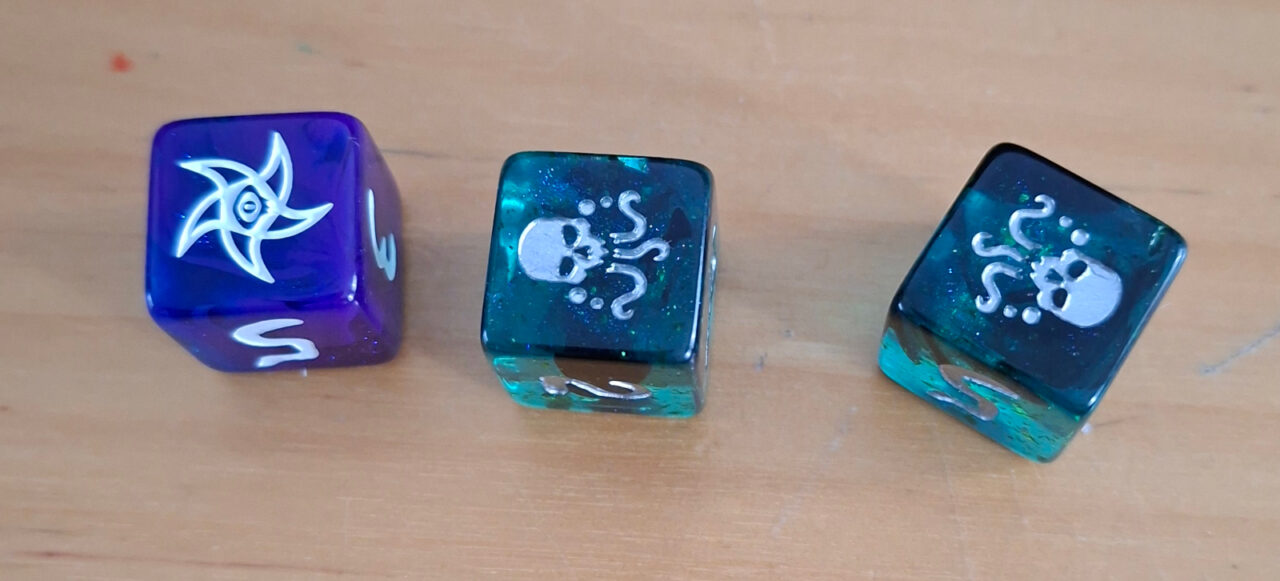

“Doug’s Oracle of Changes” is a 3d6 oracle system for solo roleplay that adds a new condition to the more standard “Yes | No” + (chance) “And | But” systems and is inspired directly by the I Ching.
It is used in a lot more quicker games where more complicated oracles are not necessarily required.
THIS IS VERSION 0.2
0. The Quick Summation [Basic Concept + Simple Complications]
- Roll 3d6 (one distinctly colored or rolled separately).
- Reading each dice individually, number >= N are + while numbers < N are -. By default, N = 4 so 1-3 = – and 4-6 = +. A majority of – = No while a majority of + = Yes.
- — and –+ = No
- +++ and ++- = Yes
- N can be increased (up to 6) or decreased (down to 2) to show altering odds.
- All three Even OR all three Odd = “Changing” and shows the results changing to the opposite.
- For instance, 3, 5, 1 = No Changing to Yes.
- The Key Die, the one which is distinct, generates And or But if it rolls a 1 or 6:
- 1 and the overall result is No = No, and…
- 1 and the overall result is Yes = Yes, but…
- 6 and the overall result is No = No, but…
- 6 and the overall result is Yes = Yes, and…
- Two 1s and 6s increases this “No, and…” into “No, AND!”
- Three 1s = No, AND!!! while Three 6s = Yes, AND!!! but should be understood to be so extremely Yes or No that things are swinging back around. Like the most self-destructive Yes and No possible.
1. BASIC CONCEPT
Roll 3D6 [three six-sided dice].
Set a value N which by default is 4.
For each die, N and up = +. [Default = 4-6]
For each die, <N = -. [Default = 1-3]
Majority + = Yes {++- | +++}.
Majority – = No {–+ | —}.
1a. OPTIONAL: Bigger 0r Smaller Dice
You can use larger or smaller even-sided dice, right down d2 which emulates the coin-flip method.
In this case, Default N = 1/2 MAX D-VALUE + 1. A 10 sided die would have a default N 0f 6+. A 20 sided die would have a default N of 11+.
Technically, I assume equal numbers of evens and odds but you do you it just might get weird in the math.
2. SIMPLE COMPLICATIONS
These next elements are considered default complications but are technically not required and can be tweaked to your heart’s content.
2a. All Even or All Odd = Changing State
If you get all Even or all Odd then it is understand that the answer is temporary and is the process of changing.
These do not have to be the same odd or even number, but they must be all “ALL EVEN” or “ALL ODD.”
It would be “Yes Changing to No” and “No Changing to Yes” in the order given.1
This is not precisely the same as a “…but” condition. It simply represents that at the moment of addressing the oracle, the situation is in flux.
If you are using 1a and d2s, ignore this as a possibility unless you want everything to be an AND/BUT.
2b. Key Die Determines “And | But” Status
For this, you need at least one die distinct from the others. This is the Key Die.
If the Key Die is the highest or lowest possible value it can be, it triggers an “And | But” addition to the answer. For a d6, this would be a 1 or 6.
If the key die matches the overall result, it is “And.” If it opposes it, it is “But”.
FOR INSTANCE, you roll 3d6 and get [1],4,6 which are two highs and therefore “Yes” but the key die disagrees. It becomes “Yes, But.”
2a and 2b can stack. “Yes Changing to No…but” is perfectly valid. It is up to you and context to decide which gets precedent or either.
If you are using 1a then larger or smaller dice will impact the threshold. This leads to two subclauses…
2b.1: You can set the key die trigger to be a range, e.g., two highest and two lowest numbers which could be used to show the strength of the exception/addition
2b.2: If you are using 1a and d2s, ignore this unless you want everything to be an AND/BUT. Changing trumps And | But.
2c. Increasing or Decreasing + and – Threshold (N+)
The default is that half the die’s values = + and half the die’s values = -.
If you want to show changing odds, then you can reduce the threshold. In notation, you write the lowest possible “+” number with a “+” sign. 4+ = Any number 4 or greater [even odds]. 3+ = Any number 3 or greater [favors yes]. 5+ = Any number 5 or greater [favors no].
The lowest possible value is always a – and the highest possible value is always a +.
The most likely odds would be 2+ (reserving 1s to equal -) while the least likely would be the highest possible value of the dice (6+ on a d6).
3. TWISTS
There are some options here but I am still figuring out my favorite.
- Once per scene, swap out Key Die with a Twist Die ranging from d4 to d20 and roll it to see if the scene goes as expected. If the non-Key Dice are greater than the number rolled on the Twist Die, then a twist occurs. Default would probably be either d10 or d12.
- If all three dice = exactly the same number during any test, it generates Twist. Higher numbers are more positive. Smaller numbers are more negative. These would override some of the “Changing” statuses.
- Treat all “Changing” as twists. Bigger numbers = bigger twists and then you could use Even = Positive vs Odd = Negative. You would need to treat {1 & 2 | 3 & 4 | 5 & 6} as three groups of numbers to stop it from having a positive bias.
4. DEEPER COMPLICATIONS
Coming soon, but the plans are to find a way to connect this to trigrams and hexagrams where there is a running tally of questions.
5. WEIRDER COMPLICATIONS
There are some other options to get more out of it if you were trying to adapt sub-systems into it.
None of these make sense in the raw but are here for future consideration.
5a. Different Sized Dice
It is possible that one die is different sizes, or all three are different sizes. For instance, have a single d8 but keeping the other numbers could be a way to make results overall more positive.
5b. Advantage/Disadvantage
Additional dice could be added to the roll with highest/lowest retained depending on Advantage/Disadvantage. This would create a number of weird cases but would fit a well-known model.
5c. Locked Dice
There could be a system where one or two dice are locked into place.
Possible, this locked die changes value to reflect more negative or positive circumstances though it would wreck other subsystems as presented.
WHY, THOUGH?
The reason this exists is because I’ve used a modified I Ching thing with three coins to generate Yes, No, Yes→No, and No→Yes style answers for years. I was thinking about how to apply it to games and my first ever Doug Alone blog post mentioned how I saw it developing at that time.
For the most part, many of those ideas are still present, here.
Earlier this year when I played De Havikmannen, I used a variation of this oracle though I strangely kind of rebuilt it from basic principles and then through playtesting drifted it closer to the original idea.
I still kind of want to see how far I can take it, though.
- In the traditional method, it would be slightly reversed. Three “yes” would be “No Changing to Yes” but simplicity I have kept that part out. ↩︎