Prep is Play and Play is Prep

A man wanders through a liminal space with dice and dominos.

Author: Doug Bolden Page 16 of 19

Currently an United States expat living in Belgium. Loves horror, tea, cats, and RPGs [especially those played alone].

The Bleak + The Pearl Intermission #5: A { Short | Mid | Longish | Un- } Hiatus from the Mainline Plot [Shadowdark + SoloDark] [Meta]

Above is a glimpse into how this campaign started six months ago. Dyson Logos maps (or dice drop point crawls) imported as backgrounds on Google Presentations; John Kapsalis art (almost always, with some games-icon icons when nothing else made sense) made into tokens using GIMP; map adjustments and such typed directly as text fields on the map; and a few notes and details typed into a couple pages of a Google Doc file. This still persisted until the Monolith got going enough it was easier to switch the whole campaign to Theater of Mind and blog-format first.

Bonus: You can see which Kapsalis heroes and monsters I picked to represent our main four heroes. Spotted Tom was just one of the goblins that caught my eye. Rance was a contemplative blue mage (maybe an elf, don’t recall) token originally used as Haig Raven in my Barston Bakersfield campaign. Inar is a silly little hafling with a staff (he wears pretty sturdy armor in the main campaign and has a crimson-red mace). And Grusk was depicted as shirtless and got his signature axe because his token had one. With the exception of Tom, the other three names were from when I tried to make the campaign in Roll20 to start and I just literally used the default random names generated. I actually kind of forgot that’s what the characters looked like. 

Too Long; Didn’t Read Summary

In short, the campaign started as my “just dungeon, don’t story” campaign and got immensely Doug-ified on the way so now requires pages of lore and while it still has some fun, usually quite short “dungeon” dives it has lost a lot of its initial anti-campaign focus (the exactly opposite of that, really). Since there are possibly months of main storyline left, using a natural break in the storyline coming up to go ahead and declare it time for a couple of months of side-quests and introduce several (at least six) new characters to make a kind of second team that will join the main one here or there in various ways. Will eventually shift back into the main storyline after everyone gets a few levels higher and we can move into the higher level, more domain-level of play. 

Or, How a Campaign Changed Over Time

According to my notes, I launched this campaign, The Bleak + The Pearl, around the middle of June 2024. At the time, there were only a few basic lore truths:

  • There were two vast islands that combined were a complete continent.
  • The western island was “The Bleak” and was dark and foggy and grimy and full of ruins. This island was originally Barthus and for centuries had been the site of a great kingdom but now was mostly just skeletons of old buildings and smaller settlements. It was to be the setting of the more “grim” sessions.
  • The eastern island was “The Pearl” which was a wild and green place with huge mountains, ancient barbarian keeps, dragons, and much more of a “large scale, mid-magic fighters-in-leathers tackling giants” kind of vibe. This was “The Silt” and was the place the ex-Barthics took refuge. This was to be the more “Frontiers of Adventure” style setting with less undead and more, you know, dinosaurs.
  • The islands are separated by a five to twenty miles of ocean called “the Gray Channel”. Whatever caused “The Bleak” has yet to find a way to cross it.
  • The initial heroes were refugees raised in The Pearl who are now going back to The Bleak because one of them keeps having dreams about a light fading, darkness spreading, and things getting worse.

There was, effectively, two meta-truths:

  • This campaign was going to be dedicated to pretty much straight dungeon delving and hex crawling with a few interrupt “city/society” scenes to act very nearly purely as dressing. 
  • Around half of the sessions would be played in pre-existing maps while the other half would either take Dyson Logos (etc) maps or just do a dice drop and use existing tables to find out content as I went.

It was the second (not posted to this blog) session where a drunken night turned into meeting Cal Grunkheart and deciding to help the Lighthouse Keepers which ended up becoming the meta-reason behind the campaign. This part is fine. It was initially going to be a mini-arc of sorts but over time morphed into a much bigger part of the campaign. Still fine.

As the mini-arc took over, there showed up a a mini-mega dungeon that was the cornerstone of this part of the campaign and a series of quests to the other dungeons and sites were going to be required to fix it up. This was fine. The “about 10 sessions to complete” was a lie but that’s ok. We were still playing. 

Prior to even starting to make the dungeon, I ran a couple of sessions in a pre-existing map, The Lost Citadel of the Scarlet Minotaur, tweaked to have elements from the campaign. Almost an entire month later, after spending way too long semi-agonizing on how to blend the more meta-elements with that initial intention we got the first entry into the Monolith. 

Over the next few weeks, I entered into an era I’ve talked about before but it represented me dealing with the stresses of solo-play. It felt less and less like fun and more and more like a difficult puzzle to solve. On the positive side, this led me to work out my more multi-phase style that is a staple for this blog (see: The GLOW for perhaps the most elaborate variation of it). I’ve seen other solo players do similar things but the distinct GM-phases where I build up information and player-phases where I test and break down that information (along with lore, interjections, and other elements) is a fairly Doug-Unique style of solo-play, one that has influenced even the play I do off this blog.

However, on the more negative-or-at-least-neutral side, I essentially lost the ability to sit down and play with a couple of colorful tokens and some varied dice rolls and had to spend increasing amount of times fact checking and considering long term impact of any and every decision.

Around three weeks from the start of retooling this campaign more and more into “Save the Lighthouse, Save the World,” I got to an encounter that effectively derailed and forever altered the entire The Bleak + The Pearl: The Grunkheart Golem. I had one room left off the starter/main branch of my dungeon and when I rolled the contents I got a boss monster. I suck at the sort of OSR-style play where rooms next to each other to have completely different contents/encounters so I wanted to come up with a reason a boss-level monster could be a few feet from the main entrance. The Golem was a solution to this and it changed quite a bit. 

  • Ancient Technology was actually some blend of high, science fiction technology with a much more refined magical system.
  • After the Ancient society collapsed, there were hundreds of years before Barthus showed up and established itself in the ruins.
  • Jonias had a more extensive appreciation for Ancient Tech than thought and had not died but instead went off to a lab in something called “The Everburning Forest” and not returned (I mean, he might have also died, we still don’t know at this time).

These seeds grew and sprouted a bit. After one intermission where I came  up with a general layout map of the forest, I had another intermission that finally sat down and figured out what the Bleak and the Pearl were. No longer just the name of two different fantasy tropes, The Bleak was a corruption of some primal energy inherit in the western island (in the Ancient tongue, it was The Becoming). Ancients had used it as part of their vast engines (along with The Pearl’s “Being”). The fall of the Ancients was basically due to them using up too much energy and draining it. Now, several centuries later, it has returned and it is changing people and causing buildings and landscapes to mutate though there are “shallows” where it has little to no impact and many settlements drifted into those shallows while traveling between them is basically an invitation to body horror. 

This led to a fight with a fight with an oddly mutated cyclops around two weeks later and then a full month after that I finally hit a stride with playing as the entered into the forest and encounters and mechanics were a lot more normal. Over the past couple of months they have pushed through the forest, found the old lab, and realized things are a lot weirder. 

While all of these shifts and dynamics have been broadly fine it still is a much different campaign than intended. For one, there has not been a pre-built dungeon/adventure since June (6 months). For two, roughly half of the session time has been dedicated to building up the world and establishing dozens of new World Truths. 

I adore the four core characters. I love Cal Grunkheart and his doomed mission that might just succeed. I like the whole trope of science-fiction world becomes high-fantasy world becomes weird body horror world. 

BUT, this was meant to be the campaign where I did not have to spend quite so long building up dungeons and where I could spend a lot of time just flipping through shopping lists and throwing a few fun monsters at people while checking for random encounters. It is just very hard to swap back to that without there being the sense that I am giving up on a lore I have spent four months honing and perfecting. 

To sum up some changes: A simple world to allow both “grim” and “dark” styles of fantasy play with only a vague storyline to justify it >> a “short” meta-quest that requires some more storyline >> the storyline becomes entirely about the meta-quest which starts dictating exactly which kind of adventures can be played >> dungeon delves start taking a backseat to more complex encounters >> virtually every post is as much about lore building and campaign design than any sort of proper dice rolling >> where we are now. 

Taking a Hiatus from the Mainline “Jonias Grunkheart Legacy” Quest

That’s why I am going to take advantage of plot developments in the world where it will take months of in-game time for Cal and his crew to move into the lab, learn the Ancient language more completely, and just get out and do some dungeon delves with pre-built or quick-built dungeons. 

The “main four” will still be part of this. However, I am about to introduce a “second six.” There were Five Great Families that came together to build the Lighthouse. The plan is to have a member from all five families join in. Some of the second six will be a tad weirder than the “four default” classes. A bard and a ranger. A pirate of some sort. A dragonborn pit fighter. A tiefling witch. I also have a silly idea for a turtle monk. The ranger will be second level and a character already met in the campaign. The other five will all be brand spanking new. 

This allows a few things. First, I can a couple of low level adventures again and those are always good fun. Second, it gives me a chance to build up a few back-up characters just in case one of the mains gets taken out or needs to spend months crafting spells or running a kingdom, etc. Third, it gives me a chance to build up a few alternate parties and combinations since those can be fun. Fourth, it just allows me to use a lot of supplements and zines I have paid good money for and I am itching to see how other classes and races work. 

Finally, it gives me a chance to go back for a bit to the OG campaign design: dungeon delves with minimal story requirements. An anti-campaign again, only this time backed with months of story that shapes some truths. 

Folks show up at a dungeon entrances, they go and grab treasure and experience, and then get drunk afterward. 

Being Spoiled for Choices and Return to Recap

Part of this is just because I currently have three very “talky” campaigns: The GLOW (which has at least two more mini-arcs I’d like to do, and it will likely spawn more), The Bloody Hands (the Stone Crack’d mini-arc likely has four to five more sessions at least, and a lot of world building is going down there, and I want to run another mini-arc soonish dealing with one character’s hidden illness and a hidden benefactor plotline from near the start), and Eustace Delmont (which is on pause, technically, because I have no time to play). There are also a few one-shots and playtests brewing or on-going. All told, I spend between eight and twelve hours a week playing these solo campaigns. I get lots of NPC interactions and world building time. 

I like the idea of taking a few maps, importing them into Google Drive, playing with some digital tokens and spreadsheets, then spending maybe half an hour a week writing up some of the fun things I did. This new arc will be back in recap style with a more OSR-style balance and less seriousness. A lot more braindead than I tend to solo-play. In balance is joy…

The “side-line quests” [I’ll call it something like The Gathering of the Families and Sundry Adventures] are a way for me to play with some of my absolute favorite solo characters, add in some more funky folk that will either be fun to play or get kicked off the team, and reduce lore from multi-paragraph continuations to maybe a short passage about why an Inn is called “The Screeching Duck” or something equally silly and funny (to me). Eventually Cal will have deciphered some stuff and we’ll be ready to get back into the main questline again. The Bleak is still there so hex crawls can have unexpected results, for sure. 

In fact, a couple/three of the planned adventures are actually going to be from the original story bank of adventures intended to tie into the Monolith (though now low enough level I would have had to redesign them or tweak them a bit for balance and content only now I can just drop a newbie team into them and play as is). The very first one I plan to play will be a different crew going after one of the fuelstone relics. Maybe also the second. So it’s less a hiatus as a bunch of side-quests presented in a different way until I feel like it is time to get back into the deep lore and two pages of conversation again. 

The GLOW 1996: Agent Johnny Blue – Chapters Two & Three [Tricube Solo] [Multi-Phase]

Johnny Blue begins his mission to learn what is flagging the psychic threads involving a werewolf pack. Macy Maron and Barlow Hendrix – the dual heads of the pack – are dangerously heavy hitters and Johnny knows there will be trouble. He visits an old friend to try and gain an edge. This decision alters his entire life as old magic meets new and reforges a destiny for Agent Johnny Blue.

The Bleak + The Pearl Part 21 – Going Underground [ShadowDark + SoloDark] [Multi-Phase]

And old set of stairs past a door in an older building.
“Stairs, Steps, Old” by depaulus on Pixabay. Recolored by Doug Bolden.


Previously, on The Bleak + The Pearl…

The four adventurers have explored the upper floors of Jonias Grunkheart’s laboratory and have continued to make discoveries without context of Jonias’s true purpose. A battle with servitor automatons pushed the group to its limits but they are rested, healed, and ready to to embark downstairs to make sense of the strange mysteries they have found.

About The Bleak + The Pearl

The Bleak (Barthus) and The Pearl (Silt) are large twin islands. Once home of an Ancient Empire that fueled its machines and miracles by tapping into the primal forces found upon each (Becoming and Being, respectively). Two thousand years after the fall of the Ancients, the Barthic Empire that grew up in its place (one of many over the years) faced its own cataclysm as The Bleak (the corrupted version of Becoming) spread like a disease. Those who stayed were subjected to rapid mutations and strange changes: their own bodies warped into monstrous forms as even the land lost its sanity.

Three hundreds later, four heroes—Grusk Obe (Half-Orc Fighter), Inar Gale (Halfling Cleric), Spotted Tom (Goblin Thief), and Rance Uffolt (Human Mage)—are on a journey across The Bleak, risking sanity and their own existence, to try and save The Lighthouse: the last great act of Jonias Grunkheart. A piece of reclaimed Ancient technology that can bring balance to the out of control forces.

Content Warning: Fantasy Violence, Occasional Body Horror…

This post is in MULTI-PHASE style. See the about page for this blog for more details. The system used to play this is ShadowDark by Kelsey Dionne and the Arcane Library with SoloDark (same) acting as the oracle.


Part 21 – Going Underground


{{ GAMEMASTER PHASE }}


A map of a temple basement in black-in-white classic style.
(c) Dyson Logos. Mild Modifications by Doug Bolden.


Jonias Grunkheart’s Lab, Upper Basement

The upper floor of Jonias’s lab is built on top of the remaining portions of Elizin Urnlight’s old Everburning Forest research station. Jonias scavenged increasing portions of the tech and those are evident in the motif as well as in specific sections. The decor of the rooms lean more to white stone with blue lines and filtration system keep around 90% of the ash from building up here. Ceilings have (inactive) glowglobs attached to stylized conduits. Once the controls are activated in B3, these rooms will be lit. Various automaton, some of which are deactivated, are on pedastals.

Automatons on This Floor

All “minion” style encounters are automatons. Outside of the Viperian Ophid Class as noted below, the rest are 1-3: simple servitors, 4-5: basic servitors, 6: advanced servitors. Specifics to each can be determined as found. There is a 3:6 chance they are deactivated in the long years since the lab was last used. On a roll of 6, the internal working should be considered too worn down to work. Once B3 is activated, still check to see if automatons have worn down.

B1: Examination and Prep Room

While 2 (Transit Room) and 4 (Cleaning Room) have equipment to finish off and sort some fuelstone brought up from the mines below, B1 is the heart where fuelstone is fully sorted, trimmed, carved, and initially activated. On the section of the room are cart tracks leading up from the lower basement and through the ramp into the upper floors. On a raised platform, a series of tables with intricate equipment is visible. To the western side, the tables are closer together and the equipment is more primitive—roughly equivalent to some of Cal Grunkheart’s equipment back in Grunce. As it tracks from west to east, the tables are “newer” (a relative turn since the newest one is over three centuries old) and more advanced. The last few tables built are quite advanced and on the lower tier of Ancient technology. Jonias spent decades learning more and all-in-all was a fast learner.

B2: Lower-Access Research Library

This was a library which housed some of the simpler, less-vital research books. There are four cases and each case has a 2:6 chance of having surviving texts. The more controlled air of this area is better at preserving the materials but it still remains dry and hot. If any surviving texts are found here, a INT DC24 roll (reduced by 3 per additional text and by an addiotional 3 if more than 1 week is spent in study) will help to bridge the gap between Ancient and Barthic languages.

B3: Control Station

Monitoring stations are in the north portion of the room. Glass screens which flash Ancient sigils while active are next to tubes and gears that provide other feedback. Through the locked doors (DC18 to open, but at disadvantage, key is downstairs) leads to stations with levers and gears to a) activate lights and life support; b) activate and control automatons; and c) activate and control the portal upstairs (in that order from west to east). The controls are written in Ancient but flipping the switch is somewhat obvious [just what it does, not so much]. INT DC18 to have a decent concept of what is happening if time is spent there.

B4: Scanning Room

This room was designed to scan security for the people who enter it. Two guard automatons (Viperian Class, 3:6 to still be powered) will activate if the doors are breached without the scan being done and the scan can only be done if the #a switch is activated in B3. The doors are not locked.

B5: Demonstration Theater

In the earliest days, the Temple/Theater upstairs was meant to be Jonias’s place for demonstration. However, as the lower levels were excavated and built, it was turned into the portal room. This room took over as a place where Jonias could show fuelstone technology to guests. [We know from previous posts that the whole attempt to get more people to adopt the fuelstone tech was a flop so there is little chance of this room ever being properly used]. A few fancy seats look up on a stage where a table on par with the most advanced in B1 and a few podiums stand. These were the core of his “magic show.”

B6: Second scan and security access to lower basement.

Both the north and south chambers contain more (currently inactive) equipment to scan visitors to check for access into the lower basement. Both doors are sealed with fuelstone tech and require STR DC24 to force open until B3 is activated (and then requires passing the scan of known people which accessible only in the floor below). Each door is guarded by another of the Viperian Ophid class automaton. Like all automatons on this level, there is an innate 3:6 chance for active status prior to the B3 switch. They will aggressively protect the doors if active.

Accessing the Lower Basement through the cart route

These shafts are narrow and steep. DEX DC18 to navigate them before activation of B3 (they are part of the automaton branch). Failure results in 1d6 damage. DEX DC15 to navigate once lights are on but failure results in 1d6 fall damage AND 1d6 damage from the fuelstone energy in the tracks. Furthermore, the carts are themselves primitive automatons (INT -2) who have a DC12 check to detect some disaster on the track.


[[ PLAYER PHASE ]]

The four have made their way over to the tool room and the large set of stairs there. Casting a light spell, Rance has his wand glowing and the four make their way carefully down the steps. Tom is leading with Grusk close behind. Inar is in the rear. Rance holds the light high from the middle.

The group stops as Grusk and Tom simultaneously let out a hissing noise from the bottom of the steps and Rance has to bend over to see what they see. Inar is too far back up to have a clear view so the halfling asks, “What is it?” [1]

“Couple of those snake golems that attacked us above. One of which is definitely turning to stare at us. The other seems…dead. Not moving,” says Tom by way of explanation.

Grusk is already pulling out his magical axe, the blood-red-bladed Bloodlust, and with a shout runs forth into the room with the axe up. Then stops. The “golem” is not moving. Just watching.

“It’s a trap, right?,” asks Inar.

“It is always a trap,” responds Rance, still crouching on the steps and watching, wand now fully aimed at the viperian ophid automatons.

Grusk walks forth and knocks on the automaton with his hand. Nothing occurs. [2]

Grusk looks back. “I’m going to chop it and wait to see what happens!”

“No, wait,” calls Rance, the seer entering the chamber now with Inar following close behind. “The ones upstairs went on attack because we got near the swirly mirror thing. These are, well, trying to stop us from getting to the door? Tom?”

“Yeah,” says Tom, thinking. The goblin checks out the door and spots no traps nor even obvious locking mechanism but when he goes to put a hand on it, the automaton quick whips its head to watch. Tom pulls his hand, back. “They are definitely stopping us from going through this door.”

“So I chop it?,” asks Grusk, still next to the automaton.

Rance again calls out for the half-orc to hold tight and examines the structure at the south of the room. A few inches higher than the rest it makes a step up into a rectangular platform filling the entire southern alcove. Then, in the middle of that, another smaller rectangular platform is again a few inches raised. At the corners of it are four pillars. They just appear to be more of the white stone prevelant in this layer of the lab. Except… “There is fuelstone laced in these pillars. And it attaches to those metal conduits making all the strange shapes, going over to that orb full of liquid, there. I think this area should be doing…something. Maybe this is helps us get past Hiss and Spit. Or we, you know…” [3]

The goblin answers the un-asked question, “I am for going back up and going down the tunnel with the railing.” [4]

Rance responds, “I know what Grusk wants. What about you, Inar?”

Inar looks at the automatons uneasily. “I think it’s worth at least a chance to see what the other way is about before we risk damaging anything.” [5]

Rance looks at Grusk and the half-orc shrugs. Puts his axe down (but not back into its belt-hook) and backs away keeping an eye on the automaton. “Ok, then, up and over and let’s see what we find.”


They make their way back up to the previous floor and follow the tracks around and look down into the dark, steep path. “Why do we not have any rope?,” asks Inar, giving it some thought.

The group goes back to the room at the top of the stairs that had various tools and gear stored. Everything there was in rough condition but in the side room with the strange armor and cloaks hanging on the wall, a good amount of rope was stored in the same material (and therefore has resisted the incessant burning). Sorting through the bits, they find hundreds of feet of rope and tie together about a hundred to start. Tom will go down first to test things out. Rance casts Light on a necklace Tom is wearing which is wrapped in a cloth so a dim glow shows the way. [6]

Tom’s foot slips slighlty in the slightly-less-than-completely-dark tunnel but he regains his footing and continues down more carefully afterward. Getting to the bottom he glances around and then makes his way back up. “Biggish room, bigger than this. Some sort of tables with bits on. Like a jeweler’s bench. Lots of these laying around.” Tom hands over a fist-sized beetle made of metal and fuelstone. It is clear from the way the wings move that it once was a automaton but now is dead. It is unclear if it will get back to working agin. [7]

“Guess the little ones don’t have as much…um…go?,” speculates Inar as he pokes it with a finger, gasps, and then tosses it away from him like it was actively trying to bite him.

Grusk brings his boot down hard on it. “At least these are easy to crack. You said there were more?”

Tom and Rance stare at the needless destruction but Tom eventually nods. “It’s a bit slippery with all the ash in the tunnel, but hold on to yourself.”

The four start going down in the same order they were descending the stairs earlier. Grusk and Inar both nagivate it about as well as Tom, holding the rope. Only Rance slips and he slides down hard enough to smack his wizardly head into the floor. Inar says not a word as he casts Cure Wounds on Rance’s bleeding scalp. [8]


Regrouping at the bottom, a chagrined Rance has been poking at exploring the tables up on a raised portion to the north of the room. There are a number of moving parts, things like that look like chisels, basins, and other bits that make only a rough bit of sense to the seer. “I think Tom was right. These are like jeweler’s benches, only…”

“Only for really big jewels,” Inar cuts in. “Like Brother Daniel might use to carve some of the statues and pillars back at the temple.”

“Right, only…more sophisticated. Look, more of those conduits out of this strange metal attaching them to paths along the floor, up the walls, and then to another series of of those globes in the ceiling. And then they…” Rance jumps down to the main and floor and then moves back and forth along the exits to the room—there are two about equidistant in the south wall—they follow this one on the left-hand side. [9]

He almost absentmindedly follows the path while the other scrabble to catch up. As he is following the conduit lines and the strange, arcane path across the ceiling, Tom points out that there are more of the inactive lady bug automatons on the floor. “More bug golems.” The room they are in is some sort of study. A few stone bookcases are covered in what was once books but now is mostly dessicated remains of books. A couple of volumes have weathered the passage of time enough to still be in roughly one piece, though. The goblin pokes Rance and has him come take a look. Rance flips through and shrugs. “Some of this is old Barthic. Some of this is…something else. I think this is Ancient. I can’t really work with either but Cal probably will be thrilled. Rance places the books very carefully in his backpack. [10]

Moving south (again, the room had a pair of doorless hallways evenly spread to the south) the four find themselves in the strangest room yet. Roughly the size of the previous room, this has walls covered in strange glass sheets reflecting nothing, a variety of multi-colored crystals, and various tubes of different metal. In the floor, another automaton is in pieces. This one started out as more human but has since fallen and shattered. Taking note of the face of the automaton, Inar rushes over to it. [11]

“Grusk, you see this?”

“Yeah…”

“This face looks like Cal’s!”

“Yeah…”

“Should we take it and show him?”

“Like, scare him with it?”

“No, you know, just show him!”

Grusk is clearly coming up with a plan. “No, I saw we convince him he is being haunted by himself. We’ll have this looking out windows, following him…”

Moving on from that conversation and letting it fade, drift back to the other two. Tom is poking another dead ladybug automaton while Rance is scratching his beard.

“Rance, why are they so lifeless here when upstairs five separate golems tried to murder us?”

“I think it’s the forest. Or, well, something in the forest.” Seeing Tom’s quizzical look, Rance continues. “Up there is ash and dust and fire everywhere. And you have multiple golems moving just fine. Down here, you have much less ash, much less heat, and…”

“…and the golems do not work. The same thing keep the forest out is keeping whatever lifespark these things need.”

And now back to the other conversation, in which Grusk has laid out a seventeen-step plan to convince Cal that evil duplicates are stalking him, as Inar shouts back to Rance and Tom: “You should come see this, it’s Cal’s face on a golem. A Cal-lem if you will!” The halfling has been in high spirits, lately. Nearly dying a few times in a week really wakes you up, sometimes.

Walking over, Rance looks down at almost immediately catches on. “This is Jonias. Look, it is an older face that Cal’s. There are some wrinkles and scars. The beard is much thicker. This is the great-great-great…well, you know. The old ancestor.” [12]

This revelation makes Grusk and Inar both more excited as the plan shifts to convincing Cal he is being haunted by Jonias.

To the right and left of the back wall, doors are shut tight. Plaques on them are painted bright yellow and red text makes the letter stick out. Unfortunately, being in Ancient, no one here can tell what it means. “I think it’s a warning.”

Rance agrees and points out the arcane conduits split and go both right and left, here, behind those doors. “Warning or not, this is the way we are going.” Rance and Tom go towards the door on the left when a loud clatter is heard behind the group. Something, more than one based on the noise, is making quite a bit of racket back there among the now mostly empty bookshelves.

“Tom,” Grusk shouts, dropping the Jonias head in his own backpack, “You see to the doors, the rest of us will investigate whatever that is.” [13]


{{ GAMEMASTER PHASE }}

There is one of the automatons match the type same as last time. The basic servitor automatons. Which is active. Rust Monsters have worked down into the lab and have been feeding off the automatons, at least the more traditional metal bits of them. This explains why some are completely collapsed and broken like the Jonias one and some of the ladybugs. Can the rust monsters feed off the strange metal in the conduits? 4 → No. That is safe. At least for now. Eventually they might start feeding on the lab, itself. The core metal which is a fuelstone alloy but things that need metal attachments is up for grabs. There are 3 rust monsters and they have been here for at least a couple of weeks and ended up sliding down the rail tunnel and haven’t been able to get back up so they have been…hungry.

They were feeding on Pearl when Pearl activated and starting fighting back. A couple of rust monsters got smashed but Pearl is now heavily damaged.

Servitor Automaton (1, this one with a Pearl Marking): AC 16, HP 10, ATK 1 slam +0 (1d6), MV 1/2 near, S +3, D -2, C +4, I -3, W 01, Ch -4, AL N, LV 5

Rust Monster (3, well-fed but getting indigestion from some of the metal blends): AC 13, HP 19, ATK 2 claw +3 (1d6), MV near (climb), S +2, D +3, C +1, I-3, W +1, Ch -3, AL N, LV 4. Corrosive (Metal that touches the rust monster is destroyed on a d6 roll of 1-3).

The servitor has already taking 20 points of damage. Only one-arm remains functional and has one leg drags limply behind it.


[[ PLAYER PHASE ]]

Running into the worn down library, they see another of the weird golems from up top (the ones that look kind of like liveried servants), only this one has a different shaped head and a large pearl in its chest slot, chasing after some strange wolf-sized bugs with spazzing antennas and odd tails. “Rust monsters!,” Rance shouts, recognizing them immediately. The Pearl-bearing servitor, moving oddly like its left leg has frozen up and its right arm is dangling loosely, goes to swing its left arm at one of the rust monsters and tilts forward and the falls over. The rust monsters turn around and leap upon it but it’s clear that their strange tendrils—extending where mandibles would be on another beetle—are having trouble getting into any good feeding spots in Pearl’s innards.

As Grusk steps forward to hit something, anything, with his axe, Inar holds him back. “Um, maybe let them get finished first. No need to fight both of them at the same time.”

Unknown to the three watching this fight, Tom has gotten past the door quite handily and is now entering into the southern chamber. [14]

The rust monsters keep attacking the servitor automaton until they hit something vital. The spark goes out and Pearl collapses. Almost immediately, the rust monsters turn and antenna and tendrils are aimed straight at Grusk and Inar. The plate armor is the first non-weird metal these bugs have had for a minute. They are ready to eat. “Well,” Grusk says as he trots forward to start the fight on his terms. Bloodlust slams down into the back of the nearest.

Inar rushes forward as support. He brings down The Crimson Star on the back of another one. Rance aims Acid Arrow at the third.

In the southern room, Tom flips the first switch and waits. Nothing obvious happens. [15]

The very hungry rust monsters are not deterred by a little bit of violence and two leap upon Grusk while the third goes for Inar. The rust monsters are crowding on top of both of them with one of the acidic tendrils hitting Grusk in the face. Likewise, Inar is getting burned while trying to find the creatures off. Grusk swings a bit wildly and gets Bloodlust into the same rust monster that Rance’s Acid Arrow struck. The Arrow burns deeper and Magic Missiles fly into the same monster to do some minor damage against its shell.

In the southernmost room, Tom flips a second switch. Again, nothing obvious occurs. [16]

The rust monsters continue their attempt at a feeding frenzy. Grusk takes more of the burning hits against his face as he roars out in anger. Inar can hear a sizzling sound as the tendrils try to get into his armor but are stopped by the dragonsilk.

Grusk finishes chopping down the second while Inar gets a quite solid hit into the shell of the third. Behind them, Rance curses as purple sparks fly everywhere and his spellwords turn into strange chant.

Even more shocking, the lights in the room turns on and the lab starts coming to life. Loud gurgles erupt as water starts flowing through pipes in the walls. A breeze can be felt on the face of the adventurers once they stop to notice. A deep hum rumbles from all around. [17]

Grusk ignores the distraction as the remaining rust moster continues to try to eat him or his armor first. The creature can’t get past the dragonsilk or there would be hells to pay. Inar has finally broken free from his opponent and has stepped back far enough the rust monster fighting him misses altogether.

Grusk swings around chops an antenna and some tendrils off his remaining opponent as Inar finally gets a good swing in and bashes the life out of the other. Behind them, Rance has managed to get his spells under control and the sparks have ceased flying.

Grusk and Inar run foward to the final rust monster and finish it off with a couple of quick blows. [18]

“What in blue blazes has Tom done?,” Rance asks, looking up at the liquid filled globes now glowing with a warm light overhead.


The Effects of Reactiving the Lab

There are several effects that occur across the lab and beyond now that the lab has been turned back on. Let us start with the obvious ones.

The glow globes have reactivated. True enough, a few explode as a side effect of the many-years of disuse. The blue conduits of fluestone-infused copper start glowing the blue-green color of oxidized copper. These two things are the most obvious.

Slightly less obvious is that the air-purification system has reactivated. The water purification system downstairs also turns on and begins pumping water through the place. The combined effect will be a great reduction of smoke and ash over the new few hours. There will be drinkable water again with six hours.

The automatons, those still functional, are now waking back up. Some are confused about the long period of inactivity.

The lab upstairs has had a low level of naturally occuring Light-energy picked up from the forest itself. This is now concentrating. The lab is starting to repair itself and all the gears are turning on.

The portal no longer looks like a swirling mirrored image but more like an actual portal. It thrums and pulses. Jewels in its frame start to light up and blink to a strange timing.

The rail system reactivates and the carts are now monitoring the track for instructions.

Finally, least obvious of all, the Left Hand and Right Hand temples are slowly rewakening. The giant fingers bend slightly. This alters the flow of the immense Light-energy that has been building between then and directs some of that towards the lab. This shift in energy is felt by Uuld Alloces, the salamanders, and even the cultists. The forest is changing to fit the lab. Deep, deep below the earth, something else stirs, as well.


[[ PLAYER PHASE ]]

The four are together again, sitting in the room with the dismantled Jonias (head still in Grusk’s backpack).

“Do you smell that?,” Inar asks.

“What?,” asks Grusk.

“The air, it’s…cleaner.”

Tom takes a deep sniff and sits upright. “You are right. I have smelled burning ash and woodsmoke for so long that I got used to it but this smells like…air.”

Rance looks somewhere between worried and delighted. “When Sir Green Fingers here decided to flip the switches he seems to have turned the whole place back on. We have to tell Cal about this.”

“But first,” says Grunce, still injured from the fight after Inar’s healing spell failed to take, “We need to get what we came here for. Whatever will allow us to go deeper into the Monolith.” [19]

The half-orc stands, kicks a rust monster corpse, and then heads west from the library to keep exploring. Tom stops briefly to pry the pearl out of Pearl’s chest but then follows suit. Inar and Rance do the same.

The room they enter into a relatively long passage is something like a twin to the “temple” above. It is a lavish place, especially in the glow of the orbs in the tall celing. A large stage takes up a lot of the room, stairs leading up. A table like a larger cousin to the ones they found earlier has a variety of even more advanced tools upon in it. Pedestals hold various odd objects under glass. A shining stone is in one. In another, an amber shows of a large beetle that might have been the inspiration for the ladybug automatons. Other pedestals hold items probably equally as rare, but more esoteric. Unfortunately, several of these have been knocked over and smashed by the rust monsters and the metals inside have been rusted away. [20]

On either side of the table are small stands. The one of the left is empty and a couple of smashed up rust monsters are dead nearby. On the right, though, another of the servitor automatons stares down at the adventurers entering into the room. This one has the same face as Pearl but a large Onyx is in its chest. It stares right at Tom and then leaps off the stage. Grusk gets in the way and breaks a good sized chunk of Onyx’s head off in the first hit. Inar goes for a leg hit as Acid Arrow and another arrow from Tom all fly out to hit the servitor. Onyx tries to smash into Grusk but the half-orc deflects the first hit with his shield and the second with an armored arm. [21]

Onyx keeps raining heavy blows against Grusk and Grusk keeps deflecting them but the assault causes Grusk to miss. Inar shatters the leg of Onyx and even though Rance’s acid arrow ceases to work, Tom shoots the automaton right above the gem and it ceases to function. Another dead automaton in a sea of them. [22]

“Is anyone else tired? I’m getting tired,” says Grusk as he shoves Onyx’s body back and uses a dagger to pry the heart-jewel out. Tossing it to Tom. The goblin is already up on the stage and gathering up whatever is valuable there. All these items are tossed in the bundle of holding.

Inar asks Rance, “Through the doors behind us, left, or right?”

Rance looks and notes the conduits are strongest to the south and makes his way to that door and opens it, carefully looking inside. Not seeing much he gestures for the others to follow. Tom hops down from the stage and goes first. The exhaustion, or the treasure, cause the goblin to make a rare misstep. He triggers a trap. As some of the seeming decoration turns out to be odd tentacle automatons, the goblin is already leaping backwards. The others, alerted by his actions, manage to get out of the way and avoid being snared in any of the grasping forms. Back in the stage room, they see the hall they were trying to get into blocked off by the tentacles. [23]

“Umm, let us try the right-hand door,” says Tom. Unfortunately, though the goblin can see the sigils that activate the trap, he can see no way to actually disarm it. “We could run through, I guess? Or, you know, we take a running start and try to dive through?” [24]

Rance looks at everyone’s tired faces. “I have a better idea. We head back up, take a breather. And we get some more rope.”


A NOTE ON XP: Regaining the lab will be worth 3XP. The books to help Cal find out more about translation = 1xp. The other will translate to 3 more XP across the four found treasures (one for each golem + 1 for the two found on the stage). This gives them another 7XP total for this session.


== DOUG’S COMMENTARY ==

In the commentary of as-of-yet-unpublished The GLOW session, I mentioned that felt like my sessions tended to get cut short for this blog and that’s half right. In reality, I often solo-play in bursts. Ten minutes one time, fifteen the next, two-and-half-hours the next day. Outside of the context of the blog, it is relatively easy for me to play for four or five hours total for a single “session” in those four to five bursts and still have the mindset and concepts of the session active in my head but with the blog I kind of need to reach a point where I can post things and I shift gears back and forth and lose track of things. Because of this, it is sometimes a bit easy to play for about half an hour, spend half an hour typing things up, and then post that instead of anything like the actual length of what I consider a “full session.”

This one feels about right because I played it over the course of a single day and kept returning to it rather than trying to force it to a close. I got food cooked. Hung out with cats and the family. Then, finally got to a point that feels like a conceptual close and it is nice. I am not sure if it is obviously longer or shorter than other Bleak + Pearl posts but it feels more complete in itself.

I like the way the shifts of technology are building. The hints and foreshadowings of things. A few nice coincidences (the dead automatons, the rust monsters, the finding of rope, the traps) all added a good flavor to proceedings.

Double fumbles and Tom not succeeding in a thieving roll were both things that I could have lucked my way out of but sometimes you got to just let the dice speak.

As a final note, I am going to start adding a SOUNDTRACK NOTE to some of these. I listen to a lot of music while solo playing and thought it might be nice to share some of the music and sounds that help inspire some of the moods and ideas.

SOUNDTRACK NOTE: The albums being played during today’s session were Dan J. Schulte’s Shadows of the Underworld volumes 1 and 2. As released by Heimat Der Katastrophe (as albums 183 and 184). The entire HDK line is perfect for setting various moods and I needed something a bit otherwordly and dark but with a kind of OSR vibe.

== MECHANICAL AND STORY NOTES ==

  1. 19 on the spell check. Room Contents Check: 1 → empty. The room is largely devoid of things except for the two previously mentioned viperian ophid automatons. 1 is currently active. As a note, since the concept of automaton is a but rusty for a group of more country boys, they will call them golems.
  2. Do the automatons consider such actions on themselves to be worthy of going into kill mode? 8 → No.
  3. Rance got a DC16+3=19 INT roll and while it would be impossible for him to guess the full details he at least is able to make some decent deductions.
  4. Would these guys have a concept of minecart railing? 14 → Yes.
  5. Rance will go with the party. Grusk says to smash through. Tom wants to investigate. {Grusk | Tom} → Inar sides with Tom, right now.
  6. Seriously, why did I forget to buy rope. I am normally of the whole 10′ Pole and 200′ of Rope school of adventuring. Well, live and learn. The equipment tool room does have rope through (18 on an oracle check) and they have 1d6x100′ = 500 feet so a good amount. we’ve already established the tools/gear in the one room is decayed so we’ll say there is some in the room with the extra-dimensional coats. Encounter check was negative. Light spell cast was positive.
  7. Treating this as a climb, Tom does it at advantage and gets a 19+3=22 check. Room Contents: 7 → Monster Mob. Automaton check brings back not only not activated but dead. These will be smaller, normally floating automatons that have all collapsed down. Using the Animals Table from Knave we get 09 → beetles. They look like little lady bugs.
  8. Grusk gets a nat 20 and nails it (no Luck Points open to regain, though). Inar gets a 19 total. Rance gets an 8. Takes 6 points of damage. Inar succeeds on a Cure Wounds so no problem. Did not test Tom because it feels pointless.
  9. INT check vs DC15 to see if Rance can follow the path to B3. Whiffed first time, spent a Karma and got a 19+3=22. He definitely susses it out after a minute. Encounter check again negative.
  10. Room Content check was coincidentally the exact same results. Mob monster but completely dead automaton. I figure I’ll take that as a sign and consider this whole floor to be littered with a number of the ladybug automatons. There will power and repair station somewhere downstairs. Shelf check brought back two volumes but the check is still DC21 and Rance only gets an 11 total.
  11. Room Content 6 → NPC but Golem Activation 6 → completely dead. We potentially had a helper droid but all the these past the doors have been fried. Need a story reason for it. This, by the way, will be the Jonias automaton. Left to run things until the power faded.
  12. Advantage for Rance to figure it out. Gets a nat-20. Luck point lost earlier returns and Rance figures it out really well.
  13. Encounter check came up with a hit this time. Just went with the Tomb list because it matched the mood of this place. Got 41 → 1d6 corroded animated armors pursue 1d4 rust monsters. That seems fun considering the vibe.
  14. Servitor, then rust monsters, then characters. Servitor gets a nat-1. It feels a good time to work that into a full on fumble. Even at the advantage, though, only one hit gets through (for 3hp). Rance got a nat-20 to identify the rust monsters. PCs sit out their turn. Tom, in the other room, gets another nat-20 to get through the door. Since he has his own light source, he is going to enter and explore.
  15. Rust monsters, then PCs, then Pearl. Rust monsters surprisingly whiff a lot but get in two hits for 7 points of damage, finishing off Pearl precisely. The metal of the plate armor Grusk and Inar wears will be like a siren call. Because it is under the dragonsilk, we’ll modify the chance of rust to 1:6. This will not include the shields which are outside of the dragonsilk robes. Grusk gets a hit for 9 (10hp remaining on A). Inar gets a hit for 4 (15 remaining on B). Rance succeeds at Acid Arrow and it does 2 (17 remaining on C). The eastern-most switch sends power to the portal upstairs which is not very obvious down here.
  16. {Grusk | Inar} → Grusk. Even with advantage, PCs go last this turn. One rust monster gets a hit on Grusk (5hp damage). The other one misses but hits between natural AC and the plate mail protection so we do a check versus the rust. It does not land and the armor resists. The other one gets a hit on Inar for 3hp. Grusk hits for another 9 (this is on C, though, since he’s having to swing a bit wildly: 8hp remaining). Inar for 2hp vs B so 13hp remaining. Rance maintains Acid Arrow and gets Magic Missile off but both only do 1hp + 1hp = 2hp total and so C has 6hp remaining. The next switch turns on the automaton control system but since all the automatons in this area are completely drained and inoperable, it does nothing much that is obvious.
  17. Again, rust monsters win. Two get high hits on Grusk (bypassing armor altogether) for a combined 8hp damage. Inar gets hit in the platemail but the dragonsilk stops the attack from rusting the armor. Grusk does another 6hp to C, killing it. Inar gets a solid hit of 7hp on B (6hp remaining). And, um, in something that has never happened to me before, Rance double-fumbles his Magic Missile roll. Both d20s were a 1. That’s too humorous to pass up with a Luck Point. He gets Spell Worm which means his spells are all burning out, one by one. Starting with Magic Missile this turn. Tom has gotten to the Turn It All On switch.
  18. Rust monsters always win init, apparently. Another hit on the armor of Grusk but again it resists due to the dragonsilk. Grusk gets 7hp damage so only 3hp remain on A. B is killed by 7hp damage from Inar. Rance gets 17+3=20 on his CON check so passes regaining control. To speed up the next round, the team wins init and both Grusk and Inar land hits on the rust monster, killing it.
  19. Skipping ahead a couple of rounds so the group can, well, regroup. Inar whiffed his Cure Wounds spell even with a luck point spent. Rance has re-upped his Light spell though the one on Tom’s necklace has faded.
  20. Room Content 9 → Treasure (guarded by monster). Here is Onyx. The treasures are 70 → Large Green Scarab encased in amber (worth 75gp) + 66 Magnetic, iridescent chunk of meteorite (70gp). Onyx will be a bit attack-y. It senses Pearl’s heart in Tom’s possession.
  21. PCs win init. Gruk gets a heavy 11hp damage. Inar gets 3hp. Rance gets 2p. Tom gets 2hp. 18hp out of 30 are done before it acts. It misses both of its hits.
  22. Onyx wins. Misses both hits. Grusk misses. Inar gets 7hp damage. Rance drops the acid arrow. Tom does 5 points of damage. That is actually enough to finish it off.
  23. Room Content 3 → Trap. Large. Magical. Tom gets a 2 and a 4 so misses it even with advantage. Jonias likely would not build a truly deadly trap but let us come up with something interesting. Using Knave‘s Traps table I get 00 Wrapping + 07 Bending. Fuelstone tentacle automatons come down and DEX DC15 to avoid them. STR DC18 to bring free once caught. Tom makes it. Grusk makes it. Inar makes it with a nat-20. Rance makes it. They all avoid the tentacles but the way is blocked.
  24. Again, even with advantage, and knowing a trap is there, he misses understanding how to turn it off (getting 11+3=14, one shy of the DC15 needed).

== CREDITS ==

This campaign is played primarily using Shadowdark and SoloDark, both by Arcane Library and Kelsey Dionne (et al).

Additional sources include a variety of things for tables, especially Knave 2nd Edition and Maze Rats (both by Ben Milton), Random Realities by Cezar Capacle, Universal NPC Emulator by Zach Best, and various pieces from Worlds without Number and Scarlet Heroes (both by Kevin Crawford).

Opening art at the top of the post is “borrowed art” meant to be invocative rather than precise to illustrating the story. Image tools to generate some of the art is GIMP and Hex Kit (featuring the Lil Hex Pack and Strange BW Hex Pack).

Photo of the stairs down into the lab proper is “Stairs, Steps, Old Architecture” by depaulus on Pixababy. Recoloring is by me.

The map is from Dyson Logos’s “Temple of the Worm” series. There will be some slight modification on the lower levels because those go on longer than I need (so a few passage-ways edited out in some way or just ignored). As usual, I just sort of take each room as I need and ignore some elements or add in elements not in the original.


The GLOW 1996: Agent Johnny Blue – Prologue and Chapter One [Tricube Solo] [Multi-Phase]

Introducing both Lamarkian Order Agent Johnny Blue and the world of The GLOW in general, this is the first post in the entire The GLOW series. Johnny is tasked by the crime boss Amy Patel to protect a mini-disc that has something on it, but almost immediately the case starts taking strange turns. The GLOW is a place of strange magic and a perpetual glowing fog – called Soulburn – created in the aftermath of “The Harrowing”: a spiritual-chemical process that generates power from the torture of spirits. Though set in the 90s, the energy and magic generated by the Harrowing has caused the region around the Gulf of Mexico to become rapidly advanced and prosperous and at odds with the rest of the world.

On the Strange Histories of Humb [Advanced Fighting Fantasy + Mythic] [Lore]

On the Nature of Calendars and the Geographic Location of an Insignificant City Growing in Power

Imagine, if you will, we are floating a mile or so over a relatively insignificant place, geographically speaking. Below us, there is a decently sized island at least a week of sea travel from the various centers of Allansia’s society.

By Allansia’s calendar, it is the Month of Reaping of the year 288 AC. Earthsday to be precise. Night time shadows the Forest Ick.

It is a time where across the ocean, great heroes have overthrown mighty villains like Zagor and the Lizard King while others then go on to let loose ancient stone giants to ravage the lands east of Blacksand.

However, where we currently are, floating over the Island of Phillia, the War of the Wizards had only the slightest of impacts. There was no “Chaos” for there to be a “After”.

The Bad King Phillic and his rebel kingdom was for sale and no one bought it. At least his inability to gather dark forces matched the ineptitudes of his moral teachings and The Bad King Phillic is mostly known for bungling a few bumper years of crops and once failing to cut a ribbon properly while unveiling a statue of himself.

We are not floating over whatever remains of Phillos, once capital of the island. Instead, we are somewhere roughly in the south of the middle of the island, and down below is a city. The City of Humb. During the day, you could see that Humb has been growing a lot, recently. New streets and lot of new buildings are cropping up. Farm land now stretches north and south along the River Eos. The old road that once connected the Valley Towns to Phillos is being rebuilt.

Some scholars debate whether Humb is a corruption of “Hub” or of “Humble” but in reality, both camps are wrong. Humb gets its name from a strange hum that once could be heard in the region. Before it was Humb, it was Sennasal: a holy site dedicated to Sennas, a God of Art. Humans and elves created great art and discussed how the land seems to have been a place of giants. It was a golden age of creativity and scholarship for the region.

Then, something occurred. We will get to that, shortly.

When it was Sennasal, there were no months. Time was reckoned in 13-day cycles each known after a shade of purple (Sennas has many, many names for colors). Each day was a shade of pink. Each hour a shade of blue. Years were marked in shades of green. Groups of seven years in shades of yellow. Orange was the color of eleven seven-year cycles. Subtler hues named longer and shorter cycles. The calendar was a sing-song collection of gradients and often these colors would be baked into current art to date it. Being able to read these dates is an art (pardon the pun) lost to time.

A Brief History of Humb

Then, roughly forty years before the end of the War of the Wizards, the event occurred and something crashed down into the land and destroyed much of Sennasal and the Faith of Sennas. Some years later, a few farmers set up homesteads along the Forest Ick and remarked upon the humming sound, and they became known as the People of the Humb. One of those families specialized in cooking the food and in time were called the Bakersfields. The set up a series of restaurants and hearths visited by growing numbers of travelers.

Trade along the River Eos and the Old Road brought in new people and made trade decent but never quite so strong. But Humb endured. Legends of strange sights and sounds were common. The Moonstone Ruins, a remnant of a Sennas holy place, became the center of Humb’s biggest festival. The waters flow out of it in a array of colors and change the shades of Eos. Once a year, these colors erupt so vibrantly that even those not trained in the subtle hues becomes aware.

In 234, the mayor of Humb, Malakar Brite, conspired with his warlock followers to try and turn Humb into his own kingdom. At least this is how Shellyton Bakersfield remembered it. Shellyton was only a child at the time. The Bakersfields fled west through the Forest Ick and joined the Seven Tows of the Valley.

In 272, Shellyton decided it was time to travel back through the Forest Ick and battle Malakar Brite and get revenge for the poor people of Humb. Alas, Shellyton died in battle versus the Red Warlocks.

In 287, his nephew, Barston Bakersfield, traveled forth to find what had happened to his uncle. Barston was more successful in surviving the forest and made his way to Humb, expecting to find ruins and corruption.

Instead, he found a bustling city.

ANOTHER Brief History of Humb

In this history, Malakar Brite was a somewhat minor mayor who took Humb from a large town to a small city, in part by codifying the various guilds that ran the town and giving them increased power. Brite passed with honors but is largely forgotten. The guilds are the powers that be with the city mayor being largely in charge with organizing the unions together.

And in this version, the Warlocks are a warring band of two groups – Red and Blue – who have closed off Humb in a thin blockade choking off progress. They are working based off missives from Malakar Brite who, in their version of events, is with the Gray Warlocks and is trying to find a true successor to his teachings.

People are going missing. The city is struggling. Trade is decreasing. Religious temples are emptying of followers and holy relics.

Barston navigates his dual-vision of a destroyed town and a sieged city. He finds a nearly forgotten Temple of Sennas. He inspires the Printer’s Guild to keep growing in power. Eventually, a fight with the Temple’s Guild exposes that that Guild is being run by the Order of Illker. A merchant’s guild who has been using the history of Malakar Brite to send fake commands to the warring Warlocks.

A version of Malakar Brite that makes no sense in this world.

Barston undergoes personal sacrifice but breaks the backs of both warring factions and ends the siege, allowing Humb to start growing again. He then goes into seclusion to restart the religion of Sennas.

In the back of his head, he realizes there’s a weird truth here. Humb not only has two (or more) written histories, it might have multiple histories in reality. Different versions of the ruins, town, and city existing together and finding a balance. Some have more factions of Warlocks. Some have other ruins and monuments. Some have giants. Some are centers of trade.

And somehow this might be related to Sennas and the event.

== DOUG’S COMMENTARY ==

This is a bit of a strange trip down a long memory lane going all the back to my Barston Bakersfield beginnings. I’ve mentioned before but that was a long campaign with two different beginnings and part of the reason I stuck with it is because the ruined-town-of-Humb ended up being a bustling city because of a single goofy oracle roll. Several plot lines got twisted and changed thanks to the randomness of dice. Nowadays, with more solo-play under my belt I would have tamped that down a bit but at the time I was playing what I thought were the rules.

At peak, there were four tribes of Warlocks. At the end, there was two. At peak, Malakar Brite was alive and well. At the end, he is most likely dead. The Forest Ick was both a fairly practical forest and a mythical place.

My final few sessions started building up a theme that somehow the worship of Sennas in the region caused multiple “paintings” to occur. One session’s canon being rewritten was not because I had screwed up and failed to follow my own notes but because reality had shifted in the region. Heh.

As I get ready to launch the Barston Bakersfield series on the blog, I want to start with a different focus, though. Alice Hunter and her band of “unofficial guards”. Humb is still reeling from finding out that most of its guards were part of a plot to kidnap and ship off people and the most powerful Guild in town was tricking Warlocks into sieging the town to drive up prices. Alice, Lun, Nadya, and Chungly are four characters from the very end of the Barston series that will form a kind of comical detective agency to try and fill in the gaps as the city grows beyond its capacity to control.

== CREDITS ==

This series is played using Arion Games’ Advanced Fighting Fantasy and Tana Pigeon’s Mythic.

There are a lot of other sources that get brought into play and have been used in the fairly extensive worldbuilding at this point. It would be hard to carry on without acknowledging the tools that made such a long campaign possible (and are still part of the world and its lore):

  • JoyPeddler Games: Harper’s Quest 2
  • Ben Milton: Knave 2nd Edition and Maze Rats
  • Cesar Capacle: Random Realities
  • Conjecture Games // Zach Best: Universal NPC Emulator Revised
  • Madeline Hale: Table Fables
  • Matt & Erin Davids: Several of the Book of Random Tables
  • Kevin Crawford: Worlds Without Number, Stars Without Number, and Scarlet Heroes
  • Chaos Gen // Duncan Thomson: various lists and tables
  • Raging Swan Press: Several titles from the GM Miscellany and 20 Things Lists (Dread Thingonomicon and Dread Laironomicon)
  • Third World Games: Into the Wild Omnibus
  • Rory’s Story Cubes
  • A few products by Philip Reed

Others as noted.

As always, I prefer splash art that gives themes and ideas rather than being designed to be a precise illustration. Other art comes from various human-created public domain and royalty free art packs or is made by me. Maps are made with Hex Kit, Gimp, Canva, and Google Drive tools.

Special shout out to all the original artists of the Fighting Fantasy and the continued work by folks like John Kapsalis who are big inspirations for my own mental images.

Splash art this time is “Village Hilltop Town” by MemoryCatcher on Pixabay. Alterations by myself using GIMP.

Solo Advice: Getting Started with Mythic, Part 1.5 – The Seven Steps in a More Visual Format + Gameplay Loop

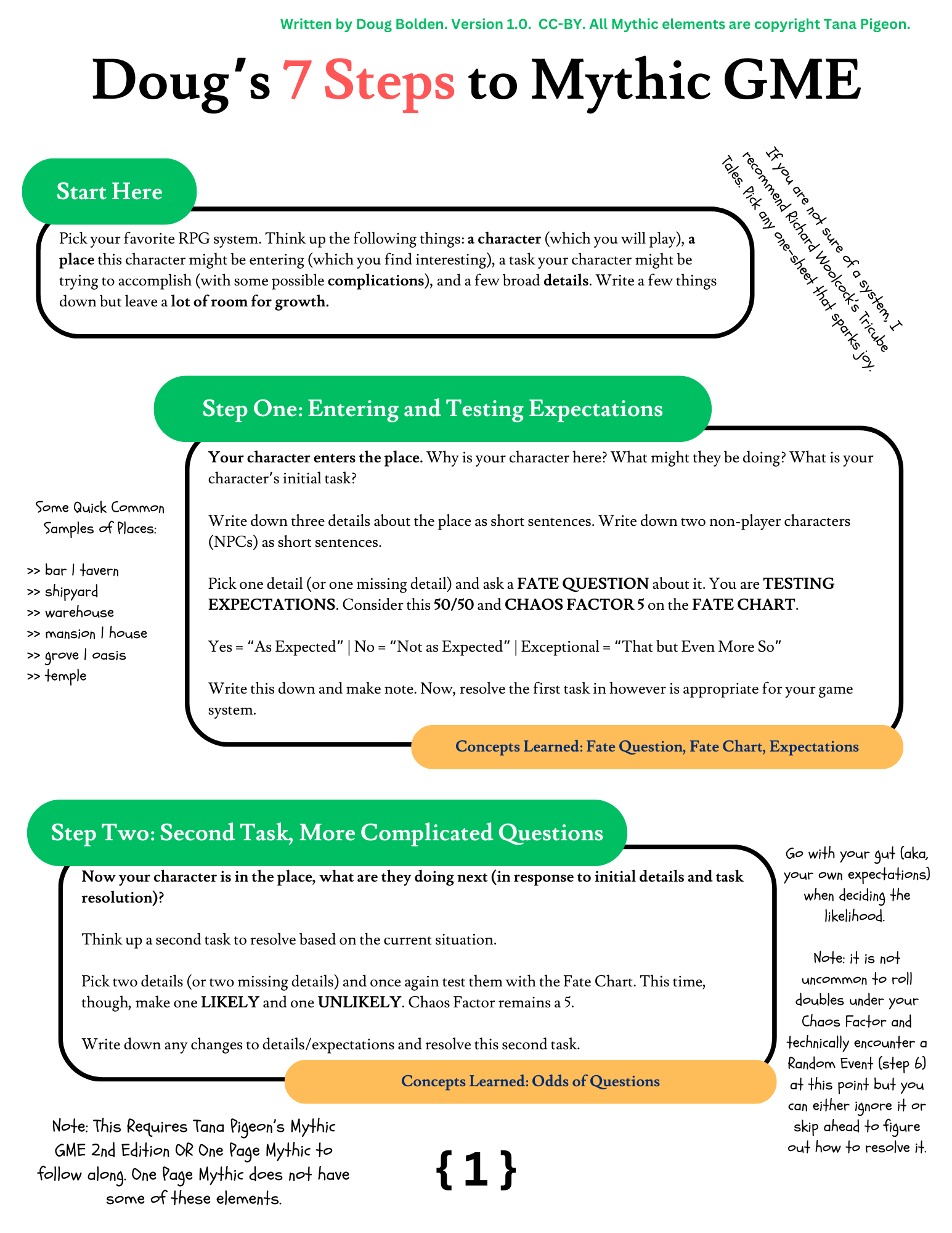
In my previous post, I shared a possible first/quick session to learn about the basic core concepts of Mythic Gamemaster Emulator 2nd Edition. However, by the nature of the beast, that ends up being a lot of words and might not be the easiest document for people who like things more at a glance. 

Thinking about that, I’ve created a companion document (thanks, Canva) that generalizes it more, uses fewer words, and formats things so the key words pop out harder:

It takes the same seven steps with essentially the same advice but there are fewer words for each. I am releasing it CC-BY but really most of the core content is taken from Tana Pigeon’s original advice and flow (I did alter the order in which certain concepts show up). 

A Rough Gameplay Loop

As part of that document, I included a page at the end that you can get in the PDF but it is meant to show how I use Mythic in a gameplay loop to generate my scenes and content. Eventually I’ll write up a bit about some my ups and downs with Mythic but that will likely be a couple parts down the road.

Solo Advice: Getting Started with Mythic, Part 1 – Someone Walks into a Bar

After posting this, I ended up making a shorter, more visual version of this post and shared it as a pdf at: The Seven Steps in a More Visual Format + Gameplay Loop. You might want to glance there afterward or even first and then come back to this one.

The Problem of (Solo Play) Freedom

I see regular posts with people asking some variation of the question: “I have Mythic, now what?” By extension, the question can be read, “How do I roleplay by myself?,” but that’s a broader a trickier topic. 

A slight glitch towards answering the second question is that there is not one answer. If you ever read the strange web-comic of some years back, A Softer World, post 391 asked the question “What can you do with a drunken sailor?” and then answered with, “Man, what can’t you do with a drunken sailor?” 

And, that, in a nutshell, shows one of the central problems with communicating the core of solo roleplay. You can play roughly whatever you want and how you want it. More so than group roleplay though, where some rules and systems are in place just to emphasize the group nature of it all. For some Forever GM types, where creating a stack of encounters is a Saturday night, it might not be too hard of a transition. For others, realizing they are standing on a great blank page can be intimidating. We are all strange and beautiful artists but getting that first brushstroke of paint down can be daunting.

A tool like Mythic provides a wonderful framework (one that I have used for many hours of my life and had great fun) but if you picked it up to be on par with How to Solo Roleplay 101 then you might get confused just trudging through the table of contents and the opening bits and seeing phrases like “Fate Chart” which is somehow different but similar as “Fate Check,” Then there are words like “Meaning Table” and “Random Event” and “Interrupt Scene” when you are kind of hoping for a “Step 1,” “Step 2,” and so forth type language. 

The idea of this post is to start with a fairly generic example and with each step to add a few Mythic pieces. This is one approach. It might click for you. 

One caveat, though, is that it assumes that you have either Mythic or One Page Mythic (at least) in front of you. If you do not, I will include some free-form variations of things but this is largely intended as some showing off some basic and key concepts that I enjoy in the system. 

I will break down and hopefully gently explain what I consider to be the important elements by a kind of “real world” example of a fairly typical roleplaying session (not just a solo one, but also a solo one). In order, the concepts I will go through are:

  • Fate Chart
  • Setting and testing expectations
  • Adjusting the likelihood of a question
  • Using Meaning Tables
  • Adjusting Chaos Factor
  • Scene Checks (with Altered and Interrupt Scenes)
  • Building Adventure Lists
  • Random Events
  • Wrapping Up a Plot Thread

Step One – Someone Walks into a Bar (aka, Trying out the Fate Chart)

Pick a game. A genre. A character. Any will do. 

Use a character you already made. Use a pre-gen. Make one up with quickstart rules. In whatever game/genre you pick, imagine “a bar.” This is the classic starting spot of many stories:

  • A tavern along the road in a fantasy world
  • A cantina on an alien world
  • A saloon in the Wild West
  • A jazz-era speakeasy in Arkham
  • A fancy club in Victorian England
  • A dockside dive in an 80s city
  • A black-light infused synthetics distillery in a cyberpunk future
  • A tent serving moonshine in a post-apocalyptical camp

Wherever this is, whenever it is, and whichever character you are playing: they are about to walk into a “bar” and they are going to do something. Think up a single task they have to accomplish. For instance:

  • Meet a contact
  • Drop off a package
  • Look for strangers
  • Pick the pocket of some rich patron to get some cash
  • Assassinate a target
  • Hide from the authorities

Using that character, in that world, trying to do that task: think a bit about this scene and what sort of things you (and your character) expect to see, to hear, to witness in general. You do not have to come up with intricate backstory or details, just come up with a few base-line assumptions to get a decent mental sketch. If you like, write it down, map it out, or describe it out loud. Mostly, just have it in mind. 

Setting and Testing Expectations

Tossing aside all the specialized language, the dice rolls, the threads, and lists you can think of Mythic at its core being a system (see also: framework, structure) all about helping you as a solo player to set and test expectations. There are tools to help generate some content in the Mythic books and magazines and such, but largely your first step is to have something you want to do that Mythic can help you to test and track. There are times where Mythic will say your expectations are not quite right, but you start with some ideas and grow from there.

The First Fate Question

Now that you have a character, a location, a goal, and some basic descriptions of what is happening: think up something you are not sure about or one of the details that might be wrong. You are not going to answer this, you are going to let the dice answer this. Examples include:

  • Is there a band (or other live entertainment) playing?
  • Does the bartender (etc) know your character?
  • Has a fight broken out at the bar? 
  • Does the bar have a private location to accomplish the task? 

If you are using the full Mythic book, set the Chaos Factor to 5 and the likelihood to “50/50.” If you are using One Page Mythic just set the likelihood to “50/50.” Ask the question and consult the Fate Chart to see if the answer is yes or no and adjust your expectations accordingly. If you get an exceptional yes then the expectations are not only correct but more than you realized. If you get an exceptional no, the expectations are incorrect and the “reality” is somehow the opposite of the expectation. 

If you are not using Mythic because you want a slight test drive then just roll a die, any die (or flip a coin). Whichever die you are using, getting the highest possible even number = exceptional yes. Getting a 1 = exceptional no. If you are flipping a coin, heads = yes and tails = no and there is no exceptional variant. 

To go with one of the questions, above, “Is there live entertainment?”:

  • Yes = “There is live entertainment and people may or may not be paying an attention”
  • No = “There is not live entertainment (there could be a stage which is empty, though)”
  • Exceptional Yes = “Not only is a band playing, but it is a pretty big deal and most people at the bar are there specifically because of it”
  • Exceptional No = “The bar does not have a set-up for live entertainment and folks would probably not like it if there was”

Now, put all this together. Adjust your expectations and your mental image of the bar. Scratch anything that might have disagreed with the answer (in actual play, you might choose to ignore something that makes no sense but for now roll with the punches, pun intended). Carry out the task in your game system of choice. Roll a skill check. Make an attribute test. Spend a token. Resolve it through pure roleplay. Your call.

Just like any other roleplaying session, imagine your character doing the task and either failing or succeeding. In a traditional game, the GM would tell you how NPCs are reacting. In solo play, you get to do both the PC and NPC side of things so imagine how your character reacts and imagine how it makes others react. Again, you do not need a lot of details for this, just a few quick words or ideas will work fine. 

Note: If you are using the full Mythic Fate Chart do not adjust Chaos Factor, yet, we are still in a single scene.

Whatever the results, keep that in mind [aka, write that down] as we move on to…

Step Two – In Which Things Develop (aka, Adjusting the Fate Chart, Slightly)

How does the world react to whatever your character just did (or failed to do)? More importantly, what does your character need to do right now to keep the story going?

  • If they were meeting a contact (and successfully made introductions), what do they need to do next?
  • If they were pickpocketing (and got caught), how do they handle their mark catching them?
  • If they are hiding for authorities (successfully or not) how do they keep from standing out as time goes on?

This is going to be the second task of the scene but to expand your Mythic skills a bit think up two questions this time to test and make one of them “Likely” and one of them “Unlikely.” You have the freedom to play your character as you want so focus on the non-player characters in the bar. Pick whichever one is most impacted by your task and then either pick another one or pick another detail you are unsure about. Examples might include:

  • Is this person with the Authorities? (Unlikely)
  • Does the bartender have good memories of your character? (Likely)
  • Does the band stop playing due to your actions? (Unlikely)
  • Is there a back exit? (Likely)

Consult the Fate Chart (again, assume Chaos Factor 5 if you are using it) and roll against those new odds. 

If you are again just free-forming this, you can use this quick system: Likely means roll two dice and if either are evens the answer is yes, unlikely means roll two dice and if and only if both are even the answer is yes. 

Again, adjust your mental expectations, write down additional details, tweak the map you are drawing, and then make your second task roll or resolve the action in however you see fit. Then, move on to Step Three when you are ready, where we will finish out this first scene and set up the second one…

Figuring Out the Likely Odds Is More Art than Science

One thing that can be tricky to grasp at first but gets to be second nature is establishing the odds for Fate Questions. When in doubt, you can stick to 50/50 (I love taking something that seems like it should be adjusted one way or the other and making it 50/50 because it sometimes feels like testing the “meat” of the world) but a lot of flavor shows up shifting things from Likely to Very Unlikely. A dozen rolls in, you will better get the hang of how the odds shift and it will get easier. 

Rather than worry about some hypothetical perfect game or worry about getting it wrong, just go with your roleplaying instincts at that time. You will make mistakes during solo play. You will be inconsistent. That is ok. The you that rolls the dice and reads them at that point in time is playing the correct game. Later, adjust expectations and odds but the little imperfections often lead to most interesting roleplaying. 

Step Three – Someone Is Leaving a Bar (aka, using Meaning Tables and Adjusting Chaos Factor)

Your character has had to resolution rolls. Things are happening (some because of your character). You have had some expectations confirmed, some changed. Now it is time for your character to leave the bar. Maybe they are heading outside. Maybe they are going down into the basement to fight some giant rats. Maybe they are being drug out by force. Maybe they are going into the owner’s office. 

To figure out why your character is leaving the bar, you are going to use Meaning Tables. You can either roll to find out the results and then decide to which NPC it applies OR you can pick an NPC and then roll the results. 

For Mythic, find the Action Meaning Tables 1 and 2. Roll once on 1. Roll once or 2. For One Page Mythic, find the Action Table and roll twice and combine. Here are four examples of the former (handpicked for clarity at this stage):

  • 12 on Action Table 1 = Bestow. 8 on Action Table 2 = Benefits. (Bestow Benefits)
  • 70 on Action Table 1 = Protect. 60 on Action Table 2 = Normal. (Protect Normal)
  • 71 on Action Table 1 = Punish. 31 on Action Table 2 = Failure. (Punish Failure)
  • 53 on Action Table 1 = Increase. 90 on Action Table 2 = Tension. (Increase Tension)

Depending on whether you picked an NPC or just rolled, think about how whatever you rolled might fit into the scene as you have built it up with the expectations and details that have been established. Does the answer fit someone (or something) in particular? Is this something out of the blue that might be a twist in your story? 

Make note that if you have been free-forming these examples, it can be hard to wing this portion without something as a base but pick one of the ones above and go with it.

Maybe your character’s bartender friend gets “Punish Failure.” Does that mean your character is about to be punished? Is your character being asked to punish someone? Is your character witnessing the bartender screaming at another NPC and thinking about intervening (or leaving the scene to avoid being a witness)? 

OR, you already have a clear reason to leave the bar (e.g., fleeing the police that just burst in to arrest you), this Meaning Table result could show some other detail, how someone else is altering your character’s world. 

The nature of Meaning Tables is that whatever results you get are open to a lot of interpretation and the same words can often mean wholly different things in difference situations and there is rarely one right way to solve them.

Whatever you get, roll with it (again, pun intended) as best you can and ask yourself what this means for your character and how it relates to you needing your character out of the bar. A third resolution task might be required. New expectations and details might be created.

Sometimes Meaning Tables Feel Perfect and Sometimes They Feel Like Nonsense

Having played a lot of Mythic based games, I can say from experience that sometimes a result from the Meaning Tables will hit the perfect sweet spot. Sometimes, though, you are left with figuring out what your character’s grandmother is doing and you get “Repair Success” and have to stop and think what that might possibly mean. I have witnessed some actual play folks rerolling results when they do not fit in but my hearty recommendation is to try and fit them into the expectations you have established. “Punish Failure” might mean a literal punishment for a failure, but it could also mean someone is being harsh on themselves, or that the punishment did not work, or failure is a form of punishment. Again, the little imperfections often tease out the better moments in solo roleplay. 

Finishing Up a Scene, Adjusting Chaos Factor, and Setting Up New Expectations

We are coming to an end of your first scene and getting ready to do the second one. One of the first things you need to ask yourself is, “Did the scene work out for my character?” 

If the scene did work out for your character, adjust the Chaos Factor down to 4. 

If the scene did not work out for your character, adjust the Chaos Factor up to 6. 

If you are unsure or if the scene felt pretty neutral, just go on whichever down/up vibe works the best for you at the moment. 

Lower Chaos Factors mean the odds more heavily favor “no” answers while Scene Checks are more “As Expected” while higher Chaos Factors more heavily favor “yes” answers while Scene Checks are increasingly likely to have Altered and Interrupt scenes. 

Your Chaos Factor should change a lot as you play to show swings in fate. 

If you are using One Page Mythic or just free-forming this, you will not be able to do this step (and the remaining steps will not make a lot of sense, so you can just continue to play more scenes using the above first three steps). 

Once you have adjusted your Chaos Factor, move on to Step Four…

Step Four – Someplace New (aka, Scene Checks)

You are going to now play a new scene with your character in this new place. Essentially, you are going to play out Steps One through Three again (except more combined, though feel free to separate them out if you need). This means you are again going to establish some expectations, you are going to test some of those expectations with Fate Questions, and you are going to using Meaning Tables to help figure out NPC actions. 

One important change is going to happen at this time: you are going to do a Scene Check.

Before you do anything else outside of establish some rough expectations and a place for the scene, roll 1d10. If you roll below or equal the current Chaos Factor (either 4 or 6 depending on how well it went last time) then you will either get an Altered Scene or an Interrupt Scene. 

If you roll below or equal to your Chaos Factor and the result is odd, the scene is Altered. An altered scene is essentially the same as the expected scene but some details are different (a little or a lot). Maybe your character runs out into the street to flag down a taxi and bumps into an old acquaintance. Maybe your character goes down into the basement to kill the giant rat but the basement is flooded. Again, the scene sort of matches your expectations but something happens that you did not expect.

If you roll below or equal to your Chaos Factor and the result is even, the scene is Interrupted. An interrupted scene means your expected scene is not happening (or delayed) and a new scene is currently taking its place. Your character runs out into the street to hail a taxi and finds a gunfight happening (or is shoved into a van). Your character goes to go down into a basement but finds a hidden door that less open and something significant inside and goes to figure that out instead. Maybe your character goes to go down into the basement but remembers some prior commitment and has to leave right away. 

An Altered scene means your expectations need to be tweaked. An Interrupt scene means your expectations are not happening (again, at least not yet). 

When in doubt, use Fate Questions and Meaning Tables to generate some details that might help you decide (there is also tables in the Mythic book to give you some prompts but for this primer example just go with your instincts). 

If your Scene Check is above your Chaos Factor, then the scene fits your current expectations. 

Play out this new scene, be it Expected, Altered, or Interrupted. Try out the Description, Location, Characters, and Object meaning tables to help generate some details. Try some Nearly Certain and Nearly Impossible (etc) Fate Checks. 

At the end, again decide if the Chaos Factor increases or decreases based on how things are going for your character and set-up expectation for a third scene. We are going to start adding a new element that is important to Mythic: lists. 

Step Five – The Plot Literally Thickens (aka, Adventure Lists)

As you play your third (and maybe fourth) scenes by recycling Steps One through Four, make note of the important characters and the important plot lines developing. Find the Mythic Adventure Lists (page 45 of the Mythic book and you can see them in the appendix). Pick a few characters besides your main character and jot them down one line at a time. Pick a few plot threads and jot them down. In this sample game, you do not need a lot. 

In general, how many you have is up to you and your sessions. I have seen some that work best with lots of characters and seen some that work best with just a core few. Likewise with the plot threads. You can always add more and you can cut those out that are not working or no longer feel important.

It is likely that specific details will change and threads might shift (growing or shrinking) as your character accomplishes things. 

Maybe you treat an entire organization as a single character. Maybe you write down individual members. Like a lot of things with Mythic, there is a lot of going with your vibe (and expectations) and being open to those changing over time. 

There Are Lots of Ways to Use These Lists

When you are playing full sessions with Mythic there are times where you are prompted to roll on the lists. 

Outside of this, there are several ways you can  use the lists to make your sessions better or to help inspire your scenes and story beats:

  • You find out someone is betraying you, roll on the characters to find who has a dark secret
  • You get an Interrupt Scene and check on the Plot Threads to figure out which one it will be about
  • You just want to add in a couple of characters to a scene
  • You find a clue but are not sure to which plotline it is related
  • You just keep the lists handy as a reminder to yourself the important elements as you make up new expectations and new details

Once again you can reroll results that make no sense but for now trying to just take what comes can be great practice. 

Step Six – Things Go Pear Shaped (aka, Random Events)

At this stage you are on your fourth or fifth (or more) scenes and that initial encounter in the bar has likely changed into something either perfectly expected or completely different or a mix of both. The Chaos Factor has probably swung back and forth a couple of times. Lists are getting some details added. The world is taking shape. 

The final element we will work in is Random Events. As you are doing your various Fate Checks, you will sometimes get a roll that is doubles (11, 22, 33, 44, …) and which is equal to or below your current Chaos Factor, you generate a Random Event. 

Random Events can change the current scene and the entire campaign a little or a lot and should be thought at as alterations and twists to your own expectations and details.

On page 37 of Mythic there is an entire Random Event Focus table that you can use if you wish to have the full experience but for the first few times you can simply just treat them as a twist to your current question until you get into the habit of spotting them. 

  • “Are the doors locked?” could lead to a twist that there are guards posted that were not known about
  • “Is he going to pay my character?” might lead to the entire plotline about finding out who is betraying the mission was all a lie to sow discord in the ranks
  • “Is she going to sell off her family heirloom?” might lead to another NPC stepping in to help

You can blend in Meaning Tables, roll on Character/Threads lists, or just go with your sense of what is interesting. 

Once you get the sense, add in the Random Event Focus which can prompt such things as “NPC Negative” (the twist causes something to be bad for one of the NPCs), “PC Positive” (the event is better for your character than expected), and “Ambiguous Event” (the twist does not seem to have an immediate impact on things but could hint towards something else brewing behind the scenes). 

You can treat Interrupt Scenes as Random Events and use the same tools to add details.

If you do not have any Random Events showing up in your scene, just add one or two in so you can get some practice for now. 

Step Seven: Someone Heads Back Home (aka, Getting the Hang of It All and Closing Your First Thread)

You now should have a few scenes, some characters, some plotlines, and a few twists. Pick one of the threads/plotlines and play out a final scene to wrap it up (or alter it into a new plotline). Figure out what expectations must be met to do this in one more scene and then set it up. Check the scene as normal. Treat Interrupt Scenes as a sign that something unexpected is needed to clear it up. 

Think up between one and three tasks to finish the scene and play those out. If you get stuck, use Meaning Tables or check on your Adventure Lists. Otherwise, just go with what you got. You should have a good sense of what is expected and have some ideas for the kind of things that might show up as twists so you are ready to respond. 

At the end of the scene, your character heads back home. Or back to the office. Or to the morgue. Or maybe even heads back to the bar. 

Look over at all the details on the lists you have and for each one ask if that detail is sticking around. Are the characters going to still be important? Are the the plot threads still open? If yes, keep them around if you want to keep playing. If not, then erase them and clean up the list to only have the things important going forward. 

At this point, you have the grasp of the Fate Chart, Chaos Factor, Likelihoods, Random Events, Adventure Lists, Meaning Tables, and Scene Checks. That is many of the major concepts. 

Still, the most important concept of the whole Mythic experience remains your expectations and ways to test and alter them.  

As you read through the book you can see a lot more examples, a lot more optional mechanics, and so forth but you can also play for hours and hours and many sessions with just these concepts. You can also ignore any parts that do not work for you. 

As this series continues, I will look at things like blending Mythic in with other solo experiences, adding in other oracles, and so forth. 

Happy playing.

The Four Solo Play Techniques of This Blog

tl;dr version

Over the months of adapting my playstyle to the blog, some of the “Dougness” of my playing got increasingly lost. This post talks about trying to reclaim that and establishes the four baseline techniques I use to communicate my sessions to folks through this blog:
  1. Play it in my normal style and then write up a recap (the original flavor)
  2. Try to play it in-line with each session being an hour-ish spent playing and writing a blog at the same time
  3. A fiction-first style of play where the mechanics are minimized and the focus is more on presentation and development of “chapters”
  4. A style of play that embraces different modes (Gamemaster, Player, Lore, Commentary) to give the different elements each a fair shake to build up mental gaps
In this post, I will look at those different elements and talk a bit why a return to #1 while retaining #4 (and some #3) is likely the best options for me. 
It also has a longish example of the kind of roleplaying mistakes I like to make: building an entire session around lore and worldbuilding that never actually got used. 

The Four Solo Play Techniques of This Blog

My usual playstyle for solo RPGs, at least before I started this blog earlier this year, tends to be a bit haphazard fitting my mood, location, time-available and some other elements. I tend to lean a bit more digital-notes rather than physical because my handwriting is crap and I toss so much text into the game-space that my hands start cramping but past that it can lean anywhere from “a stream of notes in a text document” to a bundle of (digital) character sheets, digital maps, Mythic tools, VLC Player set to stream something ambient, a stack of PDFs, a handful of physical books, and a set of physical dice. 
One of my quirks is that no matter how much digital everything else gets, I tend to prefer physical dice unless it is just too inconvenient. It’s a question of blame, you see. You can blame digital dice but you cannot properly build up a sense of resentment unless you have something physical at which to point and glare. 
This is not exactly a post about my overall playstyle, though, but instead about something closely related. As I started posting just a portion and ended up posting the vast majority of solo play content to this blog, I realized that haphazard notes and shorthand scribbles would not make anyone, not even myself, happy. I began to develop a few different write-up styles which in turn deeply impacted my own playstyle. 
Prep is play and play is prep, after all. 
I thought it could be a good time to sit down and quantify the four different styles that developed around this blog (with links to some examples). This gives me something to point towards when I am trying to explain some different flavors. 

Technique One: External Play with Recap and Notes

The original style used for this blog. Just play however I want to play with posts largely being just summations of that with some commentary and possibly links to actual supporting documents and notes.
The style here is to play as I normally play – digital files, pdfs, books, dice, notes – and then to type up a summary of what happened usually with some link (or embed) of maps and notes.
You can see it most in the earliest posts on the blogs initially. The first Bloody Hands episode – A Fragile Merger – has a link to an external document. The original Bleak + Pearl episodes – such as the Scarlet Minotaur playthroughs – had only a map with a few quick notes and then a lot longer recap trying to sum up some of the significant rolls and events. 
After a couple of weeks posting like this, I kept thinking about how to actually turn the blog as a whole into a more interesting long term project and that led me to phasing that style out because I, like a lot of folks new to something, felt the need to copy other people and their advice and there were a handful of people saying that fewer mechanics and more fictionalized story was the way. Which is a shame because a lot of my talent in the solo-sphere is the way I dance around with rules and rulings and concepts and flow and ebb to let things develop a bit organically (a paragraph might be several encounters or a lot of details alternatively). 
Eventually, I realized abandoning it entirely was a mistake that was trapping me into spending more time working on a blog than just playing and I brought it back for some campaigns. The Bloody Hands returned to this format with “The Late Returners” and by part 2 of that mini-arc, the idea occurred to me to go ahead and start posting the actual in-Doug-style type notes while prefacing it with a short recap. I really like that style. It gives me the freedom to both play in the vibe I tend to play and to have some mental space and time to go back and analyze, right up, and organize it. It maximizes my own particular solo play in both ways, without requiring a lot of external write-up. 
However, in the arc between starting this way and then returning to a modified version of it, three other styles started being used and all three deeply altered my own workflow for solo roleplaying. 

Technique Two: Blog-First Playing with Actual Play In-Line with the Blog

Trying to make posts that felt more like the standard style of such things, I started moving towards “in-line” play. I would fire up the blog editor and start typing. When I got to mechanics, I would put it in italics or have a footnote. As I wrapped up the post, I wrapped up the session (and vice versa)
This style involves typing into the blog directly as I play with mechanics set-aside but generally in-line with the rest of the post and the blog itself being the primary storage device of the session. The idea was to not slow down or hesitate but play as I wrote and write as I played. Mechanical notes start showing up at the bottom of the post (and sometimes in set-aside italics/bold-passages).
The earliest examples would be my playthrough/playtest of Sinister Semester X and then the fifth episode of The Bloody Hands (Biting the Hand that Feeds You). Both of these are definitely more in the older school of my posts and are written in a kind of quasi-summary style. A few patches of dialogue got worked in, some after-post edits showed up to blend early passages with later passages. 
Around the first delve in the Monolith of the Cyclops in Bleak + Pearl, you start to seeing this style mature a bit more. Mechanics are more blended into dialogue and room descriptions. At the peak of posts (roughly one a day), this was the style the blog was based around. 
However, it had two rough problems that are largely just a clash with own playstyle. The first, and primary one, was that mechanics tended to have been wrote up in a way that did not completely derail the flow of the fiction. My personal playstyle will sometimes involve writing up whole charts, maps, and details. 
Any but the simplest of these things simply did not fit (see the bonus story at the end of this post to see exactly the kind of thing that would not fit in with the “in-line technique”). 
Each post was a session and each session was a post and I generally wanted each to be whole unit: one played in a smooth, complete sort of flow. It put me in a mindspace where I was having to constantly bounce back and forth from a fiction writer to a gamemaster (with a much smaller sprinkle of player and a much larger sprinkle of editor). This meant that posts started getting shorter since it was more mentally exhausting. It was not easy to keep a thread going and as soon as some sort of twist or heavy scene shift occurred I would often have to take a break so I could contemplate and build up a few expectations before starting again. 
Things like scenes and threads starting getting muted because it was hard to tell exactly where one might end and another begin. I sometimes had to go back and rewrite earlier, even posted, sections because later developments would make these half-developed sections non-sensical. 
The breaking point of that playstyle was the Bleak + Pearl fight with the garfolk and the meeting of the strange mushroom man. 
Because of this, I developed another style to handle more OSR/event-heavy content. But first, the happy accident of me trying to Doug-up the in-line playstyle. 

Technique Three: The Fiction-First Game

Around the time I was taking a three week break from SoloDark to try and figure out how to move from Technique 1 to Technique 2, I embarked on what was meant to be a fancy one-shot: Gareth Hendrix and the Bunker Bigfoot. While it remains something of a successful failure that got better, that series worked out a new style for me. It is a modified take on the second technique – in-line blog-first play – but it put fiction first. 
For this style, game mechanics are minimal. Each scene tends to have only one or two rules and one or two oracles checks. Each chapter has between one and four scenes. The focus is on a more literary take with game mechanics being used to add plot twists, find out secrets, develop characters, and challenge me to take stories to places I did not expect. 
Gareth and his barely novella length adventure was a major reason this entire blog kept going. During the time period I was getting deeply frustrated about finding my voice there was a series that was entirely my own voice. It involved personal photographs and personal stories woven into the narrative and was set in (though fictionalized) my home town.
I love that I did that. It was a risk I would not have taken without this blog. 
That being said, there is a non-zero chance that the Eustace Delmont series might be the final time I try it for a while (I have long had an idea for a third part but I do not know). It can be frustrating. The Gareth storyline was kind of quick and punchy but trying to mature it into the Eustace one meant it takes a lot of time and a lot more external note taking. 
There is also the slight glitch that it is the solo roleplaying equivalent of a walking sim. 90% of the flow is decided with my own brain as the primary oracle. There were major twists that I did not expect but in between these islands of dice rolls were great seas of short story workshop. Maybe I just need to keep working on it. 
Going to the other end of the spectrum in the meantime… 

Technique Four: The Gamemaster + Player Style

In essentially the same week, I was wrapping the last of the original Bloody Hands arcs (Sink or Swim part 3) and concluding the garfolk obstacle in Bleak + Pearl (Drying off just to Get Wet Again). Both in the then standard “Technique 2” style. I had struggled through both (the “Doug’s Notes” for each talks about frustrations and switching things up while trying to put a positive spin on it). The honeymoon era of the blog was fading and I was slowly but surely getting stuck with a completely alien way to play solo games where a month long gap was suddenly noticeable. 
Would I keep going? Would I just go back to my Google Docs and quick notes? I was not sure. However, I was becoming aware of two definitely truths: 
(1) I realized that I worked best when I gave myself space to cook. I had to play with the ingredients, tweak the tastes. I would never be consistent with the ebb of flow of my playing. Sometimes I just wanted a fight with no real backstory and sometimes I wanted a backstory with no real fight. Sometimes I would spend hours crafting a town to never really visit it and sometimes I would spend around 10 seconds to make a town that would be the backbone of a campaign. I needed something that allowed for me to be me. 
(2) I am not actually that good at what might be the kind of “standard” roleplaying set of tropes. I GM a lot of games and do a decent job. I play in some games and do a decent jobs. But when it is just me, the kind of old-standards just do not quite jive with the kind of stories I like to tell. I suck at being a being a murder hobo. I play at long and complex subplots. I like my dungeons to feel uniform and purposeful. I like my NPCs to sometimes have little details like “favorite food”. Months might pass with the same story impact as days. 
I started playing with making a more Doug-like playstyle in the next Bleak + Pearl post (On Waterfalls in the Dark, Painting the Past, and When Fighting Is Best Saved for Another Day). What if I take time to construct the rooms and encounters completely separate from the “play” (though of course such prep is play even if the more in-line version made it hard to spend much time with prep without “spoiling” it) and then took more time to figuring out how the puzzles worked before trying to figure out how I, from a different viewpoint, would solve it. I have a lot of experience with dancing around the meta-game and I was pretty sure I could pull it off. 
This technique involves having two to four distinct phases of the game that each have their own methods. The first is the Gamemaster Phase which involves the construction of rooms, encounters, and scenarios using all the standard tools and a more relaxed flow that speeds up and slows down based on personal need and story requirements. Then there is the Player Phase that matches more the in-line phase but bounces off the stuff established by the Gamemaster with the post being in essentially “real time” with the play and writing flowing together. There are optional Lore Phases that are more like the Fiction-First Games of Technique 3 that are about pure world-building with a minimal amount of mechanics. Finally, there is a Commentary Phase to sum it up, figure what did and did not work, and to set-up expectations and ideas for the next session. 
The breaks in between phases allow for natural mental rests. The Gamemaster and Lore phases give a chance for worldbuilding, zooming out, and changing up the cadence so that not everything has to feel evenly split. The Player Phases then can be varied, quick, and often kind of punchy. Sometimes the Player Phase challenges the Gamemaster Phase’s assumptions. Sometimes elements in the Gamemaster Phase are not used in the Player Phase. 
It works really well for me and is kind of the ultimate expression of my personal style, though is a bit more complicated than I need for all of my campaigns. 

A Real Life Example of Why Technique 4 Is Needed for Solo Players Like Me

To show a variation of this from before I had my blog, let me tell you a story about my Advanced Fighting Fantasy campaign near the end of the Barston Bakersfield arc. 
I wanted a simple quest: a man along the side of the road has lost a valuable relic to some goblin bandits. Bog standard, right? Except I started out playing out what the jar was and who the man was. There was an entire session of backstory involving several moving pieces. He was a con-man who robbed old tombs. He had found the tomb of an ancient king and found, in this tomb, a relic that made anything inside seem valuable. People just had to have it. It was a perfect set-up for him. Toss in some rocks and sell people what they think is a jar full of gold. Later, they think they were robbed and he gets the jar back. 
Along the way to town to set up such a con, he runs into some goblins. These are not bad people, per se, but they are extremely cranky because their home had been overrun by hobgoblins who considered the short, unlucky gobs to be worthy of all the jokes and the pranks. They basically stole what they thought was a worthless jar because they were wanting to be petty. Only the man who stole the jar has angered a fairly powerful guardian who is hunting him. Now, it is hunting the goblins. Said goblins have gone to a grove that was once a place of giants and are staying in essentially a small garden that looks like a massive walled structure, complete with giant bees. 
This was going to be a set-up for a meta-story that had been going on since early in the campaign about people on the hunt for giants in the area. It was going to set-up some lore for the place. It was also going to establish a moral dilemma of the player trying to help thieving but not really bad goblins versus a righteous but murderous guardian. And there was a whole other place of power (the tomb) baked in for backstory. 
After this story session I spent time thinking what the giant garden might mean. Figuring out what might happen with the goblins if any survived. Would they become regular NPCs? Allies? Enemies? Would the conman get caught? Would the guardian be a multi-session arc? 
Only right as I was getting ready to play out the session where Barston meets this man and kicks off the whole thread I spent a couple of hours developing, a random event shows up. Barston’s best friend needs help carrying out a task. It takes a couple of days then another event shows up that gets Barston tangled up with unraveling a conspiracy. This kicks off a big fight between guilds and establishes some important lore. 
I never got to play the scenario with the goblins. I never got to meet the conman. I never got to fight the guardian. I never got to visit the giant garden. 

I spent an entire worldbuilding session building up a lot of truths that never made it “to the table.” Except they did (a side story involves a person who had to deal with the aftermath of the goblins fleeing into town while being hunted by the guardian). It is one of my favorite stories to tell because all of it is canon but all of it happened behind the scenes. 
I love the vibe of consistent inconsistences and organic plot development. I love side stories. I love dumb twists. I ADORE fun NPCs. I love ad hoc mechanics. I love off-the-cuff worldbuilding. I love that I have found different ways to achieve this in the blog format. 
It just means this blog needs to be my style of play rather than my style of play being a blog post. And I think I can do that.

The Bleak and The Pearl [SoloDark] Part 20 – Exploring the Lab


<< GAME MASTER PHASE >>

First, the matter of treasure and XP

10 Cultists, 2 Senior Cultists, 2 Horned Devils, and 2 Viperian Automatons later and we have not really adjusted for any treasure, boons, or such. ShadowDark page 117 suggests “Per treasure find, each group should gain about 10x their average party level in gold.” Neither the devils nor the automatons would have treasure, per se, but the cultist should have something worth looting. The salamanders did not care for any trinkets they could find so left with their three resurrected members (and their two recent dead). The four adventurers though, should gain something. I have been remiss in giving proper monetary reward to anything they do so I am going to be a bit OSR about this and side on the “too much”:

  • The human cultists had a variety of coins. Let’s say 2d6x10 gold and 2d10x10 silver for 80 gold and 100 silver worth of coins. 
  • The one senior cultist had the gem of devil summoning (which broke) but the other had (from the level 4 treasure tables…): Copper flask etched with an owl worth 30gp. 
  • The automatons had no treasure on them personally but do they have parts worth anything? 15 –> Yes, but… it is worth 2d20 gold if the party can find someone wanting to buy it [plot twist, they are just going to give it to free to Cal so I won’t even roll]. 50% chance of other treasure in that room… 64% so yes and the treasure is A Clockwork Dragon Doll (45gp). Is it functional? 8 –> No. So it is basically worthless and is likely only worth around 45sp instead [and will get left behind]. 

That is 3xp each from the treasure (roughly coming out to be 20gp and  25sp each, plus the flask). The gears from the automatons they will give away. The clockwork dragon will get left. However, in boons it is a different story. There were four rough challenges in the Everburning Forest. 

  • The forest itself (all the dragonsilk sidequests and such)
  • The salamanders who are one of the dominate rulers (strong but somewhat constrained in their area)
  • The cultists who are another (weaker, but covering a wider space)
  • Uuld Alloces who is the third (and perhaps most powerful, though commands the least space)

The friendship with the salamanders and Uuld Alloces constitutes a pretty major boon. They will get 4xp from this total. Not only does this give them a combined access to around half the valley but it also involves a being who personally knew Jonias Grunkheart.

This gives each of the adventurers 7xp for the past 3 sessions.

Now, The “Upper Floors”

Ground Floor


Upper Floor


Some Notes/Reminders

Rooms 1-9 were described (at least in brief) in part 18 – Entering the Lab. 10 (and parts of 19) were described in 19 – Fighting the Cultists. The reason the numbering jumps around is because the encounters with the salamanders, and the fight with the cultists, had the rooms entered into a non-standard order. I could have pre-numbered all the rooms but I did not because the nature of solo-play means I had no idea if rooms would even be visited.

A final note (for this section): the ground floor has a bit “blanked out” with a red spray. As said in the credits, a few pieces of the OG map will be excluded in this playthrough just to trim it for time. That was originally a series of secret passages that does not quite fit the flow, here.

For now, we will start with the rooms that are already defined from the above posts and go from there.


>> PLAYER PHASE <<

In the aftermath of the battle, the chat with the efreeti, and the leaving of the salamanders; the constant background noise of crackling wood and bubbling pools is practically silence. The adventurers have spent some time gathering up the bodies of the cultists, stripping them of anything valuable (not a whole lot, but a fair number of coins and one of the older cultists has a flask of some unknown liquor (no one is in a rush to drink it). Afterwards, the bodies were drug to the nearest pool of lava and tossed in while Tom and Rance spent some time hiding the tracks. Just in case any other cultists try to find out what happened to their buddies. All in all, the lab remained quiet in the meantime. [1]

The front door (bashed open at least twice and left generally open to the elements who knows how many times) is a harder repair. “Good enough to shut” will have to do for the time being. [2]

These basic repairs done, the quattro take time to eat, rest up a bit, and generally get their bearings before giving the lab a fuller search. They broadly agree to spread out a bit and search these top three floors since they got to see quite a bit of them before and during the fight. Tom and Grusk will take the vestibule. Rance and Inar will go and search “the theater” and its odd portal. 

While examining the ancient runes and bas reliefs in the pillars, and cleaning some of the ash out of them so that Rance can make a better catalog of them later, Tom comes across a switch on one and activates it, spinning a chunk of an outer layer away and exposing a…thing, inside. Once it might have represented something, but Tom mostly sees it as a misshapen hunk of gold. Which it mostly is. [3]

For now, Grusk and Tom leave the once-statues in place and turn their attention to the door in the east.

In the theater, Inar has found a mostly rusted out clockwork dragon. He plays with it a bit. The rails lead to the base of a “stage” (though the cart is not currently here, though a few odds and ends are scattered on the floor. Quill tips, bits of random guff. Like someone was packing in a hurry. On the stage is Rance who is examining the strange mirror like contraption and it’s slowly swirling, warping image. 

“It’s a portal,” Rance says, grasping the basic idea behind fairly quickly. [4] Of course, any more complicated ideas behind it are going to take a lot more time to study. 

“This is where Grusk would say something like, ‘Gale, want to make 5 gold pieces?’,” Inar jokes and Rance agrees. 

“Yeah, and then would possibly just walk through himself to see what it is only…”

“Yeah?”

“Only…it feels off. I don’t think this was activated by us being here which means it could have been running for 300 years. Like some strange beast sleeping.”

“How do we wake it up?”

“I do not know. There are various notches and stones in the frame itself, and there are those…pipes? The ones attached to the…um, gears? In the wall?” Rance makes a broad gesture pointing out the really obvious but completely undecipherable mechanisms along the walls. “Those. I guess.” [5]

From across the vestibule, they hear Grusk shout and Tom cry out in pain, and take off running. 


<< GAME MASTER PHASE >>

This section of two rooms was not initially mapped out. A lot of the ground floor is dedicated to prep of bringing and treating fuelstone. However, rooms #11 and #12 are a bit outside of that path. For #12 the SoloDark prompt pair was 20 Push 22 Obstacle + 04 Prevent 60 Trick. 

#12 will be an old meeting room, a place where some of the retainers up above who handled some basic work [what few there were] might mingle with the [again, few] who worked downstairs in the lab proper. Jonias did not work alone but he also was fairly solitary in this endeavor. As he became more focused on his final goal, this was kind of a place for him to talk and convince folks to stick with him. Did they stick with him? 2 –> No. Eventually, folks stopped trust him. The tricks being prevented and obstacles being pushed were their own complaints to him. By the end, it was just him, Uuld, and the automatons. 

To finish this out, #11 will be servant’s quarters and a food prep area. #12 also served as a makeshift dining area when there people to eat. 

The room numbers are already weird so let’s keep it going!

#12 The Meeting Room

In the era of Jonias building this lab and planning for it to be something of a meeting place for likeminded folks to gather and discuss the war against The Bleak, this room was something of a heart to the place. A place for people to meet and discuss the inner workings of the lab and its findings, but also a place for people from all tiers of the project to meet and eat and gather. 

A large stone table in an l-shape dominates the center of the room and smaller stone tables are in the southeast corner of the room. What chairs and other furniture were here have mostly given way in the hot, dry air. 

Two of the gaps in the north wall and a gap in the south wall has plinths with statues representing various Grunkheart personalities. These statues are actually automatons. At the time, Jonias meant them to be symbolic of the Grunkeart family serving the people. Now, they are in a similar mode as others in the base: guarding territory. Without the deactivation amulets (downstairs), they have a 2:6 chance of activating each round and attacking once either door to the meeting room is open. 

These serving automatons will be based off stone golems but reduced to LVL 5 as an encounter. 

++ Glitching Serving Automatons (3)

AC 16, HP 30, ATK 2 slam +4 (1d8), MV 1/2 near, S +3, D -2, C +4, I -3, W 01, Ch -4, AL N, LV 5

Each has a gemstone worth 30gp (each a different color sapphire: red, blue, green) to represent the Grunkheart family heart. 

#11 The Kitchen and Servant’s Quarters

This area is largely decayed. Cracks in the outer wall have exposed the bunkbeds and simple furniture to lots of damage. Nothing of value remains in the rubble. The kitchen utensils have largely rusted and wasted away, with the water tanks going empty. What food left behind has rotted and dried to dust in the centuries since this place was last used.


>> PLAYER PHASE <<

Grusk pushes open the door and pushes his torch in first while Tom crouches down with his bow drawn. Lucifer’s Breath has already been activated today so its glow has dulled to barely visible and his stash of arrows is running low (less than a full quiver remaining) but there have been at least a few surprises for the group in this lab. In the distance, the pair can hear Rance and Inar discussing…something. 

The room before them is largely dominated by a large stone table. The wall has remains of paintings, tapestries, and other notices but time has not been good to the decorations. Only a few scraps remain and it would require a lot of imagination to see the paintings for what they were: more of Jonias’s vision. 

Entering into the room, dry and cracking wood scatters as the two adventurer’s feet sweep along the floor. There is no hint of the smells of food or the presence of good cheer. This is now simply a room saved from some degree of decay by being sealed.  

Tom looks to a pair of statues on the north wall while Grusk makes his way to the south version of the same. Tom points to the gems in the chests of the statues and lets out a light cough with a clear intention. Grusk shrugs and then shines his torch light under the table. Not seeing any opponents and a mostly empty room, the half-orc is already starting to move on the next room. 

“Wait, wait, I can get this…” the goblin starts, realizing he is about to be the dark but also starting to get the red sapphire loose, when he realizes the blue-gemmed statue has turned to “look” at him and by sound, the green-gemmed one south is doing the same. Tom leaps back onto the table and shouts Grusk’s name. 

All three statues are approaching the goblin on the table, moving slowly but deliberately. 

Grusk, holding the torch in his off hand, rushes in and brings Bloodlust down on the shoulder on the blue-gemmed statue but feels the blade bounce off roughly. These things are way tougher than he realized. In turn, the blue-gemmed statue turns and starts swinging wildly at the half-orc but is clearly still stiff and needing repairs to be at full functionality. 

“GET IN HERE!” Grusk shouts as he tries to work out how to get Tom down from the table and to safety. Behind the blue-gemmed statue, the other are pounding heavy fists into the stone of the table, sending up chunks and debris as cracks start to form on its surface. [6]

Blue punches Grusk in the gut but the half-orc shrugs it off and returns the favor. The blood red axe blade actually bites into the fuelstone body even if the damage is mostly minimal. Unfortunately for Tom, the red-gemmed statue manages to grab hold of one of his legs and tosses the goblin bodily into the wall, dropping him. The green golem gets to Tom before he can get back up and smashes the goblin head into the same wall, which takes Tom out. [7]

Inar runs into the room and sees Tom collapsed near the door. He casts Cure Wounds on the goblin and watches some of the wounds heal and hears some cracked bones knit back together. He then grabs Tom under the armpits and starts pulling the goblin back towards the door. Rance, caught off guard, summons forth an acid arrow while nearly whiffing it but has it cast into the back of one of the two on their way towards Grusk. It sinks in, but barely so. That statue turns around slowly starts approaching. 

Across the room, Blue is taking wide swipes at Grusk but the half-orc is keeping up. “I need LIGHT!” [8]

Green catches up to Inar right as the halfing is pulling his friend to the door but one swing misses entirely and the other glances off the armor and actually helps Inar to launch out into the wider space. Rance, keeping up his mental connection with the arrow, also flings out a magic missile into the golem’s torso. These two are much heartier hits but the stone automaton does not slow down (well, it does, because its natural state of being is pretty much “slowed down”). 

Across the room, Grusk is warding off another attack when his arm is struck by Blue. He sees that Red is close by and begins backing out of the room so only one can fight him at a time. He embeds his axe in the golem’s face and looks around for a place to the torch down safely. Noting a small shelf near the door, he shoves it there so he can pull his shield up. [9]

Tom comes up firing and lands an arrow in the body of the strange green-gemmed machine. Rance stumbles the acid arrow but does toss a magic missile and Inar slams the Crimson Star into the back of the thing. It is showing heavy cracks from all the damage. The damaged, “enraged” machine swings its torso around striking Rance and knocking the wizard back into the floor. The sound of a rib snapping can be heard. The other hand strikes Inar’s armor but the halfling holds firm. 

On the other side, Grusk has almost hacked into the body of the Blue-gemmed statue and rendered non-functional, taking a punch to the face himself. The Red-gemmed statue is punching the wall, trying to collapse the door frame. [10]

Inar continues to bring his magical mace down on the green-gemmed statue with Tom landing an arrow directly through it’s eyes. The statue stops moving and, after a few seconds, falls over. Rance gets back to his feet, breathing hard. 

Grusk keeps chopping away at Blue and likewise, that automaton ceases to function. The half-orc takes a step back, knowing that Red is still moving. It is not long before the sound of punching uptakes as the red-gemmed one starts punching through the still body of its companion. [11]

Tom runs into the room and sees the red-gemmed statue trying to punch the body of the blue-gemmed one out of the way. Tom shoots an arrow that misses (17 arrows remaining). Inar heals Rance as the seer runs up beside Tom and casts acid arrow. It hits the automaton in the back. After another pointless punch into Blue, Red turns around and starts lurching across the room towards the other three. [12]

Tom and Rance, reading the room, start running around the table to try and lure the automaton while they use long range fire. Tom lands another shot and Rance is able to keep up the magic barrage. Inar pulls shield and sets up position in the doorway. Despite their quick footed actions, though, the red-gemmed horror, eyes focusing on Rance, twitches for a second and then fully leaps over the table, landing between Rance and Tom. Rance bounces back, avoiding a hit, as Red starts chasing him around. 

Outside of the room, Grusk is aware of the change of plans and so leans back and kicks Blue down and out of the door and runs in himself. [13]

Red catches the fleeing wizard with one hand and punches him in the back as Rance cries out. This drops Rance’s concentration as Rance speaks the words of the Misty Step spell and phases out of the automaton’s reach. Tom keeps up the arrow shots while Inar rushes in to flow it down and smashes against its legs. Grusk leaps up on the table to and catch it by surprise and brings down his axe on the statue’s head. [14]

Grusk misses as the statue turns around to face him, again, giving Inar the chance to smash the legs once more. They break off and the whole statue falls over into pieces. 

Catching their breath, the halfling manages to keep his focus in place long enough to heal both the human and the half-orc. The group debates for a minute whether to continue or to rest and once Rance points out that the seeing the fire-elemental, meeting the salamanders, fighting the one set of automatons, fighting the cultists, and then fighting these things was all in one day, they agree to rest. [15]

Night in the Everburning Forest is strange. The daylight is largely obscured by smoke while the night is almost entirely skipped by the orange and red glow that suffuses the place. On the ground floor of the lab, the light only comes through in places where cracks in the walls allow it. Rather than put up with the “nightless” aspect, the group decides to pull into the theater and pull the locking doors back shut behind them. The condition is in here is much better than the rest of the ground floor which suggests that nothing has been able to disturb this room for a long time. The night passes without incident. [16]


<< GAME MASTER PHASE >>

A super quick summation of the upstairs rooms. 

#17 is going to be the main suite of “upscale” rooms. Almost entirely unused. 

#14 is a smoking lounge. #15 is the water closet. #16 is the way up to the roof. 

#13 is 24 Block 23 Doubt: a display room of many wonders. There are a few things in the display cases. The only thing of value is a strange hatchling creature encased in a translucent stone (a find found in the mines). An ancient style trap attached to a mechanical blade is here. DC18 to disconnect. The exact value of this treasure would be unknown. 

#18 is a large room sort of like a large ballroom. The lack of other interest in the project meant it was never used so it stands as a strangely liminal space. Dark without windows, sealed enough from dust and smoke that overall it is good condition. 

#19 is the room that houses the special telescope. Again, the practical worth of this is immense but getting it out of the housing would require great effort and it would be…all the inventory slots. Think large Victorian style telescope with a domed roof overhead (though in this case, the roof is a large sturdier and harder to open without the proper mechanism. 

Did just three “room” rolls and besides the fire beetles in #4 there was 2 “empties” and 1 treasure protected by a trap. So the area is fairly empty. 


>> PLAYER PHASE <<

The adventurers spend the next morning crawling over the upper floors of the lab to make sure everything is secure. In a room of unknown purpose, to them, they find a whole nest of fire beetles just crawling around and doing fire beetle things. Even Grusk is feeling a bit less bloodthirsty today and so they seal the door back up, and pile some of the broken pieces of automaton in front of it. 

“Good luck, little buddies,” says Inar. 

They find a room full of some sort of…armor. They cannot tell the purpose of it. And tools. In many ways, the fighting was the easy part. This is a place full of riddles with most of the answers burned away by the constant march of smoke damage and time. 

Upstairs, it is more of the same. Empty rooms. Lost plans. One room is the size of an entire house and is completely empty of all but stone. More bedrooms. Unused (presumably). A room with water pipes so bone dry it is hard to know if there was ever water in the room. 

The only two things of interest found is first the large telescope on the roof which sees through smoke like it is not there (and sees stars despite a murky sun above the smoke layer suggesting it is daytime outside of the valley). 

Secondly, there is a room that was passed through with the salamanders that is full of several display cases, mostly empty. Not all, though. Some have strange relics from the time of Jonias. The final days of the Barthic Empire. Exactly the sort of rubble that the salamander ruffians would not have even noted. One piece, though, is a strange relic of somewhere else. A creature in translucent rock like a carved egg. Tom works out the trap [17] and takes the relic out. Rance is not sure what it might be. Tom adds it to his bundle of holding (along with the three gems from the statue). 

After this, they realize it is time to go down into the underbody of the lab. With the exception of the “temple” (Inar’s choice of words) or “theater” (Rance’s choice), very little up here has any real indication of being the the proper workshop. Meaning things are only going to get more exciting for them as they head downstairs. 

“Time to find what else Jonias has in store for us…”


== DOUG’S NOTES AND COMMENTS ==

Starting this one, I was thinking that the fire beetles were going to be an interesting set piece to play with and then found out that ShadowDark does not have stats for those. I figured I could bring over the Basic Fantasy version with minimal tweaks only that version mentions (on page 68) “They are normally timid but will fight if cornered.” The boys have shown, at least in part because of their worship of Gede, that they do not tend to fight animals unless is to protect themselves. Heck, they often try not fighting even people who attack them unless it goes south. In a session where they had more space to chew up on this, there might have been more description of them trying to empty out the beetles, but the other fight went a bit more punchy than I expected.

I made the automatons to be a kind of quick fight and in that way such things go it involved a lot of strategy and moving pieces. It was fun, no complaints, but I thought there was a non-zero chance the way the rolls were going that Tom might be the first actual death in the game. Inar, who has tended to be comic relief for most the series, got some great rolls in. 

This one does represent a mood-shift that I am on board with. The last few sessions (maybe even last dozen sessions) have been building up Jonias Grunkheart as a noble man of legend. This one represents something like the reality of that. Jonias was a legend but one who was a bit driven and needed people to sign on. The other houses were turning against him (except for the original other four of Grunce). He eventually faded from public eye, his great work on partially done. There is evidence all the way back to the development of the Monolith that he had plans for this even-bigger project that few ever excepted fully. 

Cal, in many ways, stands to be perhaps the better version of Jonias since he is all about building up a team that works together rather than relying on nobility. 

It’s too natural of a place to end this here, before they start downstairs, so I will. 

By the way, the gems were +1 XP and the thing upstairs as +1XP. 

Bonus by the way, this is the first time I am moving away from the OG style of section breaks and just using HTML. With the changes to the color scheme hopefully this works just as well with feed readers as it does with people reading in the blog. 

== MECHANICAL AND STORY NOTES ==

  1. 19+3+1 = 23 INT check meaning it would take DC23 INT to spot the fact that the tracks were covered up. 3 wandering monster checks during this passing of time and all were negative.
  2. 6+3 = 9 DEX check. It won’t be too hard for someone to punch through if they wish but it will at least cut down on the ash and embers wafting in.
  3. 19+3 = 22 to pass the check to find the secret compartments. 12-2 = 10 to fail the DC 15 check to realize these were the original models of the full fuelstone statues in the monolith.
  4. INT check 13+3 = 16 to pass a DC 15. 
  5. Is there some sort of control mechanism in the room to operate the mirror portal? 18 –> Yes. Using Knave 2nd and the “Mechanisms” table on page 17, got 91 Vacuum Pumps 65 Rack + Pinion. That’s enough to get a good “aetherpunk” picture of the place. Is the clockwork dragon somehow related to the working of the entire room? 10 –> Twist. 72 Contain 76 Anger + 28 Expand 75 Dream. So…”yes” but yes in the sense that Jonias’s frustration on getting the technology right was channeled into the construction the dragon to figure out certain Ancient building techniques. We’ll give Inar a INT 15 (at disadvantage) check to see if he notices…and no, he does not. For now, the dragon is getting left behind. 
  6. Took two rounds before they activated. Tom whiffed the first check to get the gem loose but had figured out the latch right as they were activating. PCs got first go with initiative and Tom used it to leap back up on the table to put some space between him. Grusk is not able to equip his shield while holding the torch. He whiffs his attack. The golem whiffs its attack. The two (green and red) going for Tom have a massive table to navigate and they are not the quickest so they are slamming fists down at disadvantage to hit him (and are missing, tearing chunks of the table in the process). The table holds but each time it will have a greater chance of collapsing. 
  7. Golems win init. Blue gets a weak hit in on Grusk. Red, even at disadvantage, gets two hits on Tom leaving him with only 2hp. Is the Green on the opposite side of the table? 8 –> No. Green gets a final hit in on Tom. Tom has 4+3 turns to make his death save. Grusk does get a weakish hit of 6 points of damage against Blue, though. Rance and Inar are in route and will be here next turn. 
  8. PCs win. Grusk gets another hit in for another 7 points of damage. Inar casts Cure Wounds and gets a 17 to cast. Tom is healed up by 11 points and Inar starts dragging the goblin back out of the area. Rance has to spend two luck points but gets Acid Arrow shot into the back of Green for a single point of damage. Red and Green were slowly making their way across to fight Grusk. Red continues to do so, but Green is turning around and will be coming back across. Blue fails to do any damage to Grusk.
  9. Green hits low and fails to do any damage. Inar succeeds in a DC 12 STR check to pull himself and Tom out of the room. Rance maintains concentration on the acid arrow (5 points) and gets a magic missile cast (4 points) for a total of 10 points of damage to green. Red is still moving around the table and will join Blue next round. Grusk backs up to use the door so that only one statue can swing at him at a time. Blue gets another 4 points of damage on Grusk. Grusk, in turn, gets 9 points of damage (21 total). Blue is largely broken. 
  10. PCs go first. Tom hits for 2. Rance fails his concentration check but does get another magic missile off for for 4 (16 points total). Inar burns off the team’s last luck point to get a hit but gets a crit (easy come, easy go). 2d6+2 = 7 points of damage (23 points of total). Green hits Rance for 9hp damage and sends the wizard tumbling. Then, on the back swing once again glances off of Inar’s armor. Grusk gets another 8 points of damage on Blue (29 points of damage, leaving it barely functional). Grusk takes 4 more points of damage and is definitely starting to feel it. Can the Red one hit past the doorway? 7 –> No, but…it’s going to try and punch through the wall itself. 
  11. PCs win init. Inar spends the last luck point (again) and hits in 5 points of while Tom lands another arrow and finishes off the Green-gemmed one. Rance makes a DC 12 Dex check to get back to his feet. Grusk crushes the main mechanism of Blue and then starts backing up, letting Blue’s broken body act as a blockade Red has to navigate and buying him some time to prep. Red fails to punch through Blue 6+3 = 9 does not pass the DC 12 check to move the body. 
  12. PCs win init. Inar heals Rance back up to full. Tom runs into the door frame and fires a shot into Red’s back but misses. Rance casts acid arrow and lands for 2hp. Grusk holds the line and waits. Red continues to punch through the body of Blue and still does not get through. 
  13. PCs win init. Tom and Rance run into the room and keep the large table in between. Inar stands in the door. Red is locked into Rance for now. Tom hits for 3 points of damage. Rance keeps up the arrow and adds a magic missile again (this time for 7 points of damage: 12 points total done). In checking to see if they stay distant, they roll an 18 (for Rance) and an 20 for Tom. They are keeping the table precisely in between themselves and the automaton which is tracking Rance. In a surprising move it leaps over the table (18 – 2 = 16) and comes down in between the two heroes [but does not score high enough to cancel out their maneuvering. Grusk gets WIS 15+1 = 16 to be aware that the tides have changed and now he has to punch through Blue. He kicks the blue automaton aside and will enter the conflict next turn. 
  14. Red wins init. Both attacks hit Rance (7 total damage). Rance drops his concentration and casts Misty Step to phase out of the room back into the vestibule behind Inar. Tom gets the hit for 4 points of damage. Inar gets a swing in for 4 points of damage (20 total, now). Grusk gets a nat 20 leaping up over the table to cut the distance down. Attack will be at advantage and hits. For 6.
  15. PCs win. Grusk misses. Inar hits and shatters the legs of the creature. It topples, broken. Inar passes both of his Cure Wounds tests and heals both Rance and Grusk back up. Chance encounter check was negative. Nothing outside was attracted by the sound of clashing. 
  16. Rolled 3 encounter checks, all negative. 
  17. DEX 19 + 3 = 22, passing the DC 18 difficulty.

== CREDITS == 

This campaign is played primarily using Shadowdark and SoloDark, both by Arcane Library and Kelsey Dionne (et al).

Additional sources include a variety of things for tables, especially Knave 2nd Edition and Maze Rats (both by Ben Milton), Random Realities by Cezar Capacle, Universal NPC Emulator by Zach Best, and various pieces from Worlds without Number and Scarlet Heroes (both by Kevin Crawford).

Opening art at the top of the post is “borrowed art” meant to be invocative rather than precise to illustrating the story. Image tools to generate some of the art is GIMP and Hex Kit (featuring the Lil Hex Pack and Strange BW Hex Pack). 


Photo of statue is by Hans Linde on Pixabay. Modification by me. 
      
The map is from Dyson Logos’s “Temple of the Worm” series. There will be some slight modification on the lower levels because those go on longer than I need (so a few passage-ways edited out in some way or just ignored). As usual, I just sort of take each room as I see it so some of the drawn elements will not necessarily match my description.

The Bleak and The Pearl Part 19 – The Fight with the Cultists and the Meeting with Uuld Alloces [SoloDark]


“…as the day fades, the red light of the forest bathes the word in its red glow. the shouts and calls of the cultists can be heard as they approach…” 

<< GAME MASTER PHASE >>


10. The Roof

On the western side of the laboratory, the roof provides two main functions. There is a telescope here (made of fuelstone and fuelstone laced glass which enables not only the viewing of Light lines but also has the ability to see through smoke and haze). It is a work of careful creation and would be worth 1000s of gp if it could be carefully taken down and preserved.

The other main function is for defense. There is a ledge allow for battle with some protection. Jonias was experimenting with special weapons that could channel the Light but never finished them. His notes are downstairs but it would take some time and skill. 

The Cultists

There are twelve cultists. 10 of them have the following stats:

Cultists, Regular

AC 14 (chainmail + shield), HP 9, ATK 1 longsword +1 (1d8) or 1 spell +2, MV near, S +1, D -1, C +0, I -1, W +2, Ch +0, AL C, LV 2 

Fearless (Immune to morale checks). Deathtouch (WIS Spell, DC 12. 2d4 damage to one creature within close.)

Additional, 5 have longbows (+0, 1d6). 

Cultists, Senior

Two of them are more senior and have improved stats. 

AC 14 (chainmail + shield), HP 16, ATK 2 longsword +3 (1d8) or 1 spell +4, MV near, S +1, D -1, C +0, I -1, W +2, Ch +0, AL C, LV 4 

Fearless (Immune to morale checks). Deathtouch (WIS Spell, DC 12. 2d4 damage to one creature within close.) Bog Boil (WIS DC 12, 5 rounds, Far. Turn Near sized cube of ground into muddy, boiling quicksand. Victim must save DEX vs Spellcasting or be stuck). 

The one senior has a special jewel that can be used to summon a pair of twin horned devils. DC15 to actually control them once summoned, though. 

Horned Devil Twins

AC 16, HP 35, ATK 2 burning trident (near) +7 (2d6) or 1 fire blast (far) +4 (2d8), MV double near (fly), S +5, D +2, C +4, I +2, W +1, Ch +2, AL C, LV 7 

Iron Hide (half damage from non-magical weapons)

They are cocky and think the salamanders are on the run. They will be extremely aggressive, convinced their dark gods will save them [no morale check doesn’t mean no brains, but they will definitely push past normal amounts of damage]

If not stopped, they will returned in 3+1d6 days with reinforcements and magical companions. 

>> PLAYER PHASE <<

Grusk, Tom, Inar, and Rance have joined six of the surviving salamanders in the vestibule. Grusk and Hucleo are rapidly talking strategy. 
Tom has relocked the door “in an obvious way” [1] that will helpfully pull some of the cultist here. Grusk and several salamanders are going to take position around the pillars and frame and try to catch as many by surprise as they can. Tom and Rance will take the roof and fire at them at the same time, backed up by two more salamanders. Inar is going to stay downstairs but hold back slightly for support and walks around casting bless upon the party. [2]
Tom and Rance nod and run up with one of the salamanders to join the one on the rough keeping watch. The cultists have found the laboratory and have being circling it. So far, the watchman has stayed out of sight. [3]
Downstairs… the main body of the cultists, lead by one of the seniors find the door and a low chuckling can be heard as they note the shoddy lock job. It takes them a couple of goes but they smash the door in [the sound of which carrying further than they realize as Uuld Alloces becomes aware that something is going down at the lab]. They enter in the room, which is dim by comparison, and start spreading out. Eight of the cultists are here with four more holding guard by the door and keeping watch. 
“Wait, behind the pillars, that’s…” 
“Ullknla KLet,” shouts the senior cultist as he casts bog boil on the pillar his subordinate is pointing towards. The floor turns into a sticky, tarry mess and the salamander starts sinking down into it. [4]
The other seven cultists in the room whip out their swords and begin taking up spots around the rubbish of the room (avoiding the bubbling floor). Two charge around a pillar and find Hucleo. Both slash him before can respond but one’s robes start catching fire. He turns and jabs that one while Grusk runs up and chops the other one down. One of the younger salamanders desperately starts pulling his friend up and the two are able to get out of the muck (just) as the far starts hardening and the fuelstone rebuilds itself into shape. Other salamanders charge straight into the cultists. Some of the wild jabs are pure misses but soon enough another cultist is dead. The ones outside start pouring into the room. That is, except for one, the other senior, who pulls forth a strange gem and chanting. [5]
The battle continues to go the way of the salamanders and Grusk. Grusk and Hucleo take down the senior cultist as his spell fizzles out. Another cultist is brought down by a salamander and the damage being dealt is entirely one sided. One of the injured cultists still standing starts screaming as flames wrap over his body. 
But then, a loud hiss is heard and the smell of burning flesh erupts in the room. Towering over everyone, even Grusk, two horned devils suddenly unfold into reality as the other senior cultists tries desperately to maintain control…and fails. The binding ruby shatters and the horned devils decide to have a bit of fun with everyone around. [6]
The cultists, seeing this, and hearing their companion shout a warning, start making for the door to get out. About half do before the senior cultist slams the door shut and start wedging rocks inside. The remaining three are trapped in the room between a lot of things that want to kill them. 
The salamanders, seeing a new threat, charge the devils. Hucleo’s axe barely grazes the skin of the first one but the other salamanders trust their leader and join in. The devil’s skin resists most of the damage but the salamanders are fighting for their lives and go all in. The devil, in turn, starts bringing its dark sword to bear on its reptilian assailants. Inar runs to get Rance upstairs (though his halfling legs struggle). [7] 
[Doug’s Note: After this point, there battle gets a lot more complicated to transcribe so the rest of the battle mechanics was rolled up in the mechanical notes (see notes 8-13, so six more rounds) but I will just write the sort of overall flow, here, with a few quick “game master caveats” (not tweaks to the mechanics, just tweaks to order and exact intensity) to try and keep it sensible in story form…]
The cultists, hoping the devils will see them as allies, join in to fight the enraged salamanders but fail to get any hits in. As this charge is happening, one of the devils brings a sword down into the back and slays another of the salamanders. Grusk, Hucleo, and the rest continue to land fights but it is clear the devils are a major threat. Suddenly, though, one of the devils turns on the cultists, enjoying the chance to slaughter easier prey. 
The first devil falls as the salamanders get their revenge. Sulphurous smoke erupts as the otherworldly being “sinks” into the floor. The two remaining cultists are desperately trying to defend against the other and one gets exploded into flame by a fiery blast and then starts making for the door as the salamanders leap after it and hack at it a bit. They wound, but do not kill it, as it smashes through the lab doors and flies up and away, seeking a place where it can summon more of its brethren. One of the younger salamanders kills the last cultist and they looking around and dripping blood and chaos. Upstairs, they can hear shouts…
While this was going on downstairs, upstairs the battle was calmer to start. Rance, Tom, and the other two salamanders were keeping watch on the roof. As soon as the group of cultists started pulling back after losing control of the devils, Rance once more pulled out his wand of web and slung magical webbing into their midst. It was not his strongest casting and some start breaking free but Tom and the salamanders kill most. Only the last remaining senior cultist gets free and makes for the woods. Tom rolls off the roof and lands deftly and gives chase. Inar, out of breath, makes it out and tells Rance about the devil downstairs. Rance is on his way down when the escaping devil flies up and sees what it thinks is easier prey on the roof. It lets out another fireblast, not understanding the salamanders are unaffected, and is a bit surprised to see his powerful attack do nothing. 
Arrows fly up, joined by magic missiles, as the three on the roof fight against this new foe. Right as the devil learns of its mistake, and goes to fly off but another magic missile and lucky shot from one of the iron long bows finish it and like the other, it drains into smoke as it falls to the ground. Grusk, having run much faster than Inar is able, bursts into the roof and finds the battle is done. 
Tom, in the forest, keeps shooting flaming after the now fleeing cultist. The senior cultist is trying to get enough distance that he can summon some sort of backup and lead a second charge, but Tom is pushing himself to catch up. Right as the cultist is leaping over of a small gap Tom leaps higher, bringing down his dagger and killing the man. The goblin then starts the process of dragging the body back to the lab to join the pile of other corpses.
[Doug’s Note: that ends the battle notes, mechanical notes will now appear more inline to their proper place, again.]
Unknown to all, a strange figure that at a glance appears to be an old man with bronze skin and red mustache (dressed in a variety of bright colors) floats up in the haze above and watches (see note 12). After the battle is done this character floats down and lands near the exhausted adventurers and salamanders. The salamanders are immediately terrified upon seeing the figure approach, but still pull their weapons to bear, fearing a fight. Grusk, who has gone back downstairs with Rance, pulls out Bloodlust and prepares to enter another battle. To everyone’s surprise, the “old man” laughs and waves his hand, gesturing for them to put their weapons down. [14]
“I was hasty before, and I apologize. You fight with honor. All of you.” The old man talks with a friendly voice that carries in an odd way so that it can be heard Barthic and reptilian at the same time (with the hint of something older, more threatening slightly beyond hearing). “I was going to ask what you were doing here and I realized, like most of us, you are surviving. You are working as one. Accepting losses but clutching victory through perseverance. I miss those days. It has been long and boring. Long and boring, indeed.”
The salamanders and Grusk put their weapons away and over a few minutes Rance explains the reason they are here and the old man nods. Hucleo apologizes for his group attacking the old man and the stranger smiles. A smile that seems to have teeth far too large for his face. 
“Ah, well…look, let us bend the rules a little. Tell me you would like your friends back so they can apologize as well.” 
Grusk repeats these words and the room shimmers for a moment, the old man briefly replaced by a shape far older and more dangerous, a towering form of red skin and horns and fire that even the devils would have feared, and when the room settles back into the shape, three more salamanders are in the room. These were the three that Uuld struck down a few days ago. [15]
“I will not make up for all mistakes. Just my own. I see you have lost many on your way here. Remember this. Still, you were no threat to me and I should have probably tried making friends, like these fellows serving House Grunkheart. Go back to your people. Those seeking to pull the old devil up will no doubt be riled and your people need warning.” 
Hucleo turns to the four adventurers and thanks them again. Promises to inform the salamander tribe of the four heroes, and leaves before the efreet changes his mind, taking away the bodies of the two most recent dead. They leave behind an iron band and tell Grusk to wear it while passing through salamander territory. 
Once gone, Uuld turns to the heroes and makes a lifting motion against the turban and from seemingly nowhere a brass crown comes off his head. “Years ago, Jonias did me a favor and accepted me as a friend. I have missed him these years. I will not be imprisoned again but I give you this, my relic of imprisonment. If you need it, wear me, and say aloud what it is you need. If I can, and if I choose to, I will find you.”
“Can you help us with the workshop?”
“No. I can only show you were things are, but like Jonias you must explore to find and understand. He kept searching for shortcuts when the long way around is the only answer.”
And with that cryptic answer, the ancient being turns into shades of light and is gone. 

>< LORE PHASE ><

On Uuld Alloces

In the early days after the First Cataclysm, before the Ancient Empire, before the time of the High Techno-Priests, a mid-level magician whose name is lost to everyone (including to Uuld) used a brass crown to imprison a efreet to harness the power of wish magic. This young efreet, Uuld Alloces, was trapped for centuries and passed down along family lines. Elizin Urnlight, before her travels to the Everburning Forest, found this crown in a raid against a group of hedge mages trying to sow chaos in the Ancient Empire. 

She had it upon her, not knowing its full significance, when she founded the first networks to harness Light. First as a botanical experiment, later as a whole new power source. As she built up her laboratory, she left the crown in place: thinking it it a strange battery of old energy. 

Nearly two thousand years later, Jonias Grunkheart found this crown in the utter ruins of Urnlight’s lab. Accidentally summoning forth Uuld, Jonias was asked for his wish. In the moment, Jonias was flustered by the struggle to bring about the Lighthouse. He was working to try and save an empire from collapse and petty house politics were beginning to interfere. Rather than wish for power, or for control, or for the secrets, he wished for Uuld to be free of the crown. “At least one of us be should be free of unworthy entrapments.”

Uuld, confused to be free after so many years trapped in the crown, gave Jonias seven days to reconsider. At that point, the wish could be asked again. In that time, Uuld took on the appearance of a young, rakish man from the southern regions based on a memory of Jonias’s youth spent living it up across the desert. For the week, they worked together (along with several loyal Grunkheart retainers) to rebuild and dig out portions of the lab and to start construction of a new one on top of the ruins. 

On the seventh day, Uuld asked what wish Jonias wanted and Jonias replied, “No more wishes. This has to be done the long way around.” 

For years, Uuld Alloces acted as a friend and advisor to Jonias and the other workers. The first lab was built in between months of in-fighting. Finally, Jonias had the support of just four other houses but the Lighthouse was lit. Preparation was made to start building the network to protect those above, but more fighting took place. The Five Families began to loose control of Grunce. It ended up being months and then years between Jonias’s visits to the forest, but he had started to conceive of a new aspect to the technology. As Jonias spent more and more time reading ancient texts, he became increasingly capable of working miracles. Especially when there was so much energy as what was found in Everburning Forest. 

The Clasping Hand Shrines were made to greatly increase the energy in the valley, undoing some of Urnlight’s work but also making all fuelstone technology work better. 

Jonias, eventually, as an old man had completed and improved lab and opened up a portal inside it. Uuld discussed traveling to protect his friend but Jonias laughed it off and said he was not fool enough to travel inside. However, it was only a few weeks later when Jonias returned to the forest. Uuld, sensing him, traveled to the lab to ask what was going on but found Jonias gone, the portal activated but mostly dormant. On the floor in front of it was that original crown with a note. 

“It is yours. It always was. Take care of my valley.”

Uuld Alloces does not truly age in any time scale that would make sense to most mortals but over time found himself adopting and older and older appearance, adding in elements of Jonias’s own older face into the mixture. He watched the valley, rarely showing off his true form (which had grown large and fierce even by efreeti standards). Until the resurrecting of the three salamanders, he had never used a wish, again. “The long-way around,” was Jonias’s motto and Uuld took it too heart. 

== DOUG’S NOTES ==

This is the kind of fight that I really should have had some index cards and a handful of tokens to track. I am pretty sure I added/subtracted a couple of cultists and salamanders depending on the scene. It all works out, though. Hit the vibe I wanted. 

Strangely “less” lethal than the smaller gnoll fight just because of the nature of the rolls. When it is usually the four heroes taking the hits and Rance keeps getting to be the target, it goes south. Having a stack of allies shows how much I have been slacking on the hiring of retainers but that’s ok. This is the kind of story I like…the heroes finding temporary companions and fighting a losing battle to turn to the tide. A few unlucky hits early on could have pushed the fight in any number of directions (which seemed likely considering Hucleo was less than half health before he could even act). I was going to do my best to try and keep them out of the basement (which is the “older lab”) but was willing to roll with it. Instead, it just turned into a damage race and that’s ok. 
I like the salamanders and I like Uuld Alloces and chances are we will barely see much of either. Hucleo and Uuld will make cameos but like Cal himself will fall back a bit out of the way. 
I had this idea of Uuld Alloces [whose name is a reference to Romancing Saga 3] as a somewhat reformed ifrit for a minute. One who had grown in power considerably over time but was restrained not by some magical relic but by a legendary hero. It’s an old trope, right, that heroes gather heroes and reformed villains around them? This, and the backstory of most of the other four great houses, is me playing at it. Now it’s Cal doing the same. This is essentially Cal’s story but we are seeing it through four heroes who have signed up to help. As for the appearance of Uuld, I just saw him (due in part to the standard ifrit/djinn stereotype) as a kindly old Turkish man but one whose eyes are a little too red, teeth are a little sharp, and his fingers have claws a bit too obvious. The idea that he basically matched the age he last saw Jonias was me being saccharine. 
Next time, will wrap up the exploration of the upper rooms and will start into the old lab. This might be one or two more sessions and depending on how it goes we will finally, after three to four months, get back to the Monolith. All this because I triggered a “boss monster” and didn’t want to just have another undead or simple fight. Along the way, though, we have figured out the location of Jonias’s “realm”, learned more about the Bleak, worked out a decent enough layout for the world (at least near Grunce), and gotten to know the characters a lot better. They even made friends with gargoyles and salamanders (and Uuld). It’s been a good three months, in other words. 

== MECHANICAL NOTES ==

  1. Tom got an 18+3 so DC21 to realize it’s a “trap”. 
  2. Look, Bless is cheap but so it goes. Luck points are full again.
  3. 15 to hide vs 10 to spot.
  4. The cultists got lucky on the spot. Senior cultist got bog boil off with a DC18 to break. Does the fuelstone floor interfere with the spell? 10 –> Twist. 61 Gather 07 Burden. In 3 rounds, the floor will heal itself, unfortunately trapping the victim inside. 
  5. Cultists win initiative (then Grusk, then Salamanders). 5 of the 7 hold back until they see their target. 2 charge (both chose Hucleo’s pillar by chance) and succeed on their attacks for 12 total damage. One takes 6 damage in return from the heat aura but resists. Grusk goes after the one not currently blistering and takes him out in a single blow. One of the salamanders helps the friend sinking in the muck. On advantage, that one is removed (nat 20). The floor is already starting to harden. Hucleo presses against the other one that hit him and gets a stab in for 6 [and killing him]. The remaining three salamanders charge three random cultists. 1 gets 1 point of damage. 2 misses entirely. 3 kills another cultist. There are now 5 cultists in the room and 4 outside (who will join, with a *friend*). 
  6. Grusk/Inar wins initiative. Grusk goes after the senior cultist. Hits for a five points of damage. Inar heals up 7 of the damage that Hucleo took. Hucleo joins Grusk at chopping away at the senior cultist and the spellcaster goes down. 1 does another 4 points of damage to his opponent. 2 manages to kill his opponent. 3 misses his new target. 4 misses. 5 gets 5 points of damage. This leaves 1 senior and 6 “juniors” (A – F for simplicity). A & F go for 1. Both miss. B for 2: Hits for 4. C for 3: misses. D for 4: hits for 3. E for 5: misses. At this point, the other senior cultist summons up the 2 horned demons and immediately (only an 8 vs DC 15) loses control. The horned demons will kill indiscriminately. A collapses from the heat aura. F takes 2 points of damage. C – E all make saves. 
  7. DC 12 for the cultists to get out. Only two do. The senior shuts the door and will try to trap the others inside. Hucleo gets one hit for 1 point of damage (halved). 1 gets 2 points of damage. 2 gets 3. 3 gets 3. 4 gets 1. 5 misses. That’s 10 points out of 35 on devil alpha. The first demon gets in one hit for 2. The second gets in two hits for 7. Grusk complete whiffs (losing a luck point on the way). Inar starts running upstairs to get Rance. 
  8. Devils go first. The one not surrounded by salamanders starts going for the cultists but misses. The one going for the salamanders manages to finally kill a second one. The cultists, completely unsure which side to take, go after the salamanders (all miss). Grusk does 7 points of damage (17 total). Inar is only about half the way there and running the best he can. Hucleo does another point of damage. 2 does 1. 3 misses. 4 does 4. 5 misses. (23 total) Are the cultists outside visible to the folks on the roof? 3 –> No, but they will back up next round. Another cultist catches on fire from the heat and drops. Grusk continues to resist. 
  9. Salamanders go first. Hucleo does 2 (woot). 2 does 3. 4 misses. 5 crits AND fumbles doing 5 points of damage but getting his spear stuck in the devil’s ribcage. Grusk gets another 5 points of damage which “kills” the first devil who erupts in smoke. The remaining devil singes one cultist and slaughters another. Both cultists turn on the devil and get 8 total magic damage against. Inar will be at the roof next turn. Rance slings down a web spell on the cultists backing up, trapping them (DC 14). Tom ignites his bow and takes a shot kills another cultist. The two salamanders shoot down another. 
  10. Salamanders again go first. Hucleo does 4. 2 does 3. 3 misses. 4 does 2. 5 gets a crit to get his spear back (win some, lose some, win some). The devil lets out a fire blast that destroys another cultist and turns to start flapping its wings towards the door. The last remaining cultist leaps upon it casts deadly touch again (for 3 points of damage). Grusk gets 6 damage. Outside, the trapped but attempting to escape cultists are all struck down except the senior who manages to pull free and start going for the woods. Inar actually shows up, winded, shouting about a devil. Rance will start running downstairs.
  11. Devil goes first. Gets a 12+2 flight. Requires DC14 to hit it before it gets out the door in one turn. The cultist is thrown to the floor. Grusk is unable to catch up. Hucleo is unable. 2 gets it for 4 points of damage. 3 and 4 miss but 5 gets in another 4. The devil flies outside. Outside, the others get 6 (out of 16) against the senior cultist before he disappears behind the trees. They then see the devil fly up. Is the devil simply trying to be free? 1 –> No. It wants to summon other devils to help. Rance does catch this and turns around to join in to help. Shouts for Tom to go after the cultist. Tom leaps from the roof and starts running after the cultist (13 on a DC12 check to avoid fall damage). 
  12. Salamanders go next. They dispatch the cultist. Do they hear shouts that one is escaping? 20…so…strangely, very much so yes. Grusk is going to run upstairs to join that battle. The salamanders, including Hucleo, are going to chase after the cultist. Tom gains ground and shoots (at disadvantage), missing. The devil is unaware of salmanader’s immunity to fire and shoots off a fire bolt which does nothing but make the lizard laugh. Rance gets in 3 points of damage with a magic missile. The salamander bows do nothing. Does Uuld Alloces show up at this point in time? 11 –> Yes, but… he is there, waiting to see what happens. 
  13. Devil goes first. It goes to fly off to summon other devils. Rance gets another 4 points of magic missile damage. One of the salamanders gets 3. Ok…let’s add this up. That’s…to quote the old videos…exactly lethal. The devil falls to the earth and fades into smoke. Tom has caught up the cultist and leaps at him for a backstab. With another luck point (one remaining) spent, this does… 12 points of damage, killing him. 
  14. Does Uuld approach? 12 –> Yes. Are the salmanders terrified of the efreet? (Advantage) 19 –> Very yes but they are willing to fight. Grusk gets a 5 on a WIS check and does not sense the danger. However, in a turn of events…Uuld Alloces gets a 12 on a reaction check. He is in the mood to be very friendly. He perhaps senses that the young salamanders aren’t that bad and that the adventurers are here to do good. Seeing them fight tooth and nail to protect the lab from devils and cultists probably helped. 
  15. With a slight social compel, Uuld got Hucleo to used a wish. 

== CREDITS == 

This campaign is played primarily using Shadowdark and SoloDark, both by Arcane Library and Kelsey Dionne (et al).

Additional sources include a variety of things for tables, especially Knave 2nd Edition and Maze Rats (both by Ben Milton), Random Realities by Cezar Capacle, Universal NPC Emulator by Zach Best, and various pieces from Worlds without Number and Scarlet Heroes (both by Kevin Crawford).

Opening art at the top of the post is “borrowed art” meant to be invocative rather than precise to illustrating the story. Image tools to generate some of the art is GIMP and Hex Kit (featuring the Lil Hex Pack and Strange BW Hex Pack). 

Photo is “brown concrete building under blue sky during daytime” by Billy Freeman on Unsplash. Modifications by me. 
      
The map is from Dyson Logos’s “Temple of the Worm” series. There will be some slight modification on the lower levels because those go on longer than I need (so a few passage-ways edited out in some way or just ignored). As usual, I just sort of take each room as I see it so some of the drawn elements will not necessarily match my description.
The pictured used to show a young Uuld Alloces is “Charles Lenox Cumming-Bruce in Turkish Dress” by Andrew Geddes. 

Page 16 of 19

Powered by WordPress & Theme by Anders Norén