

After a semi-recent watch of the semi-recent movie, Freaky Tales, I began to contemplate what such a format might look like in a solo rpg. Then I started working out how I might combine this with Jason Morningstar’s Fiasco. The dream is to create a short solo campaign centered around a cast of related characters [at least thinly] where each POV is largely unique but with some degree of interweaving the plot. Possible for a future experiment on this blog.
Category: Other Posts Page 2 of 3


After months, it is finally return to the world of the Bleak + Pearl. What changes will I make (both in story and gameplay) and what sort of expectations do I have bringing this back into a more traditional “Doug Alone” format?

Solo Advice: Countering Solo Burnout
All roleplaying games tend to have a degree of burnout involved. There are a lot of causes for both gamemasters and players (even if the gm/player-divide is less viable as a tool as many rpg-philosophers claim) but at the core the general issue remains the creating a story together and finding a balance between the real world, the self, and the collective fiction with the added stress of a regular (or semi-regular) meeting time. Some new tools – adventure crafters, virtual tabletops, and a wealth of pre-written adventures with plenty of systems for virtually every style of play – help but it can be hard to be on point week after week especially as things shift and change. We also have a historically high number of people with blogs like this one willing to offer their own advice.
But what about if you are the gamemaster and player at the same time? Where taking a rest, taking a backseat, or any of the usual advice means the game just ceases? It can be tricky in a way that a multiplayer game can involve communication and talking it out.
As a person who has now been doing solo play for a couple of years – and running/playing multiplayer stuff for around four decades – I have experienced various of burnout. Including in my solo stuff. There are ways I’ve come up to help myself. Some of it might help you.
This is with the caveat of it being a) stuff that can work for me and b) stuff that will be a bit contradictory in places because what works for one case might be the opposite of what works elsewhere.
1. Honestly, Embrace the Burnout
Just to start with the simplest and possibly core answer: if something about solo playing is burning you out to where you don’t want to do it then take a step back for the moment. One of the glorious things about solo play is that it reduces a lot of the stresses of multiplayer games. You no longer have the social obligation to show up at regular times or to bend your narrative around a group effort (unless your solo play is shared via blog/video but even then its up to you). If you take a week or two off, it doesn’t detract from your game.
You can use that space to be honest about what is and is not working for you. Is stuff too complicated? Too simple? Too easy? Too hard? Just not feeling it? Having a moment to reflect about what you want from your game might provide all the answers you need to the problem and make the rest of this post a bit redundant.
2. Try Changing Up Your Play on a Temporary Basis
Generally the best thing that works for me is to just try something new in the way I am playing for just a session or two and if it works then I embrace it for longer. The idea here, though, is to not worry about any long term changes but to give yourself the freedom to just try out something. New voices. New tools. New patterns. Don’t have a scheduled time play? Make one. Do have a scheduled time to play? Move it to a different time.
If I am doing a story-heavy game and that’s starting to drag down my ability to play because I have to juggle a lot of story then maybe I have a session or two where I just break out of the story and get into action-heavy stuff. Or vice versa. If I am not enjoying the POV I have picked I might introduce another POV character for a short burst. If I am getting tired building up missions, I might try something more pre-designed. Some times it is pretty theater of mind. Sometimes I like to build pretty definite maps. It keeps it fresh.
A big example of this was getting burned out on juggling 3+ campaigns at the same time and switching it from “campaigns” to “arcs within a campaign” and then playing one arc at a time.
3. Try Trimming Your Table Tools
The next thing tends to work for me is if I find that solo play is starting to stress me out is I try to peel it back to as simple as I can and just focus primarily on (1) myself and (2) the game world as currently understood by me. At the most extreme I just ignore the rule book and just play the dice based on my current understanding of the game so I have virtually zero look-up to distract from the joy of play.
Pulling back a bit from journal creep can help. Shrinking the stack of oracles and tables to just a few. Removing accessories and extras that are not going to come up in a session. Just pick a few enemies per area for combat oriented games. Just pick a few NPCs per area for more social games.
With things like miniatures or maps, break them down to more generic versions. A point crawl maybe. Stuff you can put together more on the fly and change up endlessly.
Time is the most important tool in a solo payers toolkit besides themselves and some of the trimming is just that. Shorter sessions. Breaking sessions down into three or four bursts.
The idea is to get as much efficiency as you can. Remove the having to sort through files or tracking a dozen characters “off screen.” You can always complicate it again later. Remember, the first step is to try out some temporary changes.
4. On the Other Hand: Sometimes More Is Better
Occasionally I hear people complain about the opposite problem. They are keeping a minimal amount of notes, keeping NPC interactions minor, and keeping things going fast. For some people, myself included, there is a point where things get a bit too minimal. In those moments, adding in a bit more can help me to actually feel like there is a point to my playing. Working out more character interactions. Adding in elements and background. Expanding out a bit of the world even if I am only focusing on a core bit.
This can also apply to table tools. If things start to feel a bit same-y it can be a sign that you should work in a new oracle or two, some more random tables, or other elements that bring in some stuff. Not necessarily for all of your games but having a weird mission can help make the normal missions feel a bit more brighter when there’s a chance that the next one could be an odd duckling.
Likewise if you are getting to the point where you feel like you are just telling a story with a pretense at dice, try adding in some twists or a more robust gamemaster emulator like Mythic 2 or a more robust NPC emulator like Universal NPC Emulator to reduce a few elements of control while still playing a game that fits your expectations.
I would generally say start small. Don’t add enough stuff that you immediately have to start ripping it back out.
5. Replenish Your Well of Inspiration
If you get to a point where your game seems to be stalling out and you are having a hard time trying to figure out some interesting hooks or interpreting some meaning, going back to the Well of Inspiration can help a lot. Try watching some other solo play Let’s Plays. Reading some genre fiction. Look through some modules or accessories that might talk about optional rules or some pre-built adventures. Reconnect to the kind of stories that made you want to tell your solo play narrative to begin with.
Things I like to do in this category is look at stock art. Listen to music that has the right sort of vibe. Play a video game. Even just go on and look at some maps that folks have made. Think about things like, “How would I play out that scenario differently?” Then, when I play, I forget all about the scenario and do something else instead. It just helps to rebuild some joy.
In this category can be to try things like short one-shots (very short one-shots), gamebooks, or solo board-gaming just to give you space to play without the entanglements of a main campaign. It is super easy to get attached to a campaign that has been going on for a bit and become convinced you need to complete all three-hundred-and-twenty-seven sessions of it. Taking a step back from that and looking at other systems, settings, and scenarios can help to remind you what you like and don’t like without the overhead.
Just be careful. You don’t want to end up with two campaigns. Maybe make that one-shot very one-shot-ty. Alternately, set it in the same world with different characters where if you do end up getting inspired to explore more, you are just building up additional lore.
6. Prep as Play Can Cure Multiple Ills
It is possible to write advice and my experiences for far longer than anyone would want to read so I will leave it with something that I do all the time as just a way to launch myself into play. Which I have seen other solo payers recommend to avoid burn out. Namely, just prepare stuff for your game. Or for another game. Or for no real game in particular.
What does this look like? Make some characters. Make some scenes. Create some art. Prep a few tables worth of encounters. Sketch a map. Come up with a handout like you might make if you were running this for someone else. Pick a couple of worldbooks (etc) that could be useful and put them close to hand. Double check rules in your core book that are likely to come up. Get the gist?
Do pretty much everything you might do during solo play except the play. Or do the play, too, if you feel inspired. If not, you have some tools to speed up the process the next time you feel like it.
Like I said, I tend to do a version of this at the start of every “chapter” or so in my solo play arcs. Just sit down, come up with possible NPCs, come up with some possible locations, sketch out some layouts, work out some possible twists. Once I get there in play I might change anywhere from a little to a lot of it. That’s not the point. The point is try and fish around in my brain until I find that idea that goes, “Yeah, yeah, pick me!”
And then I do. And if I don’t find anything to pick, I take a rest instead. Rest is important, too.

Solo Advice: Avoiding Journal Creep
A frequent bit of advice asked by people on forums like the r/Solo_Roleplaying subreddit is some variation of “How do you journal?” (in this case, asked by the perfectly human sounding name of u/Typical-Ad-3513 [heh]). The questions vary, but to quote part of Ad’s post:
“I love journaling but over half of the time when I play is journaling which doesn’t necessarily feel like playing. I’ve tried less details but I feel like it takes away half the imagination. Do you guys have any tips to make journalling [sic] more fun or less work?“
Of course, any time a post like this shows up, a lot of the responses take on a flavor of, “Just don’t journal,” or, “Make your journal into just bullet points.” And I will say that these 100% are potentially valid pieces of advice. It’s solo play. Absolutely the only person that you have to make happy is yourself.
It just simply does not work for people like me. I write long winded posts where I spend a lot of time working in character dialogue, scene setting, and trying to figure out logic behind my action sequences. Here is one example that has 25ish tests/checks and, when pasted into a document, is 30ish pages with formatting. That ends up being a dice roll (etc) per page [though several of the pages are just commentary, lore, white space, images, etc]. That’s a lot. Maybe too much but at the time the Eustace & Hitomi series was in desperate need for fairly intense character moments to establish why and who and where and all that. Still, I probably wouldn’t do that much again.
I’ve started to recognize there is a pretty big line between “just a few bullet points” and full on journal creep.
What Is Journal Creep?
I am considering journal creep to be the point where the act of journaling a solo play session starts to feel like work – or just a creative writing exercise – and it takes away from the actual play portions. There is nothing wrong with writing, essentially, a short story that only takes a few rolls or checks. Much like the bullet-points-are-valid argument above, it all comes down to you. You are playing a hobby that has, in theory, an audience of one.
Only there are moments with a lot of us where if we write too little we feel disconnected from our play. I suffer this pretty badly with pen-and-paper rogue-likes like D100 Dungeon where I can 100% speed up the play loop too much and just no longer care about anything happening. On the flip side, though, the opposite can be true. We can get so caught up into the act of journaling that we once again disconnect from our play.
In this way, journal creep is a problem only when you feel obligated to keep up a journal no matter what the rhythm and flow of play requires.
A non-solo-play variation might be if you are prepping an adventure for other players and you spend hours coming up with backstory that might not ever show up, paint miniatures that you do not know if you will use, or generate a bunch of handouts that players may or may not actually enjoy. Much like the solo-play journal, none of these are bad things, but they have a chance to creep into the enjoyment of the game at hand.
It can be a tricky balance.
Some Ways I Have Started to Avoid It
The Eustace & Hitomi arc helped me to realize that I was hitting that point pretty hard. I have tried things in the past while writing up more basic notes and then writing up a recap. I have tried things like having a more reactive journal that has a few basic scenes and then a few built up scenes. Both work. Both are valid. Neither quite hit my own needs at this time. Both I might end up using more in the future if my desires change.
In my response to that post, I laid out a few bullet points where the overall gist is to make your journal more about the scenes and moments that matter to you and to find ways to shortcut some of the ones that are draining your energy. These are things I have been using more and more, whether or not is obvious. I just wanted to share these here because I think they are pretty good for a person like me who wants some journal creep but also a few exit strategies.
- Compress some scenes – especially repetitive ones or the ones that interest me less – into a few lines and descriptors and very simple dialogue.
- Even more so, if I have several of the above scenes in a row, or just don’t have time to play as much, maybe cut a few scene out and resolve them with a 1-2 tests each. Just pick up the next scene I feel is more pivotal to dive in deeper. The classic “A few hours later” type moment for a movie or book. “It’s a good thing we managed to escape those goblins!”
- Cut almost every scene “early” as soon as the focus goal/test is resolved. Presumably my characters have a lots of dialogue and actions “off camera” but I try to mostly look at the bits that really interest me.
- Use this freed-up time to pick a few scenes here or there to really dig in and focus. Establish my world. Establish my characters. Let my imagination flow. Sometimes this hits with scenes/elements I thought I was going to compress because that third wandering goblin suddenly triggers some backstory I want to see.
- In general just being ok that I might get the balance wrong as long as I am having fun.
- Graphical elements sometimes help but these can actually take a lot of time depending on the flow. Things like a few screenshots to sum up combat placements, a couple of pieces of stock art to represent something that characters might be seeing, a quickly drawn map so I can avoid writing out much about the directions/shapes of a room/area.
I’m not the best at my own advice but I have been trying those sort of steps. Turning the journal and my play sessions to fewer scenes of higher impact and interest with other scenes more assumed or summed up. Allowing me to focus on 5-6 scenes per post/session with the idea that there are at least 3-4 more “off camera”. A good example of my growth in this regard could be the Traversing Wyrmfathom session from The Bloody Hands. Each “scene” had 1-3 rooms. Each room had a central conflict or character moment. I worked it out, focused on things that moved the campaign forward, and then went through another door. Once they leave Wyrmfathom, they skip ahead a day or two and focus on the aftermath rather playing 3+ scenes talking about arranging a funeral and a marriage.
The Possible Downsides
Does this make it feel artificial? Not really. It certainly can. When you are a table with other players, there is a lot of downtime. You have roleplaying scenes and GM narration and moments where you fiddle with the map. Each player takes up a portion of the total time with a fairly heavy percentage being low- to no-impact on a particular player or their character.
When you play a solo-RPG you are suddenly “on” 100% of the time. You are the thief keeping watch in the tree (and the things the thief sees), the fighter looking over the map (and the person creating the map in real time), and the wizard cooking dinner (and possibly figuring out how to make it an interesting challenge). You are the goblins sneaking up in the bushes. You are the weather. The dirt. The RNG chance of the world and the upcoming enemy fort into which the characters are planning to infiltrate.
There is a reason why traditional RPGs can take up 4-6 hours per session – at least did much of my youth though lately the move is maybe towards 2-3 hour sessions – and it feels like a lot of solo games max out at around the two hour mark with not all the two hours being used to actually play. This is guesswork on my part, but let’s assume I am roughly correct based on the people I’ve talked to, watched, and interacted with online.
So while using more variable compression of the scenes to make the journal a bit more impactful is artificial, it actually kind of emulates the way that you might be waiting 15+ minutes for your character to show back up at the table itself.
A Few Other Mentioned Alternatives That Might Work For You
Read the above linked thread for more advice but there were two things that I liked even if they would not really work for me:
- Try better journaling software to take some of the mechanical aspects away, and
- Try writing a journal in a different format – either as a script or as an old school journal.
For the former, this blog is pretty hand crafted to be the kind of journal I like – warts and all – and as for the latter my tests with other formats just don’t quite work. Maybe in the future, though.
In my previous post, I shared a possible first/quick session to learn about the basic core concepts of Mythic Gamemaster Emulator 2nd Edition. However, by the nature of the beast, that ends up being a lot of words and might not be the easiest document for people who like things more at a glance.
Thinking about that, I’ve created a companion document (thanks, Canva) that generalizes it more, uses fewer words, and formats things so the key words pop out harder:
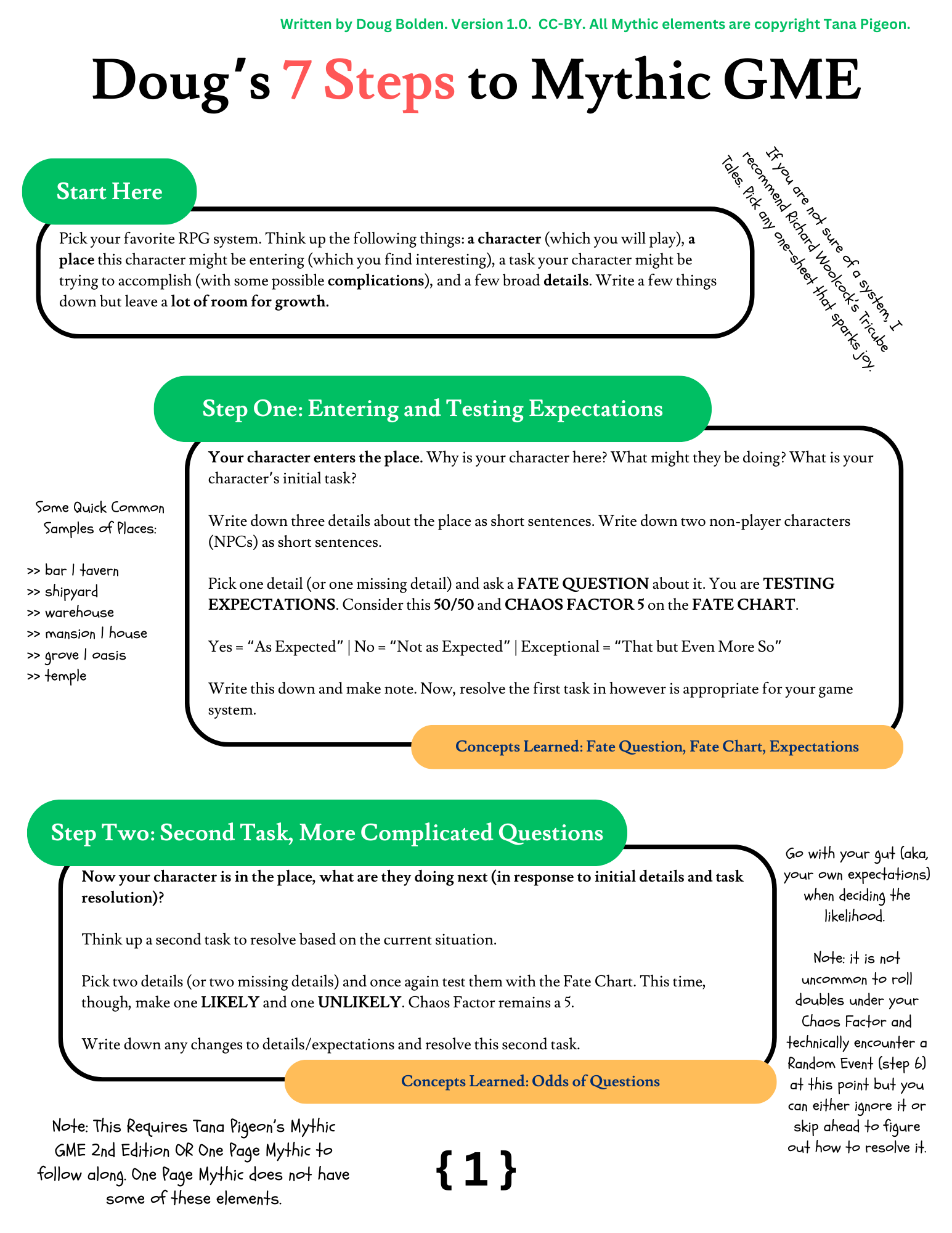
It takes the same seven steps with essentially the same advice but there are fewer words for each. I am releasing it CC-BY but really most of the core content is taken from Tana Pigeon’s original advice and flow (I did alter the order in which certain concepts show up).
A Rough Gameplay Loop
As part of that document, I included a page at the end that you can get in the PDF but it is meant to show how I use Mythic in a gameplay loop to generate my scenes and content. Eventually I’ll write up a bit about some my ups and downs with Mythic but that will likely be a couple parts down the road.

After posting this, I ended up making a shorter, more visual version of this post and shared it as a pdf at: The Seven Steps in a More Visual Format + Gameplay Loop. You might want to glance there afterward or even first and then come back to this one.
The Problem of (Solo Play) Freedom
I see regular posts with people asking some variation of the question: “I have Mythic, now what?” By extension, the question can be read, “How do I roleplay by myself?,” but that’s a broader a trickier topic.
A slight glitch towards answering the second question is that there is not one answer. If you ever read the strange web-comic of some years back, A Softer World, post 391 asked the question “What can you do with a drunken sailor?” and then answered with, “Man, what can’t you do with a drunken sailor?”

And, that, in a nutshell, shows one of the central problems with communicating the core of solo roleplay. You can play roughly whatever you want and how you want it. More so than group roleplay though, where some rules and systems are in place just to emphasize the group nature of it all. For some Forever GM types, where creating a stack of encounters is a Saturday night, it might not be too hard of a transition. For others, realizing they are standing on a great blank page can be intimidating. We are all strange and beautiful artists but getting that first brushstroke of paint down can be daunting.
A tool like Mythic provides a wonderful framework (one that I have used for many hours of my life and had great fun) but if you picked it up to be on par with How to Solo Roleplay 101 then you might get confused just trudging through the table of contents and the opening bits and seeing phrases like “Fate Chart” which is somehow different but similar as “Fate Check,” Then there are words like “Meaning Table” and “Random Event” and “Interrupt Scene” when you are kind of hoping for a “Step 1,” “Step 2,” and so forth type language.

The idea of this post is to start with a fairly generic example and with each step to add a few Mythic pieces. This is one approach. It might click for you.
One caveat, though, is that it assumes that you have either Mythic or One Page Mythic (at least) in front of you. If you do not, I will include some free-form variations of things but this is largely intended as some showing off some basic and key concepts that I enjoy in the system.
I will break down and hopefully gently explain what I consider to be the important elements by a kind of “real world” example of a fairly typical roleplaying session (not just a solo one, but also a solo one). In order, the concepts I will go through are:
- Fate Chart
- Setting and testing expectations
- Adjusting the likelihood of a question
- Using Meaning Tables
- Adjusting Chaos Factor
- Scene Checks (with Altered and Interrupt Scenes)
- Building Adventure Lists
- Random Events
- Wrapping Up a Plot Thread
Step One – Someone Walks into a Bar (aka, Trying out the Fate Chart)
Pick a game. A genre. A character. Any will do.
Use a character you already made. Use a pre-gen. Make one up with quickstart rules. In whatever game/genre you pick, imagine “a bar.” This is the classic starting spot of many stories:
- A tavern along the road in a fantasy world
- A cantina on an alien world
- A saloon in the Wild West
- A jazz-era speakeasy in Arkham
- A fancy club in Victorian England
- A dockside dive in an 80s city
- A black-light infused synthetics distillery in a cyberpunk future
- A tent serving moonshine in a post-apocalyptical camp
Wherever this is, whenever it is, and whichever character you are playing: they are about to walk into a “bar” and they are going to do something. Think up a single task they have to accomplish. For instance:
- Meet a contact
- Drop off a package
- Look for strangers
- Pick the pocket of some rich patron to get some cash
- Assassinate a target
- Hide from the authorities
Using that character, in that world, trying to do that task: think a bit about this scene and what sort of things you (and your character) expect to see, to hear, to witness in general. You do not have to come up with intricate backstory or details, just come up with a few base-line assumptions to get a decent mental sketch. If you like, write it down, map it out, or describe it out loud. Mostly, just have it in mind.
Setting and Testing Expectations
Tossing aside all the specialized language, the dice rolls, the threads, and lists you can think of Mythic at its core being a system (see also: framework, structure) all about helping you as a solo player to set and test expectations. There are tools to help generate some content in the Mythic books and magazines and such, but largely your first step is to have something you want to do that Mythic can help you to test and track. There are times where Mythic will say your expectations are not quite right, but you start with some ideas and grow from there.
The First Fate Question
Now that you have a character, a location, a goal, and some basic descriptions of what is happening: think up something you are not sure about or one of the details that might be wrong. You are not going to answer this, you are going to let the dice answer this. Examples include:
- Is there a band (or other live entertainment) playing?
- Does the bartender (etc) know your character?
- Has a fight broken out at the bar?
- Does the bar have a private location to accomplish the task?
If you are using the full Mythic book, set the Chaos Factor to 5 and the likelihood to “50/50.” If you are using One Page Mythic just set the likelihood to “50/50.” Ask the question and consult the Fate Chart to see if the answer is yes or no and adjust your expectations accordingly. If you get an exceptional yes then the expectations are not only correct but more than you realized. If you get an exceptional no, the expectations are incorrect and the “reality” is somehow the opposite of the expectation.
If you are not using Mythic because you want a slight test drive then just roll a die, any die (or flip a coin). Whichever die you are using, getting the highest possible even number = exceptional yes. Getting a 1 = exceptional no. If you are flipping a coin, heads = yes and tails = no and there is no exceptional variant.
To go with one of the questions, above, “Is there live entertainment?”:
- Yes = “There is live entertainment and people may or may not be paying an attention”
- No = “There is not live entertainment (there could be a stage which is empty, though)”
- Exceptional Yes = “Not only is a band playing, but it is a pretty big deal and most people at the bar are there specifically because of it”
- Exceptional No = “The bar does not have a set-up for live entertainment and folks would probably not like it if there was”
Now, put all this together. Adjust your expectations and your mental image of the bar. Scratch anything that might have disagreed with the answer (in actual play, you might choose to ignore something that makes no sense but for now roll with the punches, pun intended). Carry out the task in your game system of choice. Roll a skill check. Make an attribute test. Spend a token. Resolve it through pure roleplay. Your call.
Just like any other roleplaying session, imagine your character doing the task and either failing or succeeding. In a traditional game, the GM would tell you how NPCs are reacting. In solo play, you get to do both the PC and NPC side of things so imagine how your character reacts and imagine how it makes others react. Again, you do not need a lot of details for this, just a few quick words or ideas will work fine.
Note: If you are using the full Mythic Fate Chart do not adjust Chaos Factor, yet, we are still in a single scene.
Whatever the results, keep that in mind [aka, write that down] as we move on to…
Step Two – In Which Things Develop (aka, Adjusting the Fate Chart, Slightly)
How does the world react to whatever your character just did (or failed to do)? More importantly, what does your character need to do right now to keep the story going?
- If they were meeting a contact (and successfully made introductions), what do they need to do next?
- If they were pickpocketing (and got caught), how do they handle their mark catching them?
- If they are hiding for authorities (successfully or not) how do they keep from standing out as time goes on?
This is going to be the second task of the scene but to expand your Mythic skills a bit think up two questions this time to test and make one of them “Likely” and one of them “Unlikely.” You have the freedom to play your character as you want so focus on the non-player characters in the bar. Pick whichever one is most impacted by your task and then either pick another one or pick another detail you are unsure about. Examples might include:
- Is this person with the Authorities? (Unlikely)
- Does the bartender have good memories of your character? (Likely)
- Does the band stop playing due to your actions? (Unlikely)
- Is there a back exit? (Likely)
Consult the Fate Chart (again, assume Chaos Factor 5 if you are using it) and roll against those new odds.
If you are again just free-forming this, you can use this quick system: Likely means roll two dice and if either are evens the answer is yes, unlikely means roll two dice and if and only if both are even the answer is yes.
Again, adjust your mental expectations, write down additional details, tweak the map you are drawing, and then make your second task roll or resolve the action in however you see fit. Then, move on to Step Three when you are ready, where we will finish out this first scene and set up the second one…
Figuring Out the Likely Odds Is More Art than Science
One thing that can be tricky to grasp at first but gets to be second nature is establishing the odds for Fate Questions. When in doubt, you can stick to 50/50 (I love taking something that seems like it should be adjusted one way or the other and making it 50/50 because it sometimes feels like testing the “meat” of the world) but a lot of flavor shows up shifting things from Likely to Very Unlikely. A dozen rolls in, you will better get the hang of how the odds shift and it will get easier.
Rather than worry about some hypothetical perfect game or worry about getting it wrong, just go with your roleplaying instincts at that time. You will make mistakes during solo play. You will be inconsistent. That is ok. The you that rolls the dice and reads them at that point in time is playing the correct game. Later, adjust expectations and odds but the little imperfections often lead to most interesting roleplaying.
Step Three – Someone Is Leaving a Bar (aka, using Meaning Tables and Adjusting Chaos Factor)
Your character has had to resolution rolls. Things are happening (some because of your character). You have had some expectations confirmed, some changed. Now it is time for your character to leave the bar. Maybe they are heading outside. Maybe they are going down into the basement to fight some giant rats. Maybe they are being drug out by force. Maybe they are going into the owner’s office.
To figure out why your character is leaving the bar, you are going to use Meaning Tables. You can either roll to find out the results and then decide to which NPC it applies OR you can pick an NPC and then roll the results.
For Mythic, find the Action Meaning Tables 1 and 2. Roll once on 1. Roll once or 2. For One Page Mythic, find the Action Table and roll twice and combine. Here are four examples of the former (handpicked for clarity at this stage):
- 12 on Action Table 1 = Bestow. 8 on Action Table 2 = Benefits. (Bestow Benefits)
- 70 on Action Table 1 = Protect. 60 on Action Table 2 = Normal. (Protect Normal)
- 71 on Action Table 1 = Punish. 31 on Action Table 2 = Failure. (Punish Failure)
- 53 on Action Table 1 = Increase. 90 on Action Table 2 = Tension. (Increase Tension)
Depending on whether you picked an NPC or just rolled, think about how whatever you rolled might fit into the scene as you have built it up with the expectations and details that have been established. Does the answer fit someone (or something) in particular? Is this something out of the blue that might be a twist in your story?
Make note that if you have been free-forming these examples, it can be hard to wing this portion without something as a base but pick one of the ones above and go with it.
Maybe your character’s bartender friend gets “Punish Failure.” Does that mean your character is about to be punished? Is your character being asked to punish someone? Is your character witnessing the bartender screaming at another NPC and thinking about intervening (or leaving the scene to avoid being a witness)?
OR, you already have a clear reason to leave the bar (e.g., fleeing the police that just burst in to arrest you), this Meaning Table result could show some other detail, how someone else is altering your character’s world.
The nature of Meaning Tables is that whatever results you get are open to a lot of interpretation and the same words can often mean wholly different things in difference situations and there is rarely one right way to solve them.
Whatever you get, roll with it (again, pun intended) as best you can and ask yourself what this means for your character and how it relates to you needing your character out of the bar. A third resolution task might be required. New expectations and details might be created.
Sometimes Meaning Tables Feel Perfect and Sometimes They Feel Like Nonsense
Having played a lot of Mythic based games, I can say from experience that sometimes a result from the Meaning Tables will hit the perfect sweet spot. Sometimes, though, you are left with figuring out what your character’s grandmother is doing and you get “Repair Success” and have to stop and think what that might possibly mean. I have witnessed some actual play folks rerolling results when they do not fit in but my hearty recommendation is to try and fit them into the expectations you have established. “Punish Failure” might mean a literal punishment for a failure, but it could also mean someone is being harsh on themselves, or that the punishment did not work, or failure is a form of punishment. Again, the little imperfections often tease out the better moments in solo roleplay.
Finishing Up a Scene, Adjusting Chaos Factor, and Setting Up New Expectations
We are coming to an end of your first scene and getting ready to do the second one. One of the first things you need to ask yourself is, “Did the scene work out for my character?”
If the scene did work out for your character, adjust the Chaos Factor down to 4.
If the scene did not work out for your character, adjust the Chaos Factor up to 6.
If you are unsure or if the scene felt pretty neutral, just go on whichever down/up vibe works the best for you at the moment.
Lower Chaos Factors mean the odds more heavily favor “no” answers while Scene Checks are more “As Expected” while higher Chaos Factors more heavily favor “yes” answers while Scene Checks are increasingly likely to have Altered and Interrupt scenes.
Your Chaos Factor should change a lot as you play to show swings in fate.
If you are using One Page Mythic or just free-forming this, you will not be able to do this step (and the remaining steps will not make a lot of sense, so you can just continue to play more scenes using the above first three steps).
Once you have adjusted your Chaos Factor, move on to Step Four…
Step Four – Someplace New (aka, Scene Checks)
You are going to now play a new scene with your character in this new place. Essentially, you are going to play out Steps One through Three again (except more combined, though feel free to separate them out if you need). This means you are again going to establish some expectations, you are going to test some of those expectations with Fate Questions, and you are going to using Meaning Tables to help figure out NPC actions.
One important change is going to happen at this time: you are going to do a Scene Check.
Before you do anything else outside of establish some rough expectations and a place for the scene, roll 1d10. If you roll below or equal the current Chaos Factor (either 4 or 6 depending on how well it went last time) then you will either get an Altered Scene or an Interrupt Scene.
If you roll below or equal to your Chaos Factor and the result is odd, the scene is Altered. An altered scene is essentially the same as the expected scene but some details are different (a little or a lot). Maybe your character runs out into the street to flag down a taxi and bumps into an old acquaintance. Maybe your character goes down into the basement to kill the giant rat but the basement is flooded. Again, the scene sort of matches your expectations but something happens that you did not expect.
If you roll below or equal to your Chaos Factor and the result is even, the scene is Interrupted. An interrupted scene means your expected scene is not happening (or delayed) and a new scene is currently taking its place. Your character runs out into the street to hail a taxi and finds a gunfight happening (or is shoved into a van). Your character goes to go down into a basement but finds a hidden door that less open and something significant inside and goes to figure that out instead. Maybe your character goes to go down into the basement but remembers some prior commitment and has to leave right away.
An Altered scene means your expectations need to be tweaked. An Interrupt scene means your expectations are not happening (again, at least not yet).
When in doubt, use Fate Questions and Meaning Tables to generate some details that might help you decide (there is also tables in the Mythic book to give you some prompts but for this primer example just go with your instincts).
If your Scene Check is above your Chaos Factor, then the scene fits your current expectations.
Play out this new scene, be it Expected, Altered, or Interrupted. Try out the Description, Location, Characters, and Object meaning tables to help generate some details. Try some Nearly Certain and Nearly Impossible (etc) Fate Checks.
At the end, again decide if the Chaos Factor increases or decreases based on how things are going for your character and set-up expectation for a third scene. We are going to start adding a new element that is important to Mythic: lists.
Step Five – The Plot Literally Thickens (aka, Adventure Lists)
As you play your third (and maybe fourth) scenes by recycling Steps One through Four, make note of the important characters and the important plot lines developing. Find the Mythic Adventure Lists (page 45 of the Mythic book and you can see them in the appendix). Pick a few characters besides your main character and jot them down one line at a time. Pick a few plot threads and jot them down. In this sample game, you do not need a lot.
In general, how many you have is up to you and your sessions. I have seen some that work best with lots of characters and seen some that work best with just a core few. Likewise with the plot threads. You can always add more and you can cut those out that are not working or no longer feel important.
It is likely that specific details will change and threads might shift (growing or shrinking) as your character accomplishes things.
Maybe you treat an entire organization as a single character. Maybe you write down individual members. Like a lot of things with Mythic, there is a lot of going with your vibe (and expectations) and being open to those changing over time.
There Are Lots of Ways to Use These Lists
When you are playing full sessions with Mythic there are times where you are prompted to roll on the lists.
Outside of this, there are several ways you can use the lists to make your sessions better or to help inspire your scenes and story beats:
- You find out someone is betraying you, roll on the characters to find who has a dark secret
- You get an Interrupt Scene and check on the Plot Threads to figure out which one it will be about
- You just want to add in a couple of characters to a scene
- You find a clue but are not sure to which plotline it is related
- You just keep the lists handy as a reminder to yourself the important elements as you make up new expectations and new details
Once again you can reroll results that make no sense but for now trying to just take what comes can be great practice.
Step Six – Things Go Pear Shaped (aka, Random Events)
At this stage you are on your fourth or fifth (or more) scenes and that initial encounter in the bar has likely changed into something either perfectly expected or completely different or a mix of both. The Chaos Factor has probably swung back and forth a couple of times. Lists are getting some details added. The world is taking shape.
The final element we will work in is Random Events. As you are doing your various Fate Checks, you will sometimes get a roll that is doubles (11, 22, 33, 44, …) and which is equal to or below your current Chaos Factor, you generate a Random Event.
Random Events can change the current scene and the entire campaign a little or a lot and should be thought at as alterations and twists to your own expectations and details.
On page 37 of Mythic there is an entire Random Event Focus table that you can use if you wish to have the full experience but for the first few times you can simply just treat them as a twist to your current question until you get into the habit of spotting them.
- “Are the doors locked?” could lead to a twist that there are guards posted that were not known about
- “Is he going to pay my character?” might lead to the entire plotline about finding out who is betraying the mission was all a lie to sow discord in the ranks
- “Is she going to sell off her family heirloom?” might lead to another NPC stepping in to help
You can blend in Meaning Tables, roll on Character/Threads lists, or just go with your sense of what is interesting.
Once you get the sense, add in the Random Event Focus which can prompt such things as “NPC Negative” (the twist causes something to be bad for one of the NPCs), “PC Positive” (the event is better for your character than expected), and “Ambiguous Event” (the twist does not seem to have an immediate impact on things but could hint towards something else brewing behind the scenes).
You can treat Interrupt Scenes as Random Events and use the same tools to add details.
If you do not have any Random Events showing up in your scene, just add one or two in so you can get some practice for now.
Step Seven: Someone Heads Back Home (aka, Getting the Hang of It All and Closing Your First Thread)
You now should have a few scenes, some characters, some plotlines, and a few twists. Pick one of the threads/plotlines and play out a final scene to wrap it up (or alter it into a new plotline). Figure out what expectations must be met to do this in one more scene and then set it up. Check the scene as normal. Treat Interrupt Scenes as a sign that something unexpected is needed to clear it up.
Think up between one and three tasks to finish the scene and play those out. If you get stuck, use Meaning Tables or check on your Adventure Lists. Otherwise, just go with what you got. You should have a good sense of what is expected and have some ideas for the kind of things that might show up as twists so you are ready to respond.
At the end of the scene, your character heads back home. Or back to the office. Or to the morgue. Or maybe even heads back to the bar.
Look over at all the details on the lists you have and for each one ask if that detail is sticking around. Are the characters going to still be important? Are the the plot threads still open? If yes, keep them around if you want to keep playing. If not, then erase them and clean up the list to only have the things important going forward.
At this point, you have the grasp of the Fate Chart, Chaos Factor, Likelihoods, Random Events, Adventure Lists, Meaning Tables, and Scene Checks. That is many of the major concepts.
Still, the most important concept of the whole Mythic experience remains your expectations and ways to test and alter them.
As you read through the book you can see a lot more examples, a lot more optional mechanics, and so forth but you can also play for hours and hours and many sessions with just these concepts. You can also ignore any parts that do not work for you.
As this series continues, I will look at things like blending Mythic in with other solo experiences, adding in other oracles, and so forth.
Happy playing.

tl;dr version
Over the months of adapting my playstyle to the blog, some of the “Dougness” of my playing got increasingly lost. This post talks about trying to reclaim that and establishes the four baseline techniques I use to communicate my sessions to folks through this blog:
- Play it in my normal style and then write up a recap (the original flavor)
- Try to play it in-line with each session being an hour-ish spent playing and writing a blog at the same time
- A fiction-first style of play where the mechanics are minimized and the focus is more on presentation and development of “chapters”
- A style of play that embraces different modes (Gamemaster, Player, Lore, Commentary) to give the different elements each a fair shake to build up mental gaps
In this post, I will look at those different elements and talk a bit why a return to #1 while retaining #4 (and some #3) is likely the best options for me.
It also has a longish example of the kind of roleplaying mistakes I like to make: building an entire session around lore and worldbuilding that never actually got used.
The Four Solo Play Techniques of This Blog
My usual playstyle for solo RPGs, at least before I started this blog earlier this year, tends to be a bit haphazard fitting my mood, location, time-available and some other elements. I tend to lean a bit more digital-notes rather than physical because my handwriting is crap and I toss so much text into the game-space that my hands start cramping but past that it can lean anywhere from “a stream of notes in a text document” to a bundle of (digital) character sheets, digital maps, Mythic tools, VLC Player set to stream something ambient, a stack of PDFs, a handful of physical books, and a set of physical dice.
One of my quirks is that no matter how much digital everything else gets, I tend to prefer physical dice unless it is just too inconvenient. It’s a question of blame, you see. You can blame digital dice but you cannot properly build up a sense of resentment unless you have something physical at which to point and glare.
This is not exactly a post about my overall playstyle, though, but instead about something closely related. As I started posting just a portion and ended up posting the vast majority of solo play content to this blog, I realized that haphazard notes and shorthand scribbles would not make anyone, not even myself, happy. I began to develop a few different write-up styles which in turn deeply impacted my own playstyle.
Prep is play and play is prep, after all.
I thought it could be a good time to sit down and quantify the four different styles that developed around this blog (with links to some examples). This gives me something to point towards when I am trying to explain some different flavors.
Technique One: External Play with Recap and Notes
The original style used for this blog. Just play however I want to play with posts largely being just summations of that with some commentary and possibly links to actual supporting documents and notes.
The style here is to play as I normally play – digital files, pdfs, books, dice, notes – and then to type up a summary of what happened usually with some link (or embed) of maps and notes.
You can see it most in the earliest posts on the blogs initially. The first Bloody Hands episode – A Fragile Merger – has a link to an external document. The original Bleak + Pearl episodes – such as the Scarlet Minotaur playthroughs – had only a map with a few quick notes and then a lot longer recap trying to sum up some of the significant rolls and events.
After a couple of weeks posting like this, I kept thinking about how to actually turn the blog as a whole into a more interesting long term project and that led me to phasing that style out because I, like a lot of folks new to something, felt the need to copy other people and their advice and there were a handful of people saying that fewer mechanics and more fictionalized story was the way. Which is a shame because a lot of my talent in the solo-sphere is the way I dance around with rules and rulings and concepts and flow and ebb to let things develop a bit organically (a paragraph might be several encounters or a lot of details alternatively).
Eventually, I realized abandoning it entirely was a mistake that was trapping me into spending more time working on a blog than just playing and I brought it back for some campaigns. The Bloody Hands returned to this format with “The Late Returners” and by part 2 of that mini-arc, the idea occurred to me to go ahead and start posting the actual in-Doug-style type notes while prefacing it with a short recap. I really like that style. It gives me the freedom to both play in the vibe I tend to play and to have some mental space and time to go back and analyze, right up, and organize it. It maximizes my own particular solo play in both ways, without requiring a lot of external write-up.
However, in the arc between starting this way and then returning to a modified version of it, three other styles started being used and all three deeply altered my own workflow for solo roleplaying.
Technique Two: Blog-First Playing with Actual Play In-Line with the Blog
Trying to make posts that felt more like the standard style of such things, I started moving towards “in-line” play. I would fire up the blog editor and start typing. When I got to mechanics, I would put it in italics or have a footnote. As I wrapped up the post, I wrapped up the session (and vice versa)
This style involves typing into the blog directly as I play with mechanics set-aside but generally in-line with the rest of the post and the blog itself being the primary storage device of the session. The idea was to not slow down or hesitate but play as I wrote and write as I played. Mechanical notes start showing up at the bottom of the post (and sometimes in set-aside italics/bold-passages).
The earliest examples would be my playthrough/playtest of Sinister Semester X and then the fifth episode of The Bloody Hands (Biting the Hand that Feeds You). Both of these are definitely more in the older school of my posts and are written in a kind of quasi-summary style. A few patches of dialogue got worked in, some after-post edits showed up to blend early passages with later passages.
Around the first delve in the Monolith of the Cyclops in Bleak + Pearl, you start to seeing this style mature a bit more. Mechanics are more blended into dialogue and room descriptions. At the peak of posts (roughly one a day), this was the style the blog was based around.
However, it had two rough problems that are largely just a clash with own playstyle. The first, and primary one, was that mechanics tended to have been wrote up in a way that did not completely derail the flow of the fiction. My personal playstyle will sometimes involve writing up whole charts, maps, and details.
Any but the simplest of these things simply did not fit (see the bonus story at the end of this post to see exactly the kind of thing that would not fit in with the “in-line technique”).
Each post was a session and each session was a post and I generally wanted each to be whole unit: one played in a smooth, complete sort of flow. It put me in a mindspace where I was having to constantly bounce back and forth from a fiction writer to a gamemaster (with a much smaller sprinkle of player and a much larger sprinkle of editor). This meant that posts started getting shorter since it was more mentally exhausting. It was not easy to keep a thread going and as soon as some sort of twist or heavy scene shift occurred I would often have to take a break so I could contemplate and build up a few expectations before starting again.
Things like scenes and threads starting getting muted because it was hard to tell exactly where one might end and another begin. I sometimes had to go back and rewrite earlier, even posted, sections because later developments would make these half-developed sections non-sensical.
The breaking point of that playstyle was the Bleak + Pearl fight with the garfolk and the meeting of the strange mushroom man.
Because of this, I developed another style to handle more OSR/event-heavy content. But first, the happy accident of me trying to Doug-up the in-line playstyle.
Technique Three: The Fiction-First Game
Around the time I was taking a three week break from SoloDark to try and figure out how to move from Technique 1 to Technique 2, I embarked on what was meant to be a fancy one-shot: Gareth Hendrix and the Bunker Bigfoot. While it remains something of a successful failure that got better, that series worked out a new style for me. It is a modified take on the second technique – in-line blog-first play – but it put fiction first.
For this style, game mechanics are minimal. Each scene tends to have only one or two rules and one or two oracles checks. Each chapter has between one and four scenes. The focus is on a more literary take with game mechanics being used to add plot twists, find out secrets, develop characters, and challenge me to take stories to places I did not expect.
Gareth and his barely novella length adventure was a major reason this entire blog kept going. During the time period I was getting deeply frustrated about finding my voice there was a series that was entirely my own voice. It involved personal photographs and personal stories woven into the narrative and was set in (though fictionalized) my home town.
I love that I did that. It was a risk I would not have taken without this blog.
That being said, there is a non-zero chance that the Eustace Delmont series might be the final time I try it for a while (I have long had an idea for a third part but I do not know). It can be frustrating. The Gareth storyline was kind of quick and punchy but trying to mature it into the Eustace one meant it takes a lot of time and a lot more external note taking.
There is also the slight glitch that it is the solo roleplaying equivalent of a walking sim. 90% of the flow is decided with my own brain as the primary oracle. There were major twists that I did not expect but in between these islands of dice rolls were great seas of short story workshop. Maybe I just need to keep working on it.
Going to the other end of the spectrum in the meantime…
Technique Four: The Gamemaster + Player Style
In essentially the same week, I was wrapping the last of the original Bloody Hands arcs (Sink or Swim part 3) and concluding the garfolk obstacle in Bleak + Pearl (Drying off just to Get Wet Again). Both in the then standard “Technique 2” style. I had struggled through both (the “Doug’s Notes” for each talks about frustrations and switching things up while trying to put a positive spin on it). The honeymoon era of the blog was fading and I was slowly but surely getting stuck with a completely alien way to play solo games where a month long gap was suddenly noticeable.
Would I keep going? Would I just go back to my Google Docs and quick notes? I was not sure. However, I was becoming aware of two definitely truths:
(1) I realized that I worked best when I gave myself space to cook. I had to play with the ingredients, tweak the tastes. I would never be consistent with the ebb of flow of my playing. Sometimes I just wanted a fight with no real backstory and sometimes I wanted a backstory with no real fight. Sometimes I would spend hours crafting a town to never really visit it and sometimes I would spend around 10 seconds to make a town that would be the backbone of a campaign. I needed something that allowed for me to be me.
(2) I am not actually that good at what might be the kind of “standard” roleplaying set of tropes. I GM a lot of games and do a decent job. I play in some games and do a decent jobs. But when it is just me, the kind of old-standards just do not quite jive with the kind of stories I like to tell. I suck at being a being a murder hobo. I play at long and complex subplots. I like my dungeons to feel uniform and purposeful. I like my NPCs to sometimes have little details like “favorite food”. Months might pass with the same story impact as days.
I started playing with making a more Doug-like playstyle in the next Bleak + Pearl post (On Waterfalls in the Dark, Painting the Past, and When Fighting Is Best Saved for Another Day). What if I take time to construct the rooms and encounters completely separate from the “play” (though of course such prep is play even if the more in-line version made it hard to spend much time with prep without “spoiling” it) and then took more time to figuring out how the puzzles worked before trying to figure out how I, from a different viewpoint, would solve it. I have a lot of experience with dancing around the meta-game and I was pretty sure I could pull it off.
This technique involves having two to four distinct phases of the game that each have their own methods. The first is the Gamemaster Phase which involves the construction of rooms, encounters, and scenarios using all the standard tools and a more relaxed flow that speeds up and slows down based on personal need and story requirements. Then there is the Player Phase that matches more the in-line phase but bounces off the stuff established by the Gamemaster with the post being in essentially “real time” with the play and writing flowing together. There are optional Lore Phases that are more like the Fiction-First Games of Technique 3 that are about pure world-building with a minimal amount of mechanics. Finally, there is a Commentary Phase to sum it up, figure what did and did not work, and to set-up expectations and ideas for the next session.
The breaks in between phases allow for natural mental rests. The Gamemaster and Lore phases give a chance for worldbuilding, zooming out, and changing up the cadence so that not everything has to feel evenly split. The Player Phases then can be varied, quick, and often kind of punchy. Sometimes the Player Phase challenges the Gamemaster Phase’s assumptions. Sometimes elements in the Gamemaster Phase are not used in the Player Phase.
It works really well for me and is kind of the ultimate expression of my personal style, though is a bit more complicated than I need for all of my campaigns.
A Real Life Example of Why Technique 4 Is Needed for Solo Players Like Me
To show a variation of this from before I had my blog, let me tell you a story about my Advanced Fighting Fantasy campaign near the end of the Barston Bakersfield arc.
I wanted a simple quest: a man along the side of the road has lost a valuable relic to some goblin bandits. Bog standard, right? Except I started out playing out what the jar was and who the man was. There was an entire session of backstory involving several moving pieces. He was a con-man who robbed old tombs. He had found the tomb of an ancient king and found, in this tomb, a relic that made anything inside seem valuable. People just had to have it. It was a perfect set-up for him. Toss in some rocks and sell people what they think is a jar full of gold. Later, they think they were robbed and he gets the jar back.
Along the way to town to set up such a con, he runs into some goblins. These are not bad people, per se, but they are extremely cranky because their home had been overrun by hobgoblins who considered the short, unlucky gobs to be worthy of all the jokes and the pranks. They basically stole what they thought was a worthless jar because they were wanting to be petty. Only the man who stole the jar has angered a fairly powerful guardian who is hunting him. Now, it is hunting the goblins. Said goblins have gone to a grove that was once a place of giants and are staying in essentially a small garden that looks like a massive walled structure, complete with giant bees.
This was going to be a set-up for a meta-story that had been going on since early in the campaign about people on the hunt for giants in the area. It was going to set-up some lore for the place. It was also going to establish a moral dilemma of the player trying to help thieving but not really bad goblins versus a righteous but murderous guardian. And there was a whole other place of power (the tomb) baked in for backstory.
After this story session I spent time thinking what the giant garden might mean. Figuring out what might happen with the goblins if any survived. Would they become regular NPCs? Allies? Enemies? Would the conman get caught? Would the guardian be a multi-session arc?
Only right as I was getting ready to play out the session where Barston meets this man and kicks off the whole thread I spent a couple of hours developing, a random event shows up. Barston’s best friend needs help carrying out a task. It takes a couple of days then another event shows up that gets Barston tangled up with unraveling a conspiracy. This kicks off a big fight between guilds and establishes some important lore.
I never got to play the scenario with the goblins. I never got to meet the conman. I never got to fight the guardian. I never got to visit the giant garden.
I spent an entire worldbuilding session building up a lot of truths that never made it “to the table.” Except they did (a side story involves a person who had to deal with the aftermath of the goblins fleeing into town while being hunted by the guardian). It is one of my favorite stories to tell because all of it is canon but all of it happened behind the scenes.
I love the vibe of consistent inconsistences and organic plot development. I love side stories. I love dumb twists. I ADORE fun NPCs. I love ad hoc mechanics. I love off-the-cuff worldbuilding. I love that I have found different ways to achieve this in the blog format.
It just means this blog needs to be my style of play rather than my style of play being a blog post. And I think I can do that.
Roleplaying games are a fascinating artifact that I hope survives for a long time. There are a lot of things that you can say about RPGs but I think the two I want to focus on right now are a pair of contradictory statements:
- Roleplaying games cut through the near infinite amount of abstraction presented by “real world” considerations by providing a framework that simulates a particular subset (usually combat and a few other adventurer subsystems).
- Roleplaying games are an abstraction of “real world” considerations and not necessarily meant to represent any sort of 1-for-1 aspects and instead provide an escapist avenue beyond specificity.
In other words, an RPG often takes an in-Universe reality and dissolves it to fluff text and a few abstract dice rolls and stats and then feeds this back into the in-Universe reality with the broad idea that anything outside this abstraction is in itself an abstraction.
I am personally writing this like a college essay, by the way, because I am not sure if there is a better way to explain it. Maybe we can go with this. This IS not a cat:

That is a set of just a few quick shapes thrown together in Google Draw in under five minutes that represents the kind of “landmarks” we might associate with a cat face: ears, whiskers, nose, mouth. It will not win any awards but at its core I think if I made that into an icon people might go “oh, that’s a cat icon”. It boils down the immense number of elements that go into an actual cat face (thousands of strands of fur, vast differences in eye color, whisker length, variations in bone and flesh structure, and so forth) into an abstraction that is in no way a cat face but which, in RPG terms, could be seen a rough “these elements” approach to describe a cat face in the way that STR, DEX, CON and so forth is a ludicrous way to describe a person but it also makes perfect sense in the context of RPGs.

This kind of thought is what I have been giving over to how I might want to run hexcrawls. There are a lot of different flavors of abstraction but roughly speaking you see something like to represent, say, a mountain range ending at a forest with an old ruin on one side and then a small hamlet on the other side.

It makes sense and in-Universe it can represent several sessions of fun. By several conventions, those hexes represent 5-mile or 6-mile constructions and each has one or so distinguishing features. There are arguments why this “6 mile” hex makes sense and in gameplay it is a good way to guarantee a certain story/plot-density. You can travel 2-3 hexes per day and so you get a few chunks of story per in-game day but you also get to travel some 100+ mile range to help things feel nice and epic.
The problem is, that’s as nonsense as my cat face above. Give or take a few half miles, this is roughly a six mile real world hex of Monte Sano State Park nearish my house in Huntsville, AL as snipped (kind of hastily, from Google Maps.

In that 6 miles there is an entire state park. There are dozens of roads. Hundreds to thousands of houses. The park has dozens and dozens of miles of trails. There are shops and churches and schools. While this is, of course, a bit of a silly comparison because this is modern density it still shows that if you were take a dozen different parties and send them through that hex you have no reasonable reason to believe that any of them would ever crisscross. You can have entire towns and civilizations, there. Multiple dungeons could survive in that ecosystem. BUT, in that old school hex crawl, that would represent a single hex with a little mountain on it. And there are hex systems that consider 10- or 12-mile hexes to be the default.
Without triple checking math, the area inside such a hexagon should be roughly 30 square miles. For another modern comparison, that is more landmass than Manhattan. Or, to stick to something a bit more Outdoors Survival, you could roughly consider Yellowstone National Park to be something like 10 to 12ish hexes by 9 to 10ish hexes. While I don’t disagree that someone could hike across the park in 3 or 4 days (good weather permitting) it still fails to capture the true size of such a place. The sheer amount of things even a relatively wild place might contain.
On the other hand, if you are mostly driving a story forward by key points then does it really matter that you are boiling it down roughly to six “hexagonal” directions around 6-mile segments and focusing only on one landmark per hex? Going back to the bullet list above, you basically get this compression
- A reasonable amount of distance to travel VS
- A reasonable amount of story to tell.
Most other considerations about hex size are non-sense in the way that a dungeon as presented by a classic RPG scenario is beautiful nonsense. There are a surprising lack of real world examples of 20’x30′ trapped rooms with 20-floors down to make way for a lich. We can gleefully understand the hex-crawl as simply a way of saying “This is the size of the page I want to use to write my story.”
What I am trying to work out is something that might emulate elements of a hex-crawl but also give the sort of flavor that a dungeon might when generated for solo play. As in, you have a certain density of movement but rather than it suddenly decompressing from 10′ squares to 6 mile hexes it instead treats it roughly the same way as you might by gathering up certain “rooms” of varying sizes and shapes and they are connected by corridors and there are traps and hazards and occupants.
Something like how Advanced Fighting Fantasy (and many others) use with a dice drop method… (taken from page 135 of AFF 2nd Edition):

The idea would be the start there with a twist of rolling more dice and removing 1s (1 = a null space where no paths or nor significant objects exist).
- 2 = dead end
- 3 = a point along a path
- 4 = a fork where a path diverges/converges
- 5 = a crossroads of 3-4 paths
- 6 = an area off any path but which itself has significance.
I could shape that in a particular way by arranging things or the space to match my goal. A sheet of paper with an area drawn on it. Et cetera.
Then, for each path I roll a second d6 to determine path difficulty with something like 1-3 = no difficulty while 4-5 is some and 6 is notable.
Combine this with other methods to map out terrain shifts and significant points in more of a traditional hex map style system and end up with 2-3 “maps” that can be overlaid to create a story rich area that is variable as needed (long distances the relative scale shifts) and has the idea of being zoomed in and out (any given point can be looked at closer or the whole generated map can be part of a large map).

I’m the kind of person that usually (at least in my solo play sessions) likes to fling things out there and try to figure out what it means on the way down and this blog is sort of like an extension of that. It started as a place to post my “The Bloody Hands” Tricube Tales solo game while behind the scenes I was mostly focused on a couple of other campaigns, and then at least one of those campaigns, the SoloDark “The Bleak + The Pearl” has been added. It gave me the freedom of space to try out things (which lead to the completely new approach of gameplay that the Gareth Hendrix storyline let me try).
Still, each time I post I wonder not only “how can I change up how I’m playing” but “how can I change up how I’m writing about what I am playing”.
On How the Changing Style of Writing Is Impacting My Own Playing
I think is pretty obvious how the blog’s initial designation as a place where I wrote, for lack of a better word, pretty broad recaps about my sessions changed a good bit as I‘ve tried to write out my sessions as more of an actual story and keep things a bit more interesting for whatever random folks stop by (and also for myself). This has ups and downs. The up is that I am more proud of my stories. It forces me to dive into the characters, to add in details, to think even when I might be just wanting a quick reason to roll 3d6. The down is that it takes longer to write and much longer to read. This has slightly changed how I play.
Around 4-6 hours of playing through “The Lost Citadel” became two blog posts: one + two. By comparison, the time since then has involved a lot more writing over actual rolling. So a post about a single group of encounters roughly as complex as the fight with the beastmen in The Lost Citadel becomes the backbone of two different blog posts: a different one + a different two.
There will likely be 10+ more sessions to deal with the rest of just that dungeon (assuming I do not go off on a massive tangent, again). While that has given me a lot more space to work out characters like Grusk and Tom (Tom’s morality is a major part of the process, now) I know it makes the process more complex. Not just for me, but also for anyone else. 4-6 hours worth of play into two sessions will likely be 20+ hours of play and writing across a dozen plus posts.
The blog’s primary focus is my own play for my own use and to expand my thought processes and ideas. I find that it helps me to be a solo player to have to stop and think about how other people might read and experience it. Explaining it to an audience, even a primarily imaginary one, helps me to better explain it to myself. BUT… I still want it to be entertaining and not just a slog of a creative writing experiment for others to wade through, though.
I will try and work on balancing both. In that above linked “a different two” (dealing with the conclusion of the fight with the gar folk in my SoloDark campaign) I compressed down about 15 minutes of behind the scene play into just a few lines. I’m not saying that’s the solution but it’s a solution for sure.
I did think about trying to play out a session in my short hand form with quicker beats and resolutions but I found that does not quite work because it makes the longer write up more artificial. I would spend a lot of time (and I appreciate the irony of what I am about to say) making up things. What I mean, though, is that if I play out a fight and then explore a few rooms and then come back after and try to fictionalize it I have to build in more than “they opened the door” and that means I need details and concepts and emotions and motivations and if those things were not there to begin with then it’s an artificial skin on a skeleton.
My Favorite Thing from the Past Month
My favorite thing from the past month has been the finale where Gareth Hendrix ends up being less about a battle and more about fighting the good fight. Not only did he focus less on any particular conflict but he inverted the primary expectation of the whole mini-campaign. Well, I did. But I did it because it felt right for the character.
My Least Favorite Thing from the Past Month
I have already linked this twice already but my least favorite thing is the way I allowed myself to stall out when dealing with the conflict with the gar folk in “The Bleak + The Pearl”. It actually took me several days and sort of derailed what was meant to be a few days off work to focus on some fun solo play projects because my brain kept trying to make it more complex and more moral-driven. That is not a bad thing in itself but these are fictional story points in a fiction that I am writing. I should have just set a limit for myself. Just summed it up a couple of rolls. A single complex question roll could possibly solved the whole thing. I’m sure it will end up being a much better campaign because of taking time to work with it but it sucks that it took so much energy out of my enjoyment.
Something I Would Like to Do in the Next Month
I think my biggest wishlist is for a game that brings in a bit more complexity with dice rolling and more excuses to use more tables and charts and tools but also decentralizes combat as the only good conflict. I have some ideas.
I also sort of want to play with Mythic, more, since the main campaigns have kind of not needed that level of tool and I miss having more complex threads and relationships.
Finally, it is time to get my Advanced Fighting Fantasy back on and as we approach the one year anniversary of that I am ready to dive back into that world.
Solo play is a spectrum and in that spectrum you tend to have different pieces that make up your engine: some kind of yes/no style oracle, a series of prompts, some random content generators, a level of situational framework, and/or a base game that the above pieces are placed upon. When learning to play, oracles in the broad yes/no sense are “easy”. Is the door locked? Does she know what the secret is? Is the monster still following me? Yes. No. Yes, and… Maybe. Etc.
Asking the question is usually the hard part of the yes/no layer but that is a different blog post from this one.
This one addresses a different sort of problem that creeps up from time to time. In your prompts and random tables of events/people/dungeons/colors/clouds/whatever a lot of those seem definite in a way that yes/no + and/but are not. By this I mean, if I ask “Does she say yes?” and get a “Yes” then she says yes, sure but if I roll a random event table and get, “A farmer has lost his sheep and is seeking adventurer to track them down” then that feels much more contained.
For the former question I could have asked “Is she excited?” or “Does she seem hesitant?” or “Does she already have a date?” or “Is she going to the dance already?” or a relative infinity of related but different questions and, in principle, the dice would have still said yes. Again, the question part is hard the answer part is much easier. Each variation of the question is a different angle you might get a snapshot of your world.
But for that farmer that feels like a photo already taken.
On the positive side, if you want a quest then you have a quest. If you want a snippet of something happening in a town (presumably one where a farmer and his sheep make sense) then you have an event. But while that yes/no oracle was about you the solo player exploring the world you are creating AND to which you are reacting, a lot of these tables to generate other elements are less about exploring and more about being told.
A way to address that which I have been working on is to consider rolling twice on a lot of these tables. Roll two doors. Two sets of room features. Two quests. Two icons on the image table. Two emotional states. Two rumors around town.
Then, as you see fit to what figures best into your world you can either
- Combine the two wholly
- Take elements from the two and fuse them together
- Pick the one that makes the most sense
- Make one primary and one secondary as a sort of background detail
- Make on primary and the other, or at least elements from the other, as a kind of answer to a question about the other
Let us look at a few examples of what I mean. Take the “Town Quests” table from The Great Book of Random Tables: Quests by Matt & Erin Davids. Let’s say you roll…
- 4: “An arrogant noble has won the archery competition five years in a row. The town is ready to cast honors and glory on anyone who can beat him.” +
- 57: “A string of burglaries has the city’s nobles on edge. The party is asked to investigate.”
Either of those might work as a quest just fine though if play a lot of sessions using that table you might get some repetition. Using the above, though, you might get something like this…
- There is a string of burglaries in [City] and PCs are asked to investigate. While there they find that [City] has an archery competition and there is a noble who always wins so PCs also might boost moral by showing up one of their nobles that hired them.
- One noble has been challenging other nobles to compete and during these competitions things go missing so one of the losers wants PCs to investigate the one who keeps winning… OR PCs investigate a string of burglaries and while doing so find an underground archery contest where people compete for the things stolen.
- It makes no sense to be involved in archery contest so you ignore that one and focus on the other.
- The main focus is on the burglaries which started some years ago after a noble that had long run rigged archery contests was finally beaten.
- Something important was stolen from a noble and he is willing to pay good money to get it back. What was stolen? A bow his family used in some past war and which is considered to be a symbol of the house name.
Of course the #4 option and the #1 option might be pretty similar but the idea is that though you are using both, one is the actual quest while the other is more a background flavor or certain elements are brought over rather than the whole.
Another example might be the image oracle from the various Tricube Tales micro-settings. For instance, in “Arcane Agents” you get one that looks like this (at least the first half):

Let us say you get the 1,4 (House on Fire) and 3,4 (People Talking) icons. In the context of Tricube Tales these are meant to be interpretive. The house on fire might mean a fire, a house where drama is taking place, a family breaking apart, a house “under fire”, or a literal house fire. Likewise the people talking could be a more literal conversation, a need to talk, a reference to language/words, a crowd, or some other interpretation. In that, they already offer a good deal of freedom. However, combined we might get things like:
- A house burns down and there are lots of rumors going around town (maybe about the house, maybe not).
- Inside a house you hear shouts and loud conversations OR a group of people are talking about starting a fire somewhere.
- You stick with just the house fire icon because you don’t want another talkie scene.
- Two people are getting together and having whispered conversations in a coffee shop…the twist is both of them were patients at a hospital that once shut down due to an investigation but otherwise seem to not know one another (until now).
- People keep seeing weird lights over an old hotel. What about them is weird? There lights make a strange buzzing sound as they sparkle…
Because the nature of this second oracle is already meant to be more open to filling the blanks, some of the combinations are a bit more obvious but even then, having both images at once can spark connections that might not be immediate if you got one or the other (either one could lead to the details that matched all of these).
The main benefit is that this method returns some of the self-exploration elements to the kind of tables that might be more about specific details or facts. Even if you need those set-in-stone details having two rolls in front of you means you have more control over which one is picked.
It also helps to extend the tables. If you play a lot of Tricube Tales like I do, you will quite likely get at least some of the image oracle results more than once. While they are open to broad interpretation, having two at the same time just makes it more interesting to me.
In a cyberpunk game maybe you get “Corpo assassin is targeting laundromats in Old Town due to money owed” and the second time it comes up (being maybe a d20 style table) you end up rerolling it, maybe more than once if you had played even just four or five off that table. But if you take that and mix it with “Body of well known local boxer washes up at docks with all of her augmentations ripped out” you can slice and dice those together in a many different ways. Corpo assassin was blackmailing the gym the boxer worked at OR the boxer was the one shaking down the laundromats OR local boxer has become a corpo assassin AND so on.
This can be applied to meaning tables. Prompt tables. Element tables. You can definitely do it across tables.
It should not be applied to yes/no oracles since those are already pretty extensible based on how you ask the question and how you apply the results.
Likewise, even for those rolls where it makes sense you might not want to do it more than 2-3 times because too many options and oracles just bogs the flow down.
At any rate, give it a try and see if it helps spark some more joy out of your games. I like it and it might also work for you.