
Finley "Farsight" Estevan has gone rogue. Senior Agent Scooter "Wisteria" Johnson has contacted Johnny outside of official channels and sent him on a mission. The mission? Find Farsight and find out why he has seemingly gone against the Order. The Order's best liar versus the Order's best truth-seeker. Thus begins the story of Johnny Blue's worst case ever.
Category: Tricube Tales
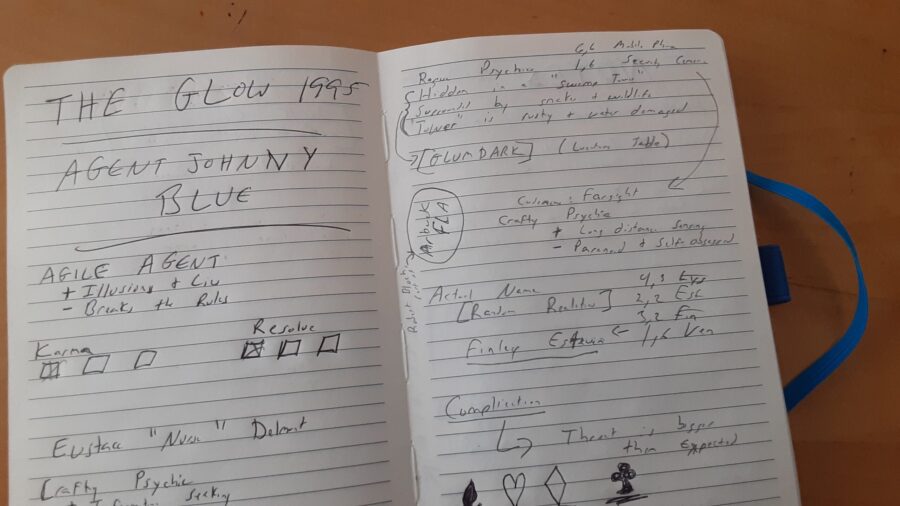
While in the middle of moving, I played what would become the first three sessions of a unplanned The GLOW adventure. Very quickly, this adventure began to morph into an important bit of character and lore building. Realizing I had something a lot more than a one-to-few shot on my hand I started pivoting towards a fuller longer story. Before we get to the actual play, though, find out about my more limited set-up and my initial expectations of a "The GLOW 1995" before it became "The GLOW 1992: Agent Johnny Blue vs The Kid" that has been foreshadowed since early in the meta-series.
The original arc finale. Johnny Blue and the werewolves enter into the other-space at the core of the Grove and confront a descent into the abyss. Even with enhanced physical powers and regeneration, will they be able to survive the final trial? Agent Johnny Blue also faces the fact that he might just very well have to tell the truth for once.
Johnny has made contact with the werewolf pack and it has gone exactly as poorly as he expected. However, his growing powers are intriguing to Macy Maron who increases her advances upon Johnny. He teams up with the werewolves to explore The Blue Sky Grove - the strange heart of The GLOW - and finds the mystery is worse than feared. A powerful adversary is attempting to bend all the rules.
Johnny Blue begins his mission to learn what is flagging the psychic threads involving a werewolf pack. Macy Maron and Barlow Hendrix - the dual heads of the pack - are dangerously heavy hitters and Johnny knows there will be trouble. He visits an old friend to try and gain an edge. This decision alters his entire life as old magic meets new and reforges a destiny for Agent Johnny Blue.
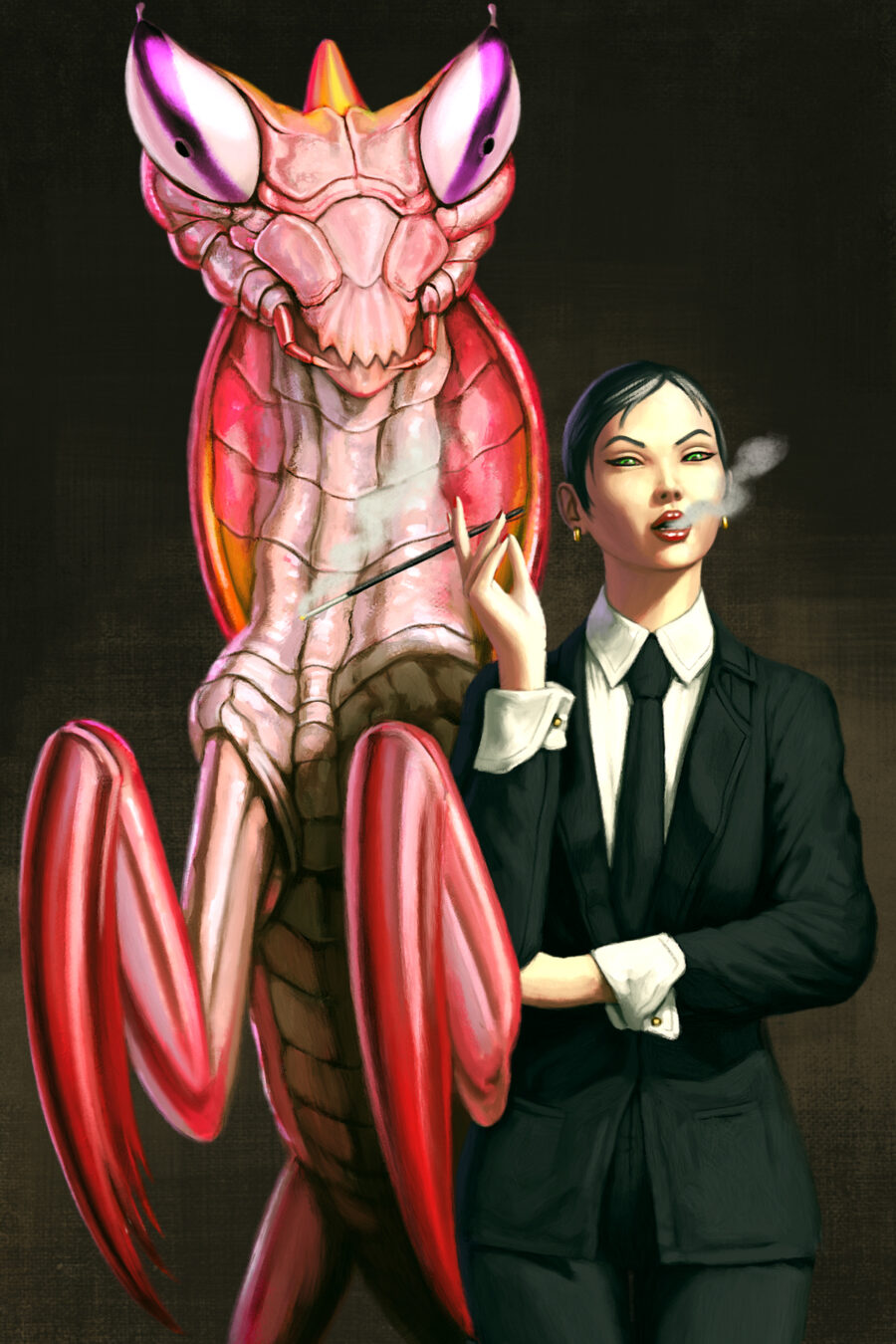
Introducing both Lamarkian Order Agent Johnny Blue and the world of The GLOW in general, this is the first post in the entire The GLOW series. Johnny is tasked by the crime boss Amy Patel to protect a mini-disc that has something on it, but almost immediately the case starts taking strange turns. The GLOW is a place of strange magic and a perpetual glowing fog - called Soulburn - created in the aftermath of "The Harrowing": a spiritual-chemical process that generates power from the torture of spirits. Though set in the 90s, the energy and magic generated by the Harrowing has caused the region around the Gulf of Mexico to become rapidly advanced and prosperous and at odds with the rest of the world.

When I started playing The Bloody Hands using Tricubes Tales Solo I used the system as is except for tweaking the basic oracle to something a bit more complicated. That worked just fine through the first four "episodes" and I still like my little "Dice of Changes" style resolution.
However, I played a TriSolo style game with my partner and have been trying to introduce some more friends to the concept of how solo playing works (yes, I understand the irony) and sometimes it takes a bit more of a framework to kick off some ideas. That got me thinking about how to expand on some of the inherent design choices in TriSolo to make something that could meet folks more half-way and could be adjusted/tweaked on the fly based on the comfort level of the player.
Here is my current working model. Like all things on this blog, I'm considering it CC-0 so take it and run with it. The OG Tricube Tales Solo materials are CC-BY 3.0 and this post in no-way-shape-or-form is meant to interfere with the original system. As we sometimes say in the adaptation business: with apologies to Richard Woolcock.
-- How to Use This --
This is primarily intended for solo and GM-less play when a more structured framework is required. If a GM wants to use this to give players more control or to provide a more precise framework and gameplay loop, sure, but is mostly designed to stand in for a GM in a fair, consistent way . As always, everything is optional. Always has been, always will be. Such are RPGs.
-- Changes & Additions to the Aces/Jokers, Face Cards, Discard Piles, and Reshuffling --
In default Tricube Tales: Solo, Ace and Jokers are marked as "Scene Changes" and then have a 1d6 element that represents something inherent in the scene. In this framework, to keep language more consistent, Ace/Joker trigger "scene shifts".
A shift had at least a minor to moderate impact on the current scene and story line, and may or may not be a major shift. Draw a second card once you get an Ace or Joker. This is the "Shift Test". To sum up these variations:
- Ace or Joker is pulled
- Roll 1d6 as instructed in TriSolo.
- Pull a second card, this is the Shift Card.
- If the Shift Card is another Ace/Joker:
- Elevate the shift to a major shift
- The second 1d6 should highlight the focus, combine the results together
- In cases such as "Positive (for you)" and "Negative (for you)" treat the combination as somehow involving both
- Do not pull a second Shift Card
- If the Shift Card is a face card:
- Progress the associated plot as expected
- If the Shift Card is a number (2-10) card:
- Play the shift as is, discarding this card
- Alternatively, use the Suit and/or Value to give hints about the direction and value of the shift (see the various oracles, below)
- If you still need a card to answer the oracle or establish the scene, draw again and discard additional Ace/Joker cards. See the note, below.
For face cards, they only trigger plot advancements when pulled as a Shift Card or as a Main Scene Card. In all other card draws, they are read as values 11, 12, and 13.
EXAMPLE
Jerry is trying to sneak into the chemical factory to search for a missing teenager in a crime drama style campaign. The player draws a card to figure out what kind of task Jerry will need to face and gets a Joker. Rolls a 1d6 and gets "Negative (for you)." Drawing a Shift Card, Jerry's player gets an Ace and rolls 1d6 again and gets "New Character (roll)". These two results are combined together that there is a major shift in the scene with this new person making the issue much harder on Jerry.
OPTIONAL: For plot shifts (Jack, Queen, Face) and scene shifts (Ace, Joker) you will only get one per card draw. Besides the Shift Card, extras can be discarded. For instance, if you draw a King of Spades and the main plot is progressed negatively. You have to draw another card as per TriSolo rules and get a King of Hearts. Rather than interpret this as a shift back into the positive (somewhat neutralizing the first) you discard it instead. The scene has a single plot shift for this one card draw. Later oracle draws in the scene might generate another shift, though. This does not include the Shift Card itself for obvious reasons.
There is now a more obvious discard pile. All cards except the main scene task cards are placed in it after being used. There are a lot of cards across the oracles, side tasks, and such. This also means you might have to reshuffle. The only cards NOT reshuffled should be the completed main scene task cards and current main scene task cards. Those are held until the end of the session.
This means you have a discard pile, a successful scene pile, and a failed scene pile. You can arrange them with the successes going to the right of the draw pile, the failures going to the left, and the discards going either above or below.
-- Karma to Draw a New Card --
Besides some of the new options for spending Karma below, Karma might be used after a card draw for any purpose (scene, oracle, relationship) to cancel that card and draw another.
This framework favors using Karma more continuously to control the flow and therefore players are encouraged to play off Quirks more often to build up additional Karma.
- Optional: Increase Starting Karma -
If groups wish to have more control, Karma's default value can be increased from three (3) to four (4) or five (5). However, it should be balanced and not made much higher than the default value.
--Additional Materials Needed --
While all of this is optional, some additional tools for using this framework are
- A number (3-4 maybe) tokens per character to represent tasks, locations, NPCs, and events/plots/elements to which that character is currently committed. Note, I did NOT say "meeple" even if we all thought the m-word.
- A small stack (maybe 10-20) index cards of a logical size (3x5, 4x6, whatever your local equivalent is) and slightly less small stack (maybe 20-30) "note cards" of a logical size (2x3, 1.5x2, your favorite sizes).
- One deck of cards is probably plenty but if you have a larger group (more than 4) you might want to shuffle a second deck in to start just to reduce the amount of reshuffles.
If you are playing digitally, you can obvious ignore all this and just use tokens as appropriate.
NOW! On with the changes and the Framework!

-- Card Based Yes/No Oracle --
When asking a yes/no question, pull a card:
- 2 to 7 = No.
- 8 to K = Yes.
- A or Joker = There is a shift to the question. Follow the procedure above. If resolving this shift does not answer the question satisfactorily, then an additional card might be drawn.
In this system, the suit of the card might indicate an and or but:
- Hearts = "And..."
- Spades = "But..."
In this way, you can have "yes, but..." "yes, and..." and so forth.
This can be expanded for Likely and Unlikely results as follows:
- Likely means 2-5 = "No" but 6+ = "Yes".
- Unlikely means 10+ = "Yes" but 2-9 = "No".
When it doubt or debate, treat it as the default setting of (2-7 & 8-K).
-- Other Basic Card Based Oracles --
There are other basic card-type oracles.
In all cases, these three general notions are true
- For card value:
- High numbers tend to represent more (usually more "yes")
- With vibe style checks, numbers on the end (2, 3 and Q, K tend to represents the extremes of the vibe)
- For card suit:
- Hearts = relationships and working with someone/something
- Diamonds = objects/transactions
- Clubs = skills/actions
- Spades = conflict, interactions, or working against someone/something
- Simple Value/Vibe Check -
In this oracle, if you are trying to figure out how much of something there is (how many people, how strong is the storm, how cluttered is this house, etc) then simply pull a card and treat higher as more. Again, Aces and Jokers represent shifts as above.
If you are trying to find how the vibe is going for or against the characters, consider, as a baseline:
- 2 to 4: Negative
- 5 to 10: Neutral
- Jack to King: Positive
This can be adjusted or read as more of a spectrum as needed.
For value/vibe checks, Hearts and Spades can be taken as
- Hearts --> The value/vibe is increasing in its direction: growing more negative, more positive, etc. For neutral vibe results, this might be interpreted as being apathetic to the characters' actions or the general flow of the campaign.
- Spades --> The value/vibe is about to change. Perhaps do another check later in the scene or in a follow-up scene.
One particular variation of this check that is frequent in hexcrawls and outside games is a weather/conditions check. In this case, lower values point to worse conditions and higher values point to more favorable conditions. Shifts and Major Shifts point to the weather/condition being particularly out of the normal (dust storm in the desert for a shift, thunderstorm in the desert for a major shift) but use the Twist oracle for ideas. Hearts/Spades can show if the conditions are holding steady, growing worse, or improving, etc.
- Determining Relationships -
If you are trying to find out how a person, location, character, or event is related to another person, location, character, or event then draw a card and consult the suit. There is a lot of overlap here so a coworker might be someone transactional or task-related or personal depending on the vibe:
- Hearts = personal relationships (family, friends, personal enemies, places of personal interest)
- Diamonds = transactional or object based relationships (store owner, coworkers, banks, something paid for)
- Clubs = related by a task, action, hobby, etc (people who share a hobby, a place where the task takes place, an event involving the action)
- Spades = related to a specific event or conflict (somewhere who was there when something happened, the place it happened, an event caused by the first).
The value of the card can be used to hint towards intensity. A 3 of Spades means the connection between the event is fairly faint while a Queen of Hearts might hint the personal relationship is very strong. For obvious reasons, ignore Heart/Spade for "And"/"But" type responses.
Aces/Jokers mean there is unusual characteristic and/or a recent change in the relationship. The Shift Card can give more details about this. Draw again if it is still unclear.
- Determining Types of Scenes -
If you need some inspiration for what type of scene or type of specific task this is, suits can also be used to generate a type of event/scene/task (again there is some overlap):
- Hearts = interpersonal or personal scene/task (probably involves talking or settling an issue with someone, could involve dealing with a personal issue)
- Diamonds = transactional or item-based scene/task (the classic "market/shopping" scene, but can also be about finding a specific item, a specific clue, etc).
- Club = action scene/task (this involves using a specific skill, performing a specific practical action, or generally applying to some external, non-personal consideration)
- Spades = conflict scene/task (scenes and tasks of opposition: this scene involves a fight or a struggle, it could also be something like sneaking past guards or climbing a wall definitely meant to keep you out).
If you draw a numbered card (2 through 10) then you can use the value to decide the general intensity of the problem or the vibe, however you wish to interpret it.
If you draw a face card then it means effort is needed. Jack = 1 effort per committed character, Queen = 2 effort, and King = 3 effort.
Obviously, in this case, as above, Hearts/Spades do not generate "And"/"But" answers.
Aces/Jokers represent scenes that are interrupting are altering the main story. Roll the dice as instructed in the base rules to try and figure out what is happening. For Aces/Jokers, the shift card can help give a focus or draw again if it is unclear.
For more inspiration, draw two two scene-type cards and treat duplicates as an increased intensity (two Spades might mean 3 effort instead of 2, two Diamonds might involve a more complicated transaction or search). Non-duplicates show how the types overlap, a Heart + Diamond might involve finding an item related to a personal quest while a Spades + Club might be a conflict where you are trying to complete a task to win the fight rather than directly confronting someone. If you use the two-card method, only count the first Ace/Joker pulled.
- OPTIONAL: Weirdness Checks -
For certain types of campaigns (horror, paranoia, mystery, surreal) it can sometimes be interesting to know if something is going strangely. A Weirdness Check is a variation of the value/vibe check.
- Number cards (2-10): the event, person, object, or task (aka, subject) is as expected given the context of the scene, session, or campaign [note: this can still be fairly weird by default]
- Jack: the subject has a minor but distinct weirdness from its base type.
- Queen: the subject has a notable weirdness from its base type.
- King: the subject has a major weirdness from its base type.
- Shift (single Ace/Joker): the subject is massively weird.
- Major Shift (double Ace/Joker): the subject is extremely weird to a degree that the base type is mostly just a suggestion that people might use to give it some explanation.
In this system, the standard suit distribution might give some idea of how it is weird
- Hearts --> something is off about the people/creatures involved
- Diamonds --> something is off about the objects/aesthetics involved
- Clubs --> something is off about the actions/procedures involved
- Spades --> something is off about how the subject interacts with the characters or world around it.
One variation could be to draw an additional card for Queen, two additional cards for King, and three/four for Shifts/Major Shifts and read only the suit if you need inspiration for how to upgrade the values.
This can be used to find out if a creature fits the general type (zombie) or is something different (a raging, screeching zombie) to add some creature inspiration more on the fly.
Example
In a horror campaign, there is a festival going on and a parade is going down the street. A Jack of Diamonds might indicate the people are wearing strange masks. A Queen of Hearts might be the people in the parade having unusual appearances (too tall, too thin, etc). A King of Spades could have the parade floats having folks in cages while the crowd cowers and looks afraid. An Ace might combine all these elements into one. An Ace followed by a Joker might involve all that and also the day shifts into the night, strange voices are heard shouting from somewhere down the side streets, and the the ground quakes and shakes as the city takes on a different vibe as the parade passes.

-- Main Scene Task vs Side Tasks --
Most scenes still has a Main Scene Task determined by cards (aka, the Main Scene Card). As in the base game, draw a card to determine the main task for that scene. This highlights the general focus of the scene, a task that must be completed to face. Face cards equal a shift while Ace/Jokers add an alteration to the scene, as above. One or more characters might work to solve this (or be required to individually solve it). If the flow of the story has reached a point where this main task is more disruptive (example: players need a scene where they discuss strategy, take a break from the main plot, or elsewise) this can be considered more indicative of the flavor of the scene but a card should be drawn since there might be shifts and/or progressions in the plot.
This main task can be solved either before, during, or after the Side Tasks. Construct the fiction at the table to reflect this: is this something blocked by the side tasks, something that enables the side tasks, or something happening at the same time, et cetera.
Characters not tackling the main task of the scene can have a side task. State the intentions for these characters and then decide to either pull a card for a completely random tasks (which can help to add a few twists and unexpected interactions) or decide the Trait used in the tasks and pull a card to determine the difficulty:
- 2, 5, 8, Jack = Easy (4+ to succeed)
- 3, 6, 9, Q = Standard (5+ to succeed)
- 4, 7, 10, K = Hard (6 to succeed)
These two methods (purely decided by cards or using cards to determine difficulty) should be considered the default way to determine side tasks outside of letting fiction decide. If not every player agrees on the fiction, then a card draw can be used.
If an Ace/Joker is drawn, this side task is somewhat related to a shift in the scene. Proceed with the Scene Shift rules as above.
In some cases, the relatively difficulty of the tasks might be obvious (example: an early scene trying to get into a nightclub when there is no real obvious conflict, yet) but the Trait might be in doubt. Or, figuring out the trait might be a good clue as to how difficult the task is. In that case, you can use this chart:
- 2, 3, 4 = Agile
- 5, 6, 7 = Brawny
- 8, 9, 10 = Craft
- Jack = Agile/Brawny
- Queen = Agile/Crafty
- King = Brawny/Crafty
Treat the face cards as if either is applicable but flavor the task in a way that makes sense. Multiple characters approaching these tasks might use either of them or in cases of effort being spent, a single character might switch.
In either of these, Aces and Jokers still result in an alteration that adjusts the task.
When using side tasks, only the main scene card is added to the success/fail pile and only the main scene card is counted for the suits to determine the flow of the adventure.
OPTIONAL: If this last detail means the session goes on too long because of the number of characters, you may treat all task cards for the determination of story flow. However, with 3+ characters, this might conversely make the session go by too quickly to actually resolve the story.
In that case, you can set up a limit of scenes (6-8), instead. For a great six-scene structure, see the Tricube Tales Micro Edition.
-- An Optional Way to Determine Effort/Conflict Scenes --
Besides drawing scene-type cards and getting face cards, an optional way to determine if a given Main Scene Task is the sort of conflict that requires effort you can use the discard pile. Keep the top three cards visible. If the suit of the main scene card matches two of the top three cards in discard pile, it requires two effort per character (or per character present, whichever makes sense). If it matches all three, then it requires three effort.
As in all cases, fiction is the cornerstone. Some scenes are just naturally lead to a task that will require effort. Likewise, sometimes effort does not make sense. Play to your table.
-- Locations, NPCs, Details, and Elements --
This is a framework that establishes the fiction at the table in a more controlled manner. It is partially inspired by some games such as Microscope but is not in any way bound by that structure. It is recommended you use both index cards and smaller note cards (or the digital equivalent) to handle some of this.
First, decide the mission being faced by using the micro-setting of your choice or through other methods. The main details are things such as main tasks (the main *required* detail), side tasks, general location, and complications. Outside of rolling, you might let players take turns deciding on these details. Add these to an index card or multiple note cards with enough basic details to start but leave room for more.
Next, create locations.
- Locations -
Start with a Positive Location unless the set-up makes it unlikely the characters have a place to treat as a home base. In that case, make a starting location which is either Neutral or Negative.
Then, for each character (not player) add a location based on the details of the mission (a place where the main quest might happen, a place related to the complication). If there is only one or two characters, then have two or three per character. You want, besides the "home base," there to be four or five places to start. Decide if each location is Positive (a place with no initial threats to the characters), Neutral (a place that might have threats, but no immediate or inherent ones), or Negative (a place where threats are active).
Write a name and a couple of basic details for each location on an index card per location and place it on the table in whatever order makes sense (rough geographic order, a relative scale of Positive to Negative, etc).
Then set aside roughly the same number of index cards to represent possible future places.
- NPCs, Non-Player Characters -
Start out with at least a couple of possible NPCs (at least two to three are good, but four or five might make sense). These can be people related to the known details (such as main quests, side quests, complications), people that make sense for certain locations, or people that might be interesting to the story. They are not guaranteed to show up in any scene but they at least provide a background fiction.
These go on the smaller cards. Like locations, these non-player characters have some basic details (name, occupation, demeanor) and are graded Positive, Neutral, or Negative. Apply these character cards to a location to start or set them at no specific location if it is unknown (such as tracking down the main villain).
Again, set aside a small stack of character cards for additional characters. The general table flow might determine this but a rough start would be no more than double or triple the number of player characters (again, around 4 to 5 extra).
MINOR NPCs might not get a character card and instead be a detail showing up on another character card (a sidekick or goon type) or a location (a bartender or barfly at a tavern, for instance).
- Events and Elements -
For this last type, think if there are any overarching events (festivals, disease, things related to the main/side-quest or the complication) and add in event cards on an index card somewhere to one side of the location cards. If this event is at a specific location, attach the card. Like above, write a couple of basic details about it.
Element cards are a kind of catch all for anything that does not fit into one of the other categories. It might be a ticking clock condition, an aspect to the adventure, a personal consideration, an overarching force, or some similar element that needs to be called out. These should NOT attach directly to a specific location, character, or event: these are more generalized than that.
For both Events and Elements, determine if they are Positive, Negative, or Neutral again and mark them as such.
There may be no starting Events or Elements or there might be several.
- Adding Content to these Cards -
As a Scene starts, first draw the main scene card from the card deck and then determine which location, NPC, event, or detail it might impact. Attach it there. Then as player characters determine their intent, assign their token (or note it somehow) to whichever of these locations/npcs/events/details they must engage with to perform their task or scene actions. Those not attached to the main scene task will then figure out their side tasks related (in some way) to the location/character/event/etc they are attached.
At the end of the scene, a character attached to one of the above (and likely multiple of above) will have a chance for their player to add in a detail or two based generally on the following principle:
- Fiction always takes precedent. The story ultimately decides details. Start with this principle to decide a detail or two to add as exposed/explored in the scene.
- When the fiction does not necessarily dictate the detail, the player may add one detail either chosen by personal choice or through an oracle role (should likely be a mix of both).
- No more than one or two details should be added at a time by a player. Leave room to keep developing.
- New details should only conflict with the given fiction IF some shift developed or the tone of the session changes or some time has passed to allow it. In all other cases, new details should consider all prior notes on the table as in-canon.
- When a player is adding a new detail, other players should give them space and avoid actively collaborating except in cases where assistance is asked or if questions need to be answered.
- When in doubt/debate, a player may spend one Karma from a character to force a detail. Even then, it should not conflict great with the prior details or general vibe of the session unless it makes overall sense with the current fiction (spending a single Karma will not create a comic-relief unicorn character at odds with the hardboiled detective story, for instance).
- Shifting Positivity -
At the end of each scene, an attached character's player may also decide to shift the positivity by one step (negative place made neutral, neutral NPC made positive or negative). The above considerations should be taken in mind.
The success or failure of the task might be a good indication (a failure might shift a relationship more negative, a success might shift it more positive).
- Adding Locations/NPCs/Events/Elements -
There are three main ways to add more:
- The fiction requires something new to make sense.
- Ace/Jokers generate new locations, characters, or events.
- A player spends one (1) Karma from their character.
Once all the possible cards are used up, this final cost should increase to two (2) Karma at least or be avoided. Permanent cards should not count against this limit.
- OPTIONAL: Splitting Locations/Events/Characters/Elements -
Once any of these Locations/Events/Characters/Element cards have accrued more than 4 or 5 details, consider possibly splitting it into two cards. A hotel might get a lobby and a rooftop nightclub. A person might get, well, themselves but also a relative or sidekick. This is one way to generally reflect the weight applied to these foci in actual play. A location with multiple sub-locations shows other players are interested in using/exploring it.
- OPTIONAL: Making Locations/Events/Characters/Elements PERMANENT -
At the end of a session, the table should have a good number of these cards in play. It will be tempting for certain campaigns to try and retain many or all of these. Instead, it is suggested that the table decides a few (one of each per player at the most) to be turned into a Permanent version (events will likely be the odd duck in this case, they tend to stick around or go away based on what they are). If players wish to choose more than one, two (2) Karma should be spent unless other players agree this is obvious. Players may also choose to add none to the pool.
As always, fiction takes charge. If a particular place is baked into the campaigns fiction or a particular person needs to show up over multiple session: that can be a freebie.
If the fiction decides a place or person should be removed from the campaign, mark off its permanent status. Likewise, a player may choose to remove one of each from the permanent pool. This should never be used to get rid of a place newly chosen by another player. If this choice is in contention, a player can spend two (2) Karma to force it unless the fiction absolutely disagrees.
It is recommended to only have 1-2 permanent places and NPCs per player on the table to keep the framework loose. For excess of this, consider placing several into a sideboard and only add to them to the main table when needed.
Not all permanent locations need to be considered to in play at all times. The sideboard can also be used to store those chosen to be permanent if it makes no sense for them to be in place (home town locations when characters on a road trip, etc).

-- The Final Scene --
As recommended in the Tricubes Tales Micro Edition, the final scene will be a task that requires effort. The default is two successes per character with resolve lost due to failure.
An optional rule to make this more variable is to look at the failures and success for the Main Scene Task cards. If the table has zero (0) failures: one (1) effort per character is required. If the table has failures equal to or less than the successes: go with the default two (2) effort per character. If the failures outnumber the success, then it takes three (3) effort per character. If there are no successes, then it requires three (3) effort per character and the scene difficulty is locked in on Hard.
- Optional: Gauntlet Scenes -
"Gauntlet" scenes can be thought of as mini-bosses or montage scenes where the team gets get together to prep a house for a zombie invasion or to build a ship to attack the dread pirate or such. With the above structure, they are used to "burn off" failures by having a collective scene task related to all characters which is called before the scene starts and takes the place of a normal scene. It might be used as the penultimate scene.
Count up all the failure cards. Using the same rough ratio as above determine that much effort per failed main scene task, not per character (if there are no failures but the table would like to play out one, go with the default of two per player). Then, go around per character and rapid fire draw a task card. It is recommended that the cards are used as is (3 of Hearts = Standard Agile). Resolve may or may not be lost depending on the fiction (a mini-boss fight will lose resolve, a gathering supplies will not). Success earned for these gauntlet tasks are applied to gauntlet effort, not to the individual tasks.
At the end, remove a number of failed cards based on how many successes were generated, rounding down (two-per would mean five (5) successes = 2 failure cards removed).
Gauntlet scenes are fun rapid fire kind of scenes but should only be used maybe once per session and should not be a default. They apply an in-framework-way to representing wrapping up loose ends if the session is coming to a close but things feel unresolved.